Difference between revisions of "EastUnBloc"
(→Events) |
|||
| (5 intermediate revisions by the same user not shown) | |||
| Line 3: | Line 3: | ||
</gallery> | </gallery> | ||
| − | + | <div class=lede> | |
| + | Reclaiming Experimental and Subversive Media art Practices from Central and Eastern Europe, 1958 to the Present | ||
| + | </div> | ||
[[Image:nGbK_2025.jpg|thumb|330px|{{sm|nGbK am Alex}}]] | [[Image:nGbK_2025.jpg|thumb|330px|{{sm|nGbK am Alex}}]] | ||
| Line 25: | Line 27: | ||
</gallery> | </gallery> | ||
| − | + | ==Introduction== | |
| − | |||
| − | |||
| − | |||
| − | |||
| − | |||
| − | |||
| − | |||
| − | |||
| − | |||
| − | |||
| − | |||
| − | |||
| − | |||
| − | |||
| − | |||
| − | |||
| − | |||
| − | |||
| − | |||
| − | |||
| − | |||
| − | |||
| − | |||
| − | |||
| − | |||
| − | |||
| − | |||
| − | |||
| − | |||
| − | |||
| − | |||
| − | |||
| − | |||
| − | |||
| − | |||
| − | |||
| − | |||
| − | |||
| − | |||
| − | |||
| − | |||
| − | |||
| − | |||
| − | |||
| − | |||
| − | |||
| − | |||
| − | |||
| − | |||
<div class=threecol> | <div class=threecol> | ||
| Line 89: | Line 42: | ||
<div class=nobreak> | <div class=nobreak> | ||
| − | === | + | ===Bring a friend=== |
| − | <div style=" background: repeating-linear-gradient( 90deg, # | + | <div style=" background: repeating-linear-gradient( 90deg, #e52d7c 0 34px, white 34px 36px ) top / 100% 36px no-repeat, white; "> </div> |
| − | : '' | + | : ''creating communities by throwing a political party'' |
<div class="mw-collapsible mw-collapsed"> | <div class="mw-collapsible mw-collapsed"> | ||
| − | + | As authorities in Central and Eastern Europe often sowed suspicion to better control their subjects, friendship became particularly precious. It also was a means of resistance. Long nights in pubs engendered not only hangovers but also plans for artistic and political activity. Private social gatherings became informal art exhibitions, fashion shows, concerts, poetry readings, film screenings, and happenings. Circles of friends co-created and had each other’s backs, worked and lived together. Making art became a way of life. And despite mistrust of potential secret police informers, encounters with the unfamiliar – people with different backgrounds and life situations as well as new experiences – were welcome. | |
| + | |||
| + | Works using this script document avant-garde fashion which irreverently used socialist symbols. Intermedia club culture, where music, media art, design, dancing and performance merged, became labs for social change or a safe space for expressing queer identities. | ||
</div> | </div> | ||
</div><div class=nobreak> | </div><div class=nobreak> | ||
| − | === | + | ===Expose the seams=== |
| − | <div style=" background: repeating-linear-gradient( 90deg, # | + | <div style=" background: repeating-linear-gradient( 90deg, #d32828 0 34px, white 34px 36px ) top / 100% 36px no-repeat, white; "> </div> |
| − | : '' | + | : ''revealing media’s underlying processes'' |
<div class="mw-collapsible mw-collapsed"> | <div class="mw-collapsible mw-collapsed"> | ||
| − | + | The persuasive effect of media often relies upon the audience’s ignorance of how it works. Official media in socialist countries also strived to remain untransparent. Particularly in the postmodern era, questioning the power of media by exposing its inner workings became a key issue for scholars and artists on both sides of the Iron Curtain. | |
| − | + | Works using this script are highly experimental and self-referential, deviating the most from conventional viewing habits. The presence of the camera is highlighted by breaking the fourth wall or showing the recording apparatus. Editing, usually invisible in classical narrative cinema, is foregrounded. Some structuralist works explore the materiality of film and video: film grain, electromagnetic signals, video dropouts, pixels, and other digital glitches. Some works walk viewers through the process of creation. | |
| − | |||
| − | |||
</div> | </div> | ||
</div><div class=nobreak> | </div><div class=nobreak> | ||
| Line 130: | Line 83: | ||
This allowed the creation of a wide range of “audiovisual samizdat,” underground self-publishing practices ranging from experimental works which challenged aesthetic norms to documentations of suppressed political movements such as Charta 77 in Czechoslovakia and Solidarność in Poland. | This allowed the creation of a wide range of “audiovisual samizdat,” underground self-publishing practices ranging from experimental works which challenged aesthetic norms to documentations of suppressed political movements such as Charta 77 in Czechoslovakia and Solidarność in Poland. | ||
| − | This script also encompasses ''interactivity''. While the audience is not completely autonomous, it is a co-creator or at least has a decision-making option within the works, foreshadowing today’s media landscape of individual prosumers. The exhibition presents ''Kinoautomat'', the first large-scale interactive | + | This script also encompasses ''interactivity''. While the audience is not completely autonomous, it is a co-creator or at least has a decision-making option within the works, foreshadowing today’s media landscape of individual prosumers. The exhibition presents ''Kinoautomat'', the first large-scale interactive narrative film from Czechoslovakia which premiered at Expo Montreal in 1967, and ''DemoKino'', a 21st century response exploring interactivity and political decision-making. |
| − | narrative film from Czechoslovakia which premiered at Expo Montreal in 1967, and ''DemoKino'', a 21st century response exploring interactivity and political decision-making. | ||
Furthermore, net art works follow this script, using the interactive features of the internet browser and hypertext, as well as 1980s independent computer games from Czechoslovakia, some of which had explicit political themes. | Furthermore, net art works follow this script, using the interactive features of the internet browser and hypertext, as well as 1980s independent computer games from Czechoslovakia, some of which had explicit political themes. | ||
</div> | </div> | ||
</div><div class=nobreak> | </div><div class=nobreak> | ||
| − | === | + | ===Reality bending=== |
| − | <div style=" background: repeating-linear-gradient( 90deg, # | + | <div style=" background: repeating-linear-gradient( 90deg, #3ab1f4 0 34px, white 34px 36px ) top / 100% 36px no-repeat, white; "> </div> |
| − | : '' | + | : ''hacking the system with pranks and hoaxes'' |
<div class="mw-collapsible mw-collapsed"> | <div class="mw-collapsible mw-collapsed"> | ||
| − | + | Analogous to the musical practice of circuit-bending – creative manipulation of circuits in electronic devices to get an output that was not intended by the manufacturer – the exhibition uses the term “reality bending” to highlight works that hijack power structures. Through parody, overaffirmation, or unexpected disruption, these works reveal hidden truths, empower the powerless (if only for a brief moment), and show that a different situation is possible. | |
| − | + | While reality bending is a practice adopted for progressive and emancipatory aims, some works also deal with ethical questions and possible unintended adverse effects. | |
| − | |||
| − | |||
| − | |||
| − | + | Media artists and activists in Central and Eastern Europe frequently used reality bending as an underlying “script.” Some works ruptured rigid and oppressive state media, in particular television, through illegal and high-risk actions or, as in the Slovenian art group [[Laibach]], by parody or détournage of official symbols and messages. Others, like [[Krzysztof Wodiczko]] with his ''Lenin Monument'', used media as interventions in public space. | |
| − | |||
| − | |||
| − | |||
| − | |||
| − | |||
| − | |||
| − | |||
</div> | </div> | ||
</div><div class=nobreak> | </div><div class=nobreak> | ||
| Line 172: | Line 114: | ||
The projects in the exhibition, through networks of likeminded artists all over Europe, forged connections via the distribution of analogue videotapes through semi-official channels like ''[[Infermental]]''. Others used TV broadcast and early internet technologies, as did [[Van Gogh TV]] with ''Piazza virtuale'', or created a dialogue between past and future selves. And ''Transcentrala'' by [[Marina Gržinić]] & Aina Šmid explores how artist collective [[NSK|NSK (Neue Slowenische Kunst)]] developed a theory of history and concept of a postnational world transcending borders. In 1992, the collective founded ''NSK State in Time'', which inspired this script’s name. | The projects in the exhibition, through networks of likeminded artists all over Europe, forged connections via the distribution of analogue videotapes through semi-official channels like ''[[Infermental]]''. Others used TV broadcast and early internet technologies, as did [[Van Gogh TV]] with ''Piazza virtuale'', or created a dialogue between past and future selves. And ''Transcentrala'' by [[Marina Gržinić]] & Aina Šmid explores how artist collective [[NSK|NSK (Neue Slowenische Kunst)]] developed a theory of history and concept of a postnational world transcending borders. In 1992, the collective founded ''NSK State in Time'', which inspired this script’s name. | ||
| + | </div> | ||
| + | </div><div class=nobreak> | ||
| + | ===Turn shit into chocolate=== | ||
| + | |||
| + | <div style=" background: repeating-linear-gradient( 90deg, #eedd00 0 34px, white 34px 36px ) top / 100% 36px no-repeat, white; "> </div> | ||
| + | |||
| + | : ''using limited resources for maximal effect'' | ||
| + | |||
| + | <div class="mw-collapsible mw-collapsed"> | ||
| + | Resources are generally scarcer for independent artists and activists, and that was certainly the case in socialist and transition-era Central and Eastern Europe. Combining available materials with ingenuity and imagination, the works applying this script are provocative, humorous and even trailblazing. They use lo-res formats like 16 mm, Super 8 or VHS, U-matic low band and Hi8 video, basic video signals, minimal computer code, such as the four kilobyte size digital animations of the [[Demoscene]], ASCII characters, and GIFs. Found footage becomes raw material. Editing takes place in camera or with rudimentary cuts, or films are shot in one take. Props and sets are handmade; trash becomes costumes; minimalism becomes virtuosity. The “turn shit into chocolate” script echoes in for example the Dogme 95 manifesto’s creative restraints and [[permacomputing]] (see the accompanying program), a concept and community of practice oriented around issues of resilience and regenerativity in computer and network technology inspired by permaculture. | ||
</div> | </div> | ||
</div></div> | </div></div> | ||
| + | |||
| + | == Photos == | ||
| + | |||
| + | <gallery mode=packed heights=250px> | ||
| + | EastUnBloc_2025_a.jpg | ||
| + | EastUnBloc_2025_4.jpg|[[#4|4]] | ||
| + | EastUnBloc_2025_b.jpg | ||
| + | EastUnBloc_2025_5.jpg|[[#5|5]] | ||
| + | EastUnBloc_2025_7.jpg|[[#7|7]], [[#11|11]] | ||
| + | EastUnBloc_2025_10.jpg|[[#10|10]] | ||
| + | EastUnBloc_2025_c.jpg|[[#11|11]], [[#12|12]], [[#13|13]], [[#14|14]] | ||
| + | EastUnBloc_2025_15.jpg|[[#15|15]] | ||
| + | EastUnBloc_2025_18.jpg|[[#18|18]] | ||
| + | EastUnBloc_2025_19.jpg|[[#19|19]] | ||
| + | EastUnBloc_2025_19b.jpg|[[#19|19]] | ||
| + | EastUnBloc_2025_19c.jpg|[[#19|19]] | ||
| + | </gallery> | ||
==Works== | ==Works== | ||
| Line 183: | Line 152: | ||
</gallery> | </gallery> | ||
| + | <div class=nobreak> | ||
| + | ; {{a|1}} | ||
| + | ; <center>1</center> | ||
; | ; | ||
| + | |||
| + | <div style="padding:1em;" class="mw-collapsible mw-collapsed"> | ||
| + | {{sm|Artistic Intelligence | ||
| + | |||
| + | Artistic Intelligence (AI) is a poetic-technological concept that we have developed for ourselves and for you. In a society that is becoming increasingly robotized, where all social processes are permeated with smarter technologies, it relies on the imagination and power of art. Today, art often seems to merge into smart surfaces and be influenced by commercial aesthetics. In turn, commercial aesthetics are themselves created by artists, or rather, they appropriate artistic positions in their market mechanisms, lure them out of their niches for creative branding and social media campaigns. But counter-movements are also emerging, celebrating, for example, the improvised and spontaneous. What can art do, what could it once do? | ||
| + | |||
| + | The exhibition offers a look back at the former Eastern Bloc and asks: What artistic intelligence can we find there? What can it give us for today? | ||
| + | |||
| + | While artificial intelligence works with algorithms, here we follow “scripts” that are hidden in the works: Principles that can be found in many of the exhibited artworks and practices. | ||
| + | |||
| + | Question to Open AI: What is the difference between a script and an algorithm? Answer: Script is the concrete implementation, algorithm is an abstract problem-solving logic. | ||
| + | |||
| + | 6 Scripts become the paths and colors of the test pattern. From here, you can use them to embark on a journey through the exhibition. Perhaps they will help to break through the many shades of industrial gray that surround us or at least bring them into play a little. Because even in the supposed gray of the East, people painted in bright colors. | ||
| + | |||
| + | This text is an invitation: Please feel at home in the exhibition, please leave the works of art in their places, but feel free to play wildly with the spaces in between. Take a pair of slippers, take a seat, share a part of your journey with this room and leave something of yourself here. | ||
| + | |||
| + | Scripts | ||
| + | |||
| + | {Turn Shit into Chocolate}<br>
>> using limited resources for maximal effect | ||
| + | |||
| + | {Reality Bending}
>> hacking the system with pranks and hoaxes | ||
| + | |||
| + | {Make Your Own Media}
>> self-empowerment through media production | ||
| + | |||
| + | {Bring a Friend}
>> creating communities by throwing a political party | ||
| + | |||
| + | {Expose the Seams}
>> revealing media’s underlying processes | ||
| + | |||
| + | {Space in Time}
>> forging connections across spatial and temporal boundaries | ||
| + | </div> | ||
| + | }} | ||
| + | </div> | ||
| + | |||
| + | <div class=nobreak> | ||
| + | ; {{a|2}} | ||
; <center>2</center> | ; <center>2</center> | ||
; | ; | ||
| + | |||
| + | <div style="background-color:#3a3b79; color:white; padding:1em;" class="mw-collapsible mw-collapsed"> | ||
| + | {{sm|In 1993, at the height of these armed conflicts during Yugoslavia’s dissolution, Marina Gržinić & Aina Šmid (Ljubljana/Slovenia) released their video work ''Transcentrala''. It portrays the Neue Slowenische Kunst (NSK) movement, founded in 1984. In 1992, it morphed into the NSK – State in Time as a response to the political shifts following the breakup of Yugoslavia. ''Transcentrala'' follows actions of NSK State in Time like the NSK Embassy in Moscow, Cosmokinetic Cabinet Noordung’s performance of a play based on Shakespeare’s biography happening every 10 years (last performance scheduled to 2045), and the “rotating swastika” installation, a continuation of NSK’s investigation of hidden aesthetic and ideological commonalities of 20th century totalitarian regimes. | ||
| + | |||
| + | Spaceship Yugoslavia | ||
| + | |||
| + | This station is also site specific. Through the inclusion of photographs of an intervention at the nGbK’s former space in Kreuzberg as part of the nGbK exhibition ''Spaceship Yugoslavia – The Suspension of Time'' (2011), ''EastUnBloc'' references previous nGbK projects which proposed more nuanced views of post socialist transitions, specifically Yugoslavia’s complex historical legacy. | ||
| + | |||
| + | “We ask ourselves—a generation whose childhood memories are anchored in a socialist Yugoslavia—if it is indeed possible to latch onto a critical nexus from which we may have constructive experiences. We did not grow up in an orderly system, causing our experiences to be irrevocably linked with a transition process. We cannot be transported backward or forward in time. We walk this earth in different countries, but have no fixed ground under our feet. Our common inheritence, our cultural connection, is a disintegrated history, a tentative space; it is a spaceship named Yugoslavia.”<br> | ||
| + | ''nGbK work group Spaceship Yugoslavia'' | ||
| + | |||
| + | Furthermore, by showing an intervention at the former nGbK location (1992–2023) on Oranienstraße, a central cultural and nightlife avenue of Kreuzberg, ''EastUnBloc'' invites the exhibition site to add its history to the conversation. This includes the nGbK’s past engagement with socio cultural developments in Central and Eastern Europe as well the eviction from the former space as an example of gentrification and discourse about “whose city” is contemporary Berlin. | ||
| + | }} | ||
| + | </div> | ||
| + | |||
| + | | ||
{{InfoCard | {{InfoCard | ||
| Line 220: | Line 243: | ||
}} | }} | ||
}} | }} | ||
| + | </div> | ||
| − | ; | + | <div class=nobreak> |
| + | ; {{a|3}} | ||
; <center>3</center> | ; <center>3</center> | ||
; | ; | ||
| + | |||
| + | <div style="background-color:#3a3b79; color:white; padding:1em;" class="mw-collapsible mw-collapsed"> | ||
| + | {{sm|''DM 1978 Talks to DM 2010'' by Dalibor Martinis (Zagreb/Croatia) is a conversation between the artist’s then-present self which becomes his past self as his future self becomes his present and now, in 2025/26, also another past self. His work bridges various moments in time. Unbeknownst to him at the time he first conceived the project, the long dissolution of Yugoslavia, ensuing wars of independence and postwar becoming (or realignment?) of the ex-YU states would occur during the time corridor between 1978 and 2010. | ||
| + | }} | ||
| + | </div> | ||
| + | |||
| + | | ||
{{InfoCard | {{InfoCard | ||
| Line 247: | Line 279: | ||
}} | }} | ||
}} | }} | ||
| + | </div> | ||
| − | ; | + | <div class=nobreak> |
| + | ; {{a|4}} | ||
; <center>4</center> | ; <center>4</center> | ||
; | ; | ||
| + | <div style="background-color:#3a3b79; color:white; padding:1em;" class="mw-collapsible mw-collapsed"> | ||
| + | {{sm|In the interest of the urge to communicate and the expansion—extension of language, the experiments should break out of the local and festival subcultures. | ||
| + | }} | ||
| + | </div> | ||
| + | |||
| + | | ||
| + | |||
| + | <div style="background-color:#3a3b79; color:white; padding:1em;" class="mw-collapsible mw-collapsed"> | ||
| + | {{sm|INFERMENTAL, "an infomagnetic living space" (Gábor Bódy), the "encyclopedia of the year" (Diederich Diederichsen), the "circulating information repository" (Oliver Hirschbiegel), "seeks, despite its internationalist concept, the local and the personal in order to set fermentation processes in motion at the edges and borders. The now three editions of INFERMENTAL impressively demonstrated how close and similar the video centers of the continents of our planet are." <br> | ||
| + | ''(from Veruschka Bódy and Gábor Bódy eds., Axis. Auf der elektronischen Bühne Europa. Eine Auswahl aus den 80er Jahren, Cologne: DuMont Verlag, Köln, 1986.)'' | ||
| + | }} | ||
| + | </div> | ||
| + | |||
| + | | ||
| + | |||
| + | <div style="background-color:#3a3b79; color:white; padding:1em;" class="mw-collapsible mw-collapsed"> | ||
| + | {{sm|In order to summarise their work and to expand research, the compilation of a film enyclopedia is planned - an encyclopedia which would deal with image and sound as language. The work would encompass the work of the European avant-garde from Poland, Jugoslavia, Hungary, Switzerland, West-Germany, Holland and England. The K-Group already has contacts within these countries and is currently working to establish contact with similar groups in America. | ||
| + | }} | ||
| + | </div> | ||
| + | |||
| + | | ||
| + | |||
| + | <div style="background-color:#75b036;padding:1em;" class="mw-collapsible mw-collapsed"> | ||
| + | {{sm|„INFERMENTAL is the expression of an ‚independent video network‘,“ writes Hank Bull in the exhibition catalogue, noting, that „the dramatic growth of independent video production is the beginning of a new kind of writing, or at least the beginning of a change in the nature of the mass media, as indeed the spread of home video already hints“. | ||
| + | }} | ||
| + | </div> | ||
| + | |||
| + | | ||
| + | |||
| + | <div style="background-color:#75b036;padding:1em;" class="mw-collapsible mw-collapsed"> | ||
| + | {{sm|Materials for the encyclopedia will be solicited through a widely diseminated announcemenz and invitation. Anyone’s participation os welcome with completed or incomplete works in any format within a range of 0-30 minutes. The collected material will be compiled and selected by an editorial board which will also distribute the material on color video tape or film. The project is non-profit. Surplus funds, if any, would be distributed equally among the participants. | ||
| + | }} | ||
| + | </div> | ||
| + | |||
| + | | ||
| + | |||
| + | <div style="background-color:#75b036;padding:1em;" class="mw-collapsible mw-collapsed"> | ||
| + | {{sm|There are no ratings or prizes, no competition. INFERMENTAL is a collection of new artistic phenomena and tendencies, a circular for those interested in art. | ||
| + | }} | ||
| + | </div> | ||
| + | |||
| + | | ||
| + | |||
| + | <div style="background-color:#eedd00;padding:1em;" class="mw-collapsible mw-collapsed"> | ||
| + | {{sm|Annual plan of the Hungarian experimental film group K-GROUP of the Béla Balázs Studio, with the support of MAFILM (Hungarian Motion Picture Production Co.) from 1981. | ||
| + | |||
| + | Through this support, the film director Gábor Bódy attempted to realize the project INFERMENTAL. Ultimately, he financed the first edition almost entirely himself from his DAAD scholarship. | ||
| + | }} | ||
| + | </div> | ||
| + | |||
{{InfoCard | {{InfoCard | ||
|heading = | |heading = | ||
| Line 271: | Line 355: | ||
}} | }} | ||
}} | }} | ||
| + | </div> | ||
| − | ; | + | <div class=nobreak> |
| + | ; {{a|5}} | ||
; <center>5</center> | ; <center>5</center> | ||
; | ; | ||
| + | |||
| + | <div style="background-color:#d32828;color:white;padding:1em;" class="mw-collapsible mw-collapsed"> | ||
| + | {{sm|Aleksandra Domanović's work focuses on the intersections between technology, history and culture and explores how these shape our understanding of identity and contemporary society. Her work includes sculptures, videos, prints, photography and digital media. In doing so, she sheds light on the development of a playful yet critical practice shaped by information culture in the post-internet age. | ||
| + | |||
| + | ''Grobari'' (2009) is an early example of Aleksandra Domanović’s “paper stacks” works: PDFs, several thousand pages long, which are displayed as sculptural objects. When printed onto standard office paper using the “borderless printing” setting, they are stacked vertically, several feet high, to reveal images printed on their sides. | ||
| + | |||
| + | Domanović began creating these downloadable PDFs as monuments to the .yu internet domain name, which expired only in March 2010, many years after Yugoslavia had ceased to exist as a nation. Grobari depicts plumes of smoke from flares set off by an organized group of extremist football fans who played an integral role in bloody conflicts during and after the dissolution of the Socialist Federation of Yugoslavia. | ||
| + | |||
| + | ''From yu to me'' traces the history of the domain .yu. Registered as the international country code for Yugoslavia in 1989 and deleted in 2010, its significance shifted during the course of the 1990s as the regions of the country gained independence. Beginning with Slovenia in 1992, each of the eight new countries was assigned its own domain, a process only completed in 2007, when Serbia began to use .rs and Montenegro, .me. Domanović’s documentary reveals how Yugoslavia became one of the first countries to be connected to the Internet at a time of intense social and political change. | ||
| + | |||
| + | Domanović’s interviews with the computer scientists who helped establish the connection are interspersed with footage that she collected from Yugoslav television archives and recorded during the course of her research, revealing how a symbol of modernization became bitterly contested. The film traces the origins of the domain to the Yugoslav Network for the Academic Community (YUNAC) in Ljubljana, which established the connection for Slovenia and the rest of Yugoslavia in the months following the outbreak of war in 1991, as the Republic of Slovenia was being formed. It follows the story of its transfer to Belgrade in 1994, and eventually to the Museum of Yugoslav History, Belgrade, where it became the first virtual item to enter the collection in 2010. | ||
| + | }} | ||
| + | </div> | ||
{{InfoCard | {{InfoCard | ||
| Line 295: | Line 394: | ||
}} | }} | ||
}} | }} | ||
| + | </div> | ||
| − | ; | + | <div class=nobreak> |
| + | ; {{a|6}} | ||
; <center>6</center> | ; <center>6</center> | ||
; | ; | ||
| + | |||
| + | <div style="background-color:#d32828; color:white; padding:1em;" class="mw-collapsible mw-collapsed"> | ||
| + | {{sm|Through the de-digitalization of his online-based work, Igor Štromajer foregrounds the materiality of the internet and exposes its seams. | ||
| + | |||
| + | “Like software, hardware is also changing rapidly, continuously and inexorably, losing its functionality, purpose and, consequently, its content – the (non-)art itself. The author’s basic premise here is that (non-)art is not only hidden in the concept, the idea, i.e., not only in the nominal and declared, but equally also in the tools and machines that produce it. That is why the parts of machines, now more or less dead, are full of intimate memories that have faded and stories that have died. | ||
| + | |||
| + | The series is part of Štromajer’s de-digitalization processes over several years, from the deletion of his net non-art works back in 2011 to the present. (...) The title of the work indicates the amount of now deleted net non-art works (101.72 MB of files) produced and processed by these machines and their parts between 1996 and 2007: intima.org/ex | ||
| + | |||
| + | de-digitalization ≠ re-analogization” | ||
| + | |||
| + | ''Igor Štromajer'' | ||
| + | }} | ||
| + | </div> | ||
| + | |||
| + | | ||
{{InfoCard | {{InfoCard | ||
| Line 313: | Line 429: | ||
}} | }} | ||
}} | }} | ||
| + | </div> | ||
| − | ; | + | <div class=nobreak> |
| + | ; {{a|7}} | ||
; <center>7</center> | ; <center>7</center> | ||
; | ; | ||
| + | |||
| + | <div style="background-color:#3a3b79; color:white; padding:1em;" class="mw-collapsible mw-collapsed"> | ||
| + | {{sm|Many early net artists and collectives have found having their work shown in galleries problematic. Their work was primarily browser-native, non-hierarchical, ephemeral, distributed, anti-commodity, and globally accessible. Displaying it in a gallery often meant removing the very qualities that defined it. | ||
| + | |||
| + | The gallery shows that did resonate with the culture incorporated parody, as seen in ''Written in Stone'' (2003), which featured busts of several net artists and various ephemera such as the flowers given by cyberfeminist collective Old Boys Network to Vuk Ćosić when he invited them to Venice Biennale in 2001. | ||
| + | |||
| + | Net Art has been defined by storytelling and by its culture: gatherings and happenings of people who often first met online through lists such as nettime, Syndicate, Spectre or FACES. | ||
| + | |||
| + | One of these events was the MetaForum series, which was associated with the emergence of the Nettime list. It was held three times in Budapest (1994–1996) and again in 2024. On this occasion, Flóra Barkóczi created a video documentary composed of Metaforum recordings made by students from the Intermedia Department at the Hungarian University of Fine Arts in the 1990s. The exhibited video loop also features a video documentary about the first meeting of artists running servers from the East and West, which took place in London in 1998 (the follow-up edition was held in Labin, Croatia, in 2001). | ||
| + | |||
| + | Finally, there is a short documentary about the 2011 Belgrade edition of the ongoing series of cyber- and techno-feminist gatherings known as Eclectic Tech Carnival, first held in 2002 in Pula, Croatia. | ||
| + | |||
| + | This station will be expanded with video recordings of two sessions held as part of the exhibition program: ''Net Art Surfing Session'' with Sakrowski and Igor Štromajer, and the ''Networks of Net Art – Syndicate and Deep Europe'' session with Tereza Havlíková and Andreas Broeckmann.}} | ||
| + | </div> | ||
| + | |||
| + | | ||
{{InfoCard | {{InfoCard | ||
| Line 365: | Line 499: | ||
}} | }} | ||
}} | }} | ||
| + | </div> | ||
| − | ; | + | <div class=nobreak> |
| + | ; {{a|8}} | ||
; <center>8</center> | ; <center>8</center> | ||
; | ; | ||
| + | |||
| + | <div style="background-color:#e52d7c;color:white;padding:1em;" class="mw-collapsible mw-collapsed"> | ||
| + | {{sm|Prior to World War II, there were significant technological advances which originated in Central and Eastern European countries. Photo-optical innovations in Czechoslovakia went hand in hand with the work of world-renowned experimental photographers and filmmakers. In the Soviet Union, the synaesthetic turn engendered such unique devices as the ANS optical synthesizer, and novel techniques in sound and image production were encouraged until some were deemed too formalist. | ||
| + | |||
| + | The post war bloc situation made technology transfer extremely difficult. Nonetheless, innovation processes were unstoppable and the computer age dawned on both sides of the Iron Curtain. Homegrown and imported personal computers, and starting in the 1980s, more widespread computer skill education for beginners, encouraged a generation of tech savvy youngsters to smuggle and crack games from the West. Or they coded their own games, which often transported regime critical messages. | ||
| + | }} | ||
| + | </div> | ||
| + | |||
| + | | ||
{{InfoCard | {{InfoCard | ||
| Line 388: | Line 533: | ||
}} | }} | ||
}} | }} | ||
| + | </div> | ||
| − | ; | + | <div class=nobreak> |
| + | ; {{a|9}} | ||
; <center>9</center> | ; <center>9</center> | ||
; | ; | ||
| + | |||
| + | <div style="background-color:#75b036; padding:1em;" class="mw-collapsible mw-collapsed"> | ||
| + | {{sm|Monoskop is an independent web-based educational resource and research platform for arts, culture and humanities founded in 2004. Monoskop features wiki pages with multilingual genealogical bibliographies of contemporary themes and movements in art, culture, and society such as Fediverse, technofeminism, decolonial aesthetics, the Anthropocene, community radio, free software, artists’ publishing, performance, sound art and experimental film and video, accompanied by personal bio-bibliographical profiles of their exponents. Many of the titles in the bibliographies are linked to electronic versions of publications made available on Monoskop or other free and libre libraries such as Aaaaarg, Memory of the World, textz.com or UbuWeb. | ||
| + | }} | ||
| + | </div> | ||
| + | |||
| + | | ||
{{InfoCard | {{InfoCard | ||
| Line 406: | Line 560: | ||
}} | }} | ||
}} | }} | ||
| + | </div> | ||
<div class=nobreak> | <div class=nobreak> | ||
| − | ; | + | ; {{a|10}} |
; <center>10</center> | ; <center>10</center> | ||
; | ; | ||
| + | |||
| + | <div style="background-color:#eedd00; padding:1em;" class="mw-collapsible mw-collapsed"> | ||
| + | {{sm|In the 1980s, the demoscene emerged in Central and Eastern Europe from a landscape of scarcity, improvisation, and informal exchange. In Hungary—then behind the Iron Curtain—home computers, software, and games were restricted by embargo, entering the country only through grey channels and personal smuggling. Teenagers built vast trans-national networks by mailing copied floppy disks, cultivating a parallel circulation system that bypassed official markets. Early “crack intros”—short graphic sequences added to pirated games—quickly overshadowed the games themselves, becoming a space for technical virtuosity, sound experimentation, and group identity. | ||
| + | |||
| + | Out of these intros grew the independent form of the “demo”: a self-contained audiovisual program designed to push limited hardware far beyond its intended capacities. Demoscene groups organized themselves like small studios, with coders, musicians, graphic artists, and “swappers” who ensured global distribution. Their competitions, parties, and rivalries shaped a subculture defined equally by collaboration and contestation. | ||
| + | |||
| + | This station presents three PC demos by the Slovak group Satori whose abstract, code-driven aesthetics reflect the scene’s mature period. Alongside them, an excerpt from a documentary on the Hungarian demoscene highlights how this underground network transformed technological limitation into a catalyst for creativity.}} | ||
| + | </div> | ||
| + | |||
| + | | ||
{{InfoCard | {{InfoCard | ||
| Line 460: | Line 625: | ||
}}</div> | }}</div> | ||
| − | ; | + | <div class=nobreak> |
| + | ; {{a|11}} | ||
; <center>11</center> | ; <center>11</center> | ||
; | ; | ||
| + | |||
| + | <div style="background-color:#3a3b79; color:white; padding:1em;" class="mw-collapsible mw-collapsed"> | ||
| + | {{sm|'''Welcome to the future of ’89''' | ||
| + | |||
| + | ''' ''TV Free Europe'' ''' is a communication channel between the past and present, between different locations and people who can experiment with (tele)communication and its potentialities of freedom. ''TVFE'' is also a tool to interrogate historic material with recent questions. Last but not least, during its making in 2020–21 it was an experiment of “staying alive” together during the Covid-19 pandemic. | ||
| + | }} | ||
| + | </div> | ||
| + | |||
| + | | ||
| + | |||
| + | <div style="background-color:#d32828;color:white;padding:1em;" class="mw-collapsible mw-collapsed"> | ||
| + | {{sm|What is a free artist in a free world? Iconic hosts of the ''TVFE'' shows are '''Mari Szürke''' (HU) and '''Mari Grau''' (GDR), who met at the Pan-European Picnic in 1989 to become besties and emerging TV talents. The tragicomic duo looks at today’s “free art world” with witful naïveté. Their shows are interrogating the notion of freedom in an art world that always tends to slip into forgetting what freedom is and ultimately operates against its own ideals. | ||
| + | }} | ||
| + | </div> | ||
| + | |||
| + | | ||
{{InfoCard | {{InfoCard | ||
| Line 514: | Line 696: | ||
}} | }} | ||
}} | }} | ||
| + | </div> | ||
| − | ; | + | <div class=nobreak> |
| + | ; {{a|12}} | ||
; <center>12</center> | ; <center>12</center> | ||
; | ; | ||
| + | |||
| + | <div style="background-color:#3ab1f4; padding:1em;" class="mw-collapsible mw-collapsed"> | ||
| + | {{sm|Since 1980, the Polish artist and industrial designer Krzysztof Wodiczko, based in Canada and then the USA since 1977, has created over 90 slide and video projections in public spaces in North America, Europe, and Japan. They pose provocative questions with mischievous humour and give visibility to marginalized positions in particular. His projections are interventions that invite people from different walks of life to engage in dialog. | ||
| + | |||
| + | In September 1990, a few months after the opening of the Berlin Wall, Wodiczko realized two projections for the exhibition The Finiteness of Freedom Berlin 1990, which brought together site-specific artistic responses in East and West Berlin to the historical paradigm shift and the rapid transformation of the city. | ||
| + | |||
| + | One was on the Lenin monument on Leninplatz, today the United Nations Square in the Friedrichshain district of East Berlin. The 19-metre-high statue made of Ukrainian granite was designed by the leading Soviet sculptor Nikolai Tomski and erected in 1970 to mark the 100th anniversary of Lenin’s birth. | ||
| + | |||
| + | 20 years later, Krzysztof Wodiczko transformed the Lenin statue into an ephemeral monument to people from Poland who shaped the Berlin streetscape after the fall of the Berlin Wall until the summer of 1990. In an interview with art historian Dr. Sarah Alberti in 2019, Wodiczko said that for him, these people were “new philosophers on the ruins of state socialism or communism, also in the sense of a ‘shabby, dubious freedom’ in the not yet united city of Berlin, the then capital of liberal capitalism and East Berlin, the capital of Leninism.” | ||
| + | |||
| + | Wodiczko also addressed the monument itself, which was dismantled in 1991 and removed from the list of monuments in 1992. The more than 129 granite and concrete segments of the monument were moved to a former gravel pit in the Müggelheim forest. To prevent vandalism, the Berlin Senate had the fragments filled in with gravel and earth. Since 2026, Lenin’s stone head has been on display in the permanent exhibition Unveiled. Berlin and its monuments in the Citadel in Spandau. | ||
| + | |||
| + | The second projection showed a stuffed eagle on the outer wall of Haus Huth, the only building still standing on the then empty Potsdamer Platz not far from the border. On July 16, 1990, Daimler-Benz bought a 61,710 m2 plot of land here for a tenth of its value. The eagle can be read as a federal eagle, but features as a symbol in numerous other states, such as the USA, Mexico, Poland, Russia, Austria, and Albania. | ||
| + | }} | ||
| + | </div> | ||
| + | |||
| + | | ||
| + | |||
| + | <div style="background-color:#3ab1f4; padding:1em;" class="mw-collapsible mw-collapsed"> | ||
| + | {{sm|The video ''Jedes Denkmal ist ein Mensch (Every Monument Is a Person)'', Berlin 1990, by art critic Sabine B. Vogel and the now deceased video artist Mike Steiner is a rare audiovisual document of Wodiczko’s Berlin projections. The residents of the housing estate around the Lenin monument express controversial opinions on Wodiczko’s projections and the fate of socialist monuments. Wodiczko discusses the function of monuments and Lenin’s legacy with them, moderated by the exhibition coordinator at the time, Dr. Brigitte Hammer. | ||
| + | }} | ||
| + | </div> | ||
| + | |||
| + | | ||
{{InfoCard | {{InfoCard | ||
| Line 554: | Line 762: | ||
}} | }} | ||
}} | }} | ||
| + | </div> | ||
| − | ; | + | <div class=nobreak> |
| + | ; {{a|13}} | ||
; <center>13</center> | ; <center>13</center> | ||
; | ; | ||
| Line 570: | Line 780: | ||
}} | }} | ||
}} | }} | ||
| + | </div> | ||
| − | ; | + | <div class=nobreak> |
| + | ; {{a|14}} | ||
; <center>14</center> | ; <center>14</center> | ||
; | ; | ||
| + | |||
| + | <div style="background-color:#3ab1f4; padding:1em;" class="mw-collapsible mw-collapsed"> | ||
| + | {{sm|The “Wiktoria Cukt Presidential Campaign” was a groundbreaking project that introduced the world’s first virtual candidate for the presidency of Poland. The campaign was launched in 2000 by the Central Office of Technical Culture (CUKT). It was born from the belief that this innovative initiative could challenge the traditional political landscape by blending art, technology, and public participation. | ||
| + | The campaign began as an artistic project, using a virtual persona to question the role of politicians in a rapidly changing digital world. Through a series of events across Poland, including major cities like Gdańsk, Warszawa, and Poznań, the campaign transformed galleries into political platforms, engaging citizens directly through the Citizens’ Electoral System (CES). This digital system allowed voters to submit their opinions and proposals in real time, forming a political program directly shaped by the people. | ||
| + | |||
| + | The project gained international attention, including stops in Berlin and Chicago, where the Polish diaspora also contributed to the campaign’s growing impact. The campaign questioned not only the need for traditional political figures but also explored the future of democracy in a world where technology plays a central role. | ||
| + | |||
| + | The core of the campaign was the concept of the Citizens’ Electoral System (CES) / OSW — an innovative vision of direct democracy where people, through the Internet, would collectively shape and build the will of Wiktoria Cukt, representing the voice of the citizens themselves. | ||
| + | |||
| + | “Politicians are unnecessary.”<br> | ||
| + | ''Wiktoria Cukt'' | ||
| + | |||
| + | “The Wiktoria Cukt campaign was more than a political movement—it was a cultural and technological experiment designed to inspire new ways of thinking about governance, citizenship, and the power of collective decision-making in the digital age. Join us as we continue to explore this vision and shape a new future for democracy”<br> | ||
| + | ''Wiktoria Cukt'' | ||
| + | }} | ||
| + | </div> | ||
| + | |||
| + | | ||
{{InfoCard | {{InfoCard | ||
| Line 640: | Line 870: | ||
}} | }} | ||
}} | }} | ||
| + | </div> | ||
<div class=nobreak> | <div class=nobreak> | ||
| − | ; | + | ; {{a|15}} |
; <center>15</center> | ; <center>15</center> | ||
; | ; | ||
| + | |||
| + | <div style="background-color:#eedd00;padding:1em;" class="mw-collapsible mw-collapsed"> | ||
| + | {{sm|Vákuum TV events took place between 1994 and 1995 on Monday nights, a reference to the fact that until 1 January 1989, the state TV channel did not broadcast on this night. This created an empty evening, a vacuum in the entertainment of the country’s population. | ||
| + | |||
| + | “If there is nothing and we use this nothing as a source of energy, then there is no God who could ruin or stop us.”<br> | ||
| + | ''László Kistamás, initiator and member of Vákuum TV'' | ||
| + | |||
| + | “It became clear that in Vákuum TV, one can present an idea quickly, even in a sketchy form, without long preparation. This format thus allows for rapid responses to daily social events—and practically to anything.”<br> | ||
| + | ''Kristóf Forgács, member of Vákuum TV'' | ||
| + | }} | ||
| + | </div> | ||
| + | |||
| + | | ||
| + | |||
| + | <div style="background-color:#e52d7c;color:white;padding:1em;" class="mw-collapsible mw-collapsed"> | ||
| + | {{sm|“We created Vákuum TV so that finally there is some real good TV programme that our friends get to see.”<br> | ||
| + | ''László Kistamás, initiator and member of Vákuum TV'' | ||
| + | |||
| + | “At that time, politics and communication in performing arts started to be very splintered. The roles of the actors, the speakers, and the audience started to take shape. The personal nature of things seemed to be at risk. A trend began where personal and direct interconnections started to transform into more distant ones, which made me feel that there was a need to create a kind of ‘pseudo-TV’ that people could watch together and that would have a community-organizing power.”<br> | ||
| + | ''László Kistamás'' | ||
| + | }} | ||
| + | </div> | ||
| + | |||
| + | | ||
| + | |||
| + | <div style="background-color:#75b036;padding:1em;" class="mw-collapsible mw-collapsed"> | ||
| + | {{sm|“Vákuum TV is the most independent TV station of Hungary. It is independent even from a TV set.”<br> | ||
| + | ''Vákuum TV'' | ||
| + | |||
| + | “Apart from one or two program segments, the host was present in the show almost constantly as an active medium. Whether within the TV frame or outside it, her presence continuously connected not only the program segments but also the internal and external spaces of Vákuum TV; her personality erased the boundary between these two areas.”<br> | ||
| + | ''Kristóf Forgács, member of Vákuum TV'' | ||
| + | |||
| + | “The artistic endeavor and expression, which aimed at free thinking and the constant correction of thought, and which created some kind of public sphere through its openness, accessibility, and uniqueness, seems, from today’s perspective, to have had numerous productive effects.”<br> | ||
| + | ''Kristóf Forgács'' | ||
| + | }} | ||
| + | </div> | ||
| + | |||
| + | | ||
| + | |||
| + | <div style="background-color:#d32828;color:white;padding:1em;" class="mw-collapsible mw-collapsed"> | ||
| + | {{sm|“In the case of Vákuum TV, the viewer didn’t have to be suspicious; it was clear that the stage elements of Vákuum TV were sketchy and imitative, and this applied to all other elements as well – sets, costumes, lighting, the editing of video materials, their quality. Because of this sketchiness, the manipulativity of the traditional medium of television, which Vákuum TV imitated, was constantly visible to the viewers (…)”<br> | ||
| + | ''Kristóf Forgács, member of Vákuum TV'' | ||
| + | |||
| + | ''The quotes by Kristóf Forgács stem from his DLA thesis Vákuum TV intermedia performance cabaret, in the period 1994–95, Hungarian University of Fine Arts, Doctoral School, Budapest, 2022'' | ||
| + | }} | ||
| + | </div> | ||
| + | |||
| + | | ||
{{InfoCard | {{InfoCard | ||
| Line 708: | Line 987: | ||
</p> | </p> | ||
}} | }} | ||
| − | }}</div> | + | }} |
| + | </div> | ||
| − | ; | + | <div class=nobreak> |
| + | ; {{a|16}} | ||
; <center>16</center> | ; <center>16</center> | ||
; | ; | ||
| + | |||
| + | <div style="background-color:#75b036; padding:1em;" class="mw-collapsible mw-collapsed"> | ||
| + | {{sm|Within the script “Make Your Own Media,” ''EastUnBloc'' also features works which engage with the idea of interactivity. While the audience is not completely autonomous, it is given a co-creating or at least decision-making option within the work. Interactivity can encompass various modes, from letters to the editor to call in radio and TV shows (see also see also [[#18|Piazza virtuale]]), from fan fiction to cosplay. The works featured here explore the use of media technology to facilitate real time and symmetrical interactivity. | ||
| + | |||
| + | Kinoautomat was first presented at the 1967 Expo in Montreal. It was the first large-scale interactive movie, allowing the audience to choose among various plotpoints and outcomes. | ||
| + | |||
| + | Experiments with interactive TV, video art and CD ROMs followed in the 1980s and 1990s, but audiences have embraced interactivity primarily in gaming (see also [[#8|Computer games]]). | ||
| + | |||
| + | After the demise of the linear videotape as the primary medium of on demand home entertainment, the DVD and later BluRay (building upon the media asset depository feature of the CD ROM) provide limited interactivity on demand with scene selection, alternative endings et al., a feature also infrequently offered by streaming platforms as bonus material. | ||
| + | }} | ||
| + | </div> | ||
| + | |||
| + | | ||
{{InfoCard | {{InfoCard | ||
| Line 729: | Line 1,023: | ||
}} | }} | ||
}} | }} | ||
| + | </div> | ||
| − | ; | + | <div class=nobreak> |
| + | ; {{a|17}} | ||
; <center>17</center> | ; <center>17</center> | ||
; | ; | ||
| + | |||
| + | <div style="background-color:#75b036; padding:1em;" class="mw-collapsible mw-collapsed"> | ||
| + | {{sm|DemoKino is a 21st century response which explores interactivity and political decision making. | ||
| + | |||
| + | The internet (see also [[#7|Net art, net culture]]) seems to be the realization of utopian dreams of interactivity. However, intransparent algorithms and dominance of big tech platforms exercise surveillance and malevolent use of gathered data. Is this a fair trade off for an illusion of choice? | ||
| + | |||
| + | „What if I tell you it was all pre-defined?“ | ||
| + | }} | ||
| + | </div> | ||
| + | |||
| + | | ||
{{InfoCard | {{InfoCard | ||
| Line 749: | Line 1,056: | ||
}} | }} | ||
}} | }} | ||
| + | </div> | ||
| − | ; | + | <div class=nobreak> |
| + | ; {{a|18}} | ||
; <center>18</center> | ; <center>18</center> | ||
; | ; | ||
| + | |||
| + | <div style="background-color:#d32828;color:white;padding:1em;" class="mw-collapsible mw-collapsed"> | ||
| + | {{sm|“The artistic practice of launching and carrying out collective projects under ever new ‘brand names’ instead of individual artworks can be traced back, on the one hand, to methods introduced into the canon of aesthetic modernism by loose associations of artists such as Dada and Fluxus. On the other hand, this practice also corresponded to a neoliberal form of work organisation and ‘branding’ that corresponded to the emerging internet economy. Piazza virtuale was the starting point of further art groups and activities, but it was also from the circle of Piazza virtuale organisers that companies emerged which were among the forerunners of the ‘New Economy’ in Germany. (…) the project anticipated some of the management techniques that would be adopted by many companies in the years to come, especially IT and internet start-ups, of which Van Gogh TV was in some ways a precursor.”<br> | ||
| + | ''Tilman Baumgärtel with Julian Weinert: Van Gogh TV‘s “Piazza Virtuale” – The Invention of Social Media at documenta IX in 1992.'' | ||
| + | }} | ||
| + | </div> | ||
| + | |||
| + | | ||
| + | |||
| + | <div style="background-color:#75b036;padding:1em;" class="mw-collapsible mw-collapsed"> | ||
| + | {{sm|“The aim of Piazza Virtuale was to transform the mass medium of television into an interactive medium, reversing the relationship between one transmitter and many receivers. Van Gogh TV wanted to transfer the concept of an Italian piazza – a place for casual meetings and conversations – into the media. To do this, they used all the electronic media available at the time to involve the television audience, who could watch the program daily on 3sat, in what was happening on the screen. Via telephone, fax, mailbox and videophone people could participate in the program, join discussions, get to know each other, make music and paint together or move an interactive camera in the studio in Kassel.”<br> | ||
| + | ''Tilman Baumgärtel'' | ||
| + | |||
| + | “The viewer is welcome to stay in his pyjamas, but he should show himself to the virtual public on the streets. (…) In the privacy of his own slippers, the viewer operates the functions of the machine.”<br> | ||
| + | ''Van Gogh TV – Piazza Virtuale: 100 Days of Interactive Art Television”, documenta IX catalogue, 1992.'' | ||
| + | }} | ||
| + | </div> | ||
| + | |||
| + | | ||
| + | |||
| + | <div style="background-color:#3a3b79;color:white;padding:1em;" class="mw-collapsible mw-collapsed"> | ||
| + | {{sm|Piazzetta Ljubljana<br>
Broadcast dates:<br>
16 September 1992, 12:10–12:30 (3sat); <br>
20 September 1992, 01:26–03:30 | ||
| + | |||
| + | “Piazzetta Ljubljana was organised by the media and performance artist Marko Košnik (…). Košnik was a founding member of the Slovenian band Laibach in the 1980s. Laibach in turn was part of the artists’ collective Neue Slowenische Kunst (New Slovenian Art, NSK), which was formed in 1984. In cooperation with the student radio station Radio Študent (RŠ), the Piazzetta Ljubljana contributed two shows to Piazza virtuale. (...) In addition to being broadcast on 3sat, the show was broadcast on the newly founded private television station Kanal A in Slovenia. At that time, the armed conflict between the former states of Yugoslavia was at a peak. In the first broadcast on September 16, intellectuals and artists from the country, which had disintegrated into individual republics, made short statements about the ongoing war. These were largely delivered in Slovenian by telephone, with short summaries in English in the modem chat in the lower half of the picture. The philosopher Slavoj Žižek was on the phone and discussed his view of the religious and historical dimension of the conflict. (...)<br> | ||
| + | In the second broadcast on September 20, the journalist Petar Luković, who worked for the news magazine Vrijem, spoke by telephone from Belgrade. At that time, regular telephone calls between Ljubljana and Belgrade were not possible because of the war, and the callers had to be connected via the studio in Kassel. (...)”<br> | ||
| + | ''Tilman Baumgärtel with Julian Weinert: Van Gogh TV’s “Piazza Virtuale” – The Invention of Social Media at documenta IX in 1992.'' | ||
| + | }} | ||
| + | </div> | ||
| + | |||
| + | | ||
{{InfoCard | {{InfoCard | ||
| Line 837: | Line 1,176: | ||
}} | }} | ||
}} | }} | ||
| + | </div> | ||
| − | ; | + | <div class=nobreak> |
| + | ; {{a|19}} | ||
; <center>19</center> | ; <center>19</center> | ||
; | ; | ||
| + | |||
| + | <div style="background-color:#75b036;padding:1em;" class="mw-collapsible mw-collapsed"> | ||
| + | {{sm|Take a seat in front of the TV Tower! | ||
| + | |||
| + | Tune into a TV schedule that is utopian in the original sense of the word: it could exist nowhere outside this space. | ||
| + | |||
| + | On view are a variety of works which hijack media power structures, allow suppressed voices to express information the authorities didn’t or don’t want to hear, investigate the process behind recording and playback of audiovisual images itself and celebrate the subversive fun of music videos. | ||
| + | |||
| + | Check the TV guide to plan your (n)on-demand viewing experience. | ||
| + | |||
| + | What do the different color codes mean? Read our Artistic Intelligence (AI) statement or the explanations in the leaflet. | ||
| + | }} | ||
| + | </div> | ||
| + | |||
| + | | ||
{{InfoCard | {{InfoCard | ||
| Line 857: | Line 1,213: | ||
}} | }} | ||
}} | }} | ||
| + | </div> | ||
</div> | </div> | ||
| Line 940: | Line 1,297: | ||
: nGbK. Sun, 14 Feb 26, 18:00 h | : nGbK. Sun, 14 Feb 26, 18:00 h | ||
| + | |||
| + | ==Contributors== | ||
| + | |||
| + | With contributions by | ||
| + | |||
| + | <div class=threecol> | ||
| + | * [[Aleksandra Domanović]] | ||
| + | * [[Andreas Broeckmann]] | ||
| + | * [[Art Servers Unlimited]] | ||
| + | * [[Benjamin Heidersberger]] | ||
| + | * [[Brendan Howell]] / [[permacomputing.net]] | ||
| + | * [[CUKT]] | ||
| + | * [[Dalibor Martinis]] | ||
| + | * [[Damir Radović]] | ||
| + | * [[Davide Grassi]] / [[Janez Janša]] | ||
| + | * [[D'epog]] | ||
| + | * [[Eclectic Tech Carnival]] | ||
| + | * [[Gusztáv Hámos]] | ||
| + | * [[Igor Štromajer]] | ||
| + | * [[Infermental]] | ||
| + | * [[Jennifer Helia DeFelice]] / [[Vašulka Kitchen Brno]] | ||
| + | * [[Krzysztof Wodiczko]] | ||
| + | * [[Laibach]] | ||
| + | * [[Lucia Repašská]] | ||
| + | * [[Marina Gržinić]] & [[Aina Šmid]] | ||
| + | * [[MetaForum]] | ||
| + | * [[Mike Hentz]] | ||
| + | * [[Monoskop]] | ||
| + | * [[Pneuma Szöv.]] / [https://tv-free-europe.eu TV Free Europe] | ||
| + | * Pneuma Vizuál | ||
| + | * [[Radúz Činčera]] / Alena Činčerová | ||
| + | * [[Sabine Vogel]] & [[Mike Steiner]] | ||
| + | * [[Sakrowski]] | ||
| + | * [[Sarah Alberti]] | ||
| + | * [[Satori]] | ||
| + | * [https://sgda.sk/ Slovak Game Developers Association] / [https://scd.sk/en/slovak-design-museum/ Slovak Design Museum] | ||
| + | * Szilárd Matusik | ||
| + | * [[Tereza Havlíková]] | ||
| + | * [[Tilman Baumgärtel]] | ||
| + | * [[Vákuum Tv]]: Dóra Csernatony, Kristóf Forgács, Dániel Garas, Donáta Gajzágó, László Kistamás, Attila Till | ||
| + | * [[Van Gogh TV]] / Piazza virtuale | ||
| + | * [[Zbigniew Rybczyński]] | ||
| + | * [[Zemira Alajbegović]] & [[Neven Korda]] | ||
| + | * and others. | ||
| + | </div> | ||
| + | |||
| + | Exhibition design: [[Luca Szabados]]. | ||
| + | |||
| + | nGbK work group: [[Natalie Gravenor]], [[Sarah Günther]], [[Zsuzsa Berecz]], Friedemann Bochow, [[Dušan Barok]]. | ||
| + | |||
| + | Funded by the Senate Department for Culture and Social Cohesion in Berlin. | ||
| + | Supported by the German-Czech Fund for the Future. | ||
== Downloads == | == Downloads == | ||
| Line 946: | Line 1,355: | ||
* [[Media:EastUnBloc_2025_poster.pdf|Poster PDF]], [[Media:EastUnBloc_2025_poster.jpg|Poster JPG]] | * [[Media:EastUnBloc_2025_poster.pdf|Poster PDF]], [[Media:EastUnBloc_2025_poster.jpg|Poster JPG]] | ||
* [[Media:EastUnBloc 2025 wall labels.pdf|Wall labels PDF]] | * [[Media:EastUnBloc 2025 wall labels.pdf|Wall labels PDF]] | ||
| + | * [[Media:EastUnBloc_2025 wall texts.pdf|Wall texts PDF]] | ||
* [https://ngbk.de/de/institution/kontakt/presse/eastunbloc-wiederaneignung-von-experimentellen-und-subversiven-medienkunstpraktiken-aus-mittel-und-osteuropa-1958-bis-heute Press materials on the nGbK website] | * [https://ngbk.de/de/institution/kontakt/presse/eastunbloc-wiederaneignung-von-experimentellen-und-subversiven-medienkunstpraktiken-aus-mittel-und-osteuropa-1958-bis-heute Press materials on the nGbK website] | ||
Latest revision as of 23:37, 6 December 2025

Reclaiming Experimental and Subversive Media art Practices from Central and Eastern Europe, 1958 to the Present

Group exhibition
nGbK, Karl-Liebknecht-Str. 11/13, 10178 Berlin
29 November 2025 – 15 February 2026
Opening hours: Tue–Sun 12:00–18:00, Fri 12:00–20:00
Admission: free
Contents
- 1 Introduction
- 2 Photos
- 3 Works
- 4 Events
- 4.1 Opening
- 4.2 “Bring a Friend” – Early Night Show
- 4.3 Entropy Coding – Experiments with Video and Permacomputing
- 4.4 Net Art Gallery Surfing Session
- 4.5 Networks of Net Art – Syndicate and Deep Europe
- 4.6 Bye Bye My Eye: Confirmed. Understood. Over and out.
- 4.7 Archival Outreach Symposium
- 4.8 Finissage
- 5 Contributors
- 6 Downloads
- 7 Links
35 years into the post-socialist transition in Europe, images of the “former East” are often still rendered in shades of gray. Only recently, Cold War scholarship is beginning to move away from a view of two monolithic opposing blocs, instead exploring the concept of alternate or parallel modernities rather than the idea of lack and lag in the former Eastern bloc. To add color to these images, explore the ruptures and permeability of the “Iron Curtain” and blast apart pre-conceptions, the group exhibition EastUnBloc presents subversive and experimental media art works and practices by more than two dozen artists and collectives from socialist and transition-era Central and Eastern Europe as well as the production contexts in which they were created. Beyond presentation, the exhibition seeks to reclaim these works, as “artistic intelligence”: inspiration and toolkits to respond to current challenges.
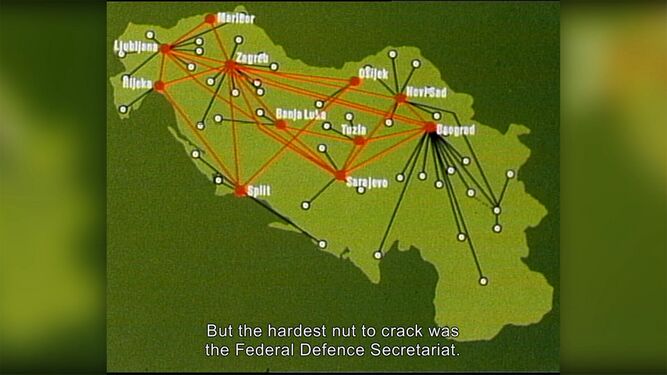
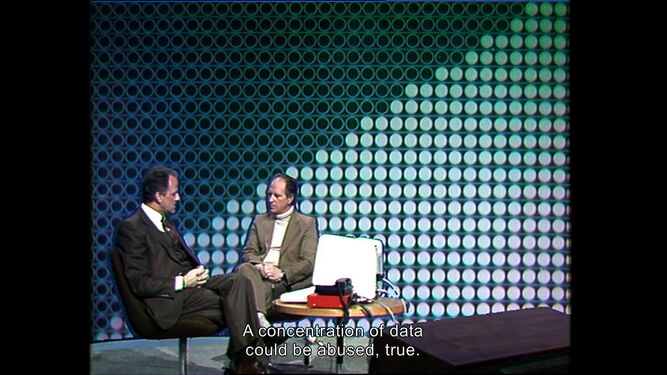 Aleksandra Domanović, From yu to me, 2013/14.
 Aleksandra Domanović, From yu to me, 2013/14.
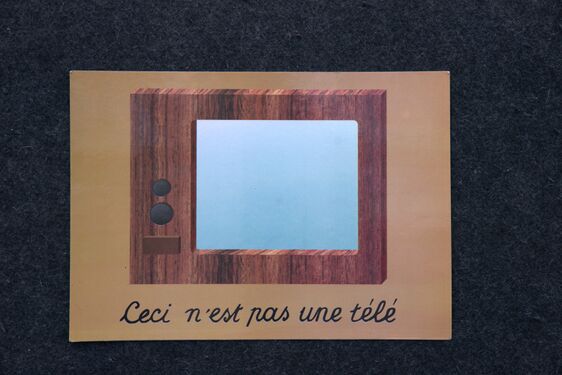 Vákuum Tv, 1996.


Introduction[edit]
The five curators of the exhibition grew up in different countries along both sides of the former Iron Curtain. They experienced – firsthand or with the critical distance passed time allows – the social situation which shaped the exhibited works.
In Central and Eastern Europe, the late 1980s and early 1990s were marked by two intertwined paradigm shifts: the dissolution of state socialism and the dawn of the digital and internet age. This simultaneity brought about a diverse body of media works. EastUnBloc “reverse engineers” the underlying principles of these works and their production processes. Borrowing a term from computer programming, these principles and strategies are referred to as “scripts”.
They invite visitors to connect with the exhibited works and reflect their own past, future and present through the exhibits’ lenses.
Instead of insisting on a spatial, chronological or geographical dramaturgy, the scripts guide visitors to encounter works in an optional order, revealing themselves through color-coding and other clues in the exhibition design.
A cooperation with Wiki-based arts online library Monoskop provides background information throughout the exhibition.
Bring a friend[edit]
- creating communities by throwing a political party
As authorities in Central and Eastern Europe often sowed suspicion to better control their subjects, friendship became particularly precious. It also was a means of resistance. Long nights in pubs engendered not only hangovers but also plans for artistic and political activity. Private social gatherings became informal art exhibitions, fashion shows, concerts, poetry readings, film screenings, and happenings. Circles of friends co-created and had each other’s backs, worked and lived together. Making art became a way of life. And despite mistrust of potential secret police informers, encounters with the unfamiliar – people with different backgrounds and life situations as well as new experiences – were welcome.
Works using this script document avant-garde fashion which irreverently used socialist symbols. Intermedia club culture, where music, media art, design, dancing and performance merged, became labs for social change or a safe space for expressing queer identities.
Expose the seams[edit]
- revealing media’s underlying processes
The persuasive effect of media often relies upon the audience’s ignorance of how it works. Official media in socialist countries also strived to remain untransparent. Particularly in the postmodern era, questioning the power of media by exposing its inner workings became a key issue for scholars and artists on both sides of the Iron Curtain.
Works using this script are highly experimental and self-referential, deviating the most from conventional viewing habits. The presence of the camera is highlighted by breaking the fourth wall or showing the recording apparatus. Editing, usually invisible in classical narrative cinema, is foregrounded. Some structuralist works explore the materiality of film and video: film grain, electromagnetic signals, video dropouts, pixels, and other digital glitches. Some works walk viewers through the process of creation.
Make your own media[edit]
- self-empowerment through media production
Bertolt Brecht famously said in the early 1930s, with the advent of radio as a mass medium, that radio not only allows one sender to reach a broad audience in a top down fashion, its technology also has the potential for each receiver to broadcast their own programming.
Then 16 mm and Super 8 film emerged which could be developed at home – crucial particularly in Central and Eastern Europe to avoid state control through film labs. Later video formats such as VHS, Video / Hi8 and (Mini)DV became accessible, empowering more people to create their own media. Non-conformist self-expression, aesthetic exploration, and sharing suppressed information were some of the aims of this practice.
In the strongly controlled media system of the socialist era, alternative niches emerged. In state supported or tolerated experimental film and video art practices in Poland, Hungary, Yugoslavia, and Romania, abstract visual art works flew under the radar of censors who were watching out for explicit, often verbal artistic expression. Amateur films, which occasionally tested limits of form and content, were produced in clubs associated with worker leisure time and worker creativity encouragement or, as in Yugoslavia, as part of aesthetic education.
Autonomous production occurred with Super 8 film cameras and video equipment, sometimes smuggled from the West.
This allowed the creation of a wide range of “audiovisual samizdat,” underground self-publishing practices ranging from experimental works which challenged aesthetic norms to documentations of suppressed political movements such as Charta 77 in Czechoslovakia and Solidarność in Poland.
This script also encompasses interactivity. While the audience is not completely autonomous, it is a co-creator or at least has a decision-making option within the works, foreshadowing today’s media landscape of individual prosumers. The exhibition presents Kinoautomat, the first large-scale interactive narrative film from Czechoslovakia which premiered at Expo Montreal in 1967, and DemoKino, a 21st century response exploring interactivity and political decision-making.
Furthermore, net art works follow this script, using the interactive features of the internet browser and hypertext, as well as 1980s independent computer games from Czechoslovakia, some of which had explicit political themes.
Reality bending[edit]
- hacking the system with pranks and hoaxes
Analogous to the musical practice of circuit-bending – creative manipulation of circuits in electronic devices to get an output that was not intended by the manufacturer – the exhibition uses the term “reality bending” to highlight works that hijack power structures. Through parody, overaffirmation, or unexpected disruption, these works reveal hidden truths, empower the powerless (if only for a brief moment), and show that a different situation is possible.
While reality bending is a practice adopted for progressive and emancipatory aims, some works also deal with ethical questions and possible unintended adverse effects.
Media artists and activists in Central and Eastern Europe frequently used reality bending as an underlying “script.” Some works ruptured rigid and oppressive state media, in particular television, through illegal and high-risk actions or, as in the Slovenian art group Laibach, by parody or détournage of official symbols and messages. Others, like Krzysztof Wodiczko with his Lenin Monument, used media as interventions in public space.
Space in time[edit]
- forging connections across spatial and temporal boundaries
Geography and history, intertwined manifestations of space and time, particularly shaped everyday life and states of mind in Central and Eastern Europe. Centuries of armed conflicts, domination by foreign colonial powers, and the redrawing of national borders impacted identities. The establishment of the capitalist and socialist blocs in post-war Europe resulted in the Iron Curtain as a seemingly invincible barrier with a far-reaching shadow.
As a consequence, much artistic practice engaged with ghosts of the past and utopian or dystopian futures as they blur or battle each other in the present.
The projects in the exhibition, through networks of likeminded artists all over Europe, forged connections via the distribution of analogue videotapes through semi-official channels like Infermental. Others used TV broadcast and early internet technologies, as did Van Gogh TV with Piazza virtuale, or created a dialogue between past and future selves. And Transcentrala by Marina Gržinić & Aina Šmid explores how artist collective NSK (Neue Slowenische Kunst) developed a theory of history and concept of a postnational world transcending borders. In 1992, the collective founded NSK State in Time, which inspired this script’s name.
Turn shit into chocolate[edit]
- using limited resources for maximal effect
Resources are generally scarcer for independent artists and activists, and that was certainly the case in socialist and transition-era Central and Eastern Europe. Combining available materials with ingenuity and imagination, the works applying this script are provocative, humorous and even trailblazing. They use lo-res formats like 16 mm, Super 8 or VHS, U-matic low band and Hi8 video, basic video signals, minimal computer code, such as the four kilobyte size digital animations of the Demoscene, ASCII characters, and GIFs. Found footage becomes raw material. Editing takes place in camera or with rudimentary cuts, or films are shot in one take. Props and sets are handmade; trash becomes costumes; minimalism becomes virtuosity. The “turn shit into chocolate” script echoes in for example the Dogme 95 manifesto’s creative restraints and permacomputing (see the accompanying program), a concept and community of practice oriented around issues of resilience and regenerativity in computer and network technology inspired by permaculture.
Photos[edit]


Works[edit]

1
Artistic Intelligence (AI) is a poetic-technological concept that we have developed for ourselves and for you. In a society that is becoming increasingly robotized, where all social processes are permeated with smarter technologies, it relies on the imagination and power of art. Today, art often seems to merge into smart surfaces and be influenced by commercial aesthetics. In turn, commercial aesthetics are themselves created by artists, or rather, they appropriate artistic positions in their market mechanisms, lure them out of their niches for creative branding and social media campaigns. But counter-movements are also emerging, celebrating, for example, the improvised and spontaneous. What can art do, what could it once do?
The exhibition offers a look back at the former Eastern Bloc and asks: What artistic intelligence can we find there? What can it give us for today?
While artificial intelligence works with algorithms, here we follow “scripts” that are hidden in the works: Principles that can be found in many of the exhibited artworks and practices.
Question to Open AI: What is the difference between a script and an algorithm? Answer: Script is the concrete implementation, algorithm is an abstract problem-solving logic.
6 Scripts become the paths and colors of the test pattern. From here, you can use them to embark on a journey through the exhibition. Perhaps they will help to break through the many shades of industrial gray that surround us or at least bring them into play a little. Because even in the supposed gray of the East, people painted in bright colors.
This text is an invitation: Please feel at home in the exhibition, please leave the works of art in their places, but feel free to play wildly with the spaces in between. Take a pair of slippers, take a seat, share a part of your journey with this room and leave something of yourself here.
Scripts
{Turn Shit into Chocolate}
>> using limited resources for maximal effect
{Reality Bending} >> hacking the system with pranks and hoaxes
{Make Your Own Media} >> self-empowerment through media production
{Bring a Friend} >> creating communities by throwing a political party
{Expose the Seams} >> revealing media’s underlying processes
{Space in Time} >> forging connections across spatial and temporal boundaries
2
Spaceship Yugoslavia
This station is also site specific. Through the inclusion of photographs of an intervention at the nGbK’s former space in Kreuzberg as part of the nGbK exhibition Spaceship Yugoslavia – The Suspension of Time (2011), EastUnBloc references previous nGbK projects which proposed more nuanced views of post socialist transitions, specifically Yugoslavia’s complex historical legacy.
“We ask ourselves—a generation whose childhood memories are anchored in a socialist Yugoslavia—if it is indeed possible to latch onto a critical nexus from which we may have constructive experiences. We did not grow up in an orderly system, causing our experiences to be irrevocably linked with a transition process. We cannot be transported backward or forward in time. We walk this earth in different countries, but have no fixed ground under our feet. Our common inheritence, our cultural connection, is a disintegrated history, a tentative space; it is a spaceship named Yugoslavia.”
nGbK work group Spaceship Yugoslavia
Furthermore, by showing an intervention at the former nGbK location (1992–2023) on Oranienstraße, a central cultural and nightlife avenue of Kreuzberg, EastUnBloc invites the exhibition site to add its history to the conversation. This includes the nGbK’s past engagement with socio cultural developments in Central and Eastern Europe as well the eviction from the former space as an example of gentrification and discourse about “whose city” is contemporary Berlin.
Marina Gržinić & Aina Šmid
Transcentrala
(Neue Slowenische Kunst State in Time)
SI 1993
Video, Beta SP, 20 min
Color, sound
Production: TV Slovenia / Artistic Programme
Slovenian with English subtitles
The Blind Spot
Installation by Damir Radović
for the exhibition
Spaceship Yugoslavia, nGbK 2011
Photo: Nihad Nino Pušija
3
Dalibor Martinis
DM 1978 Talks to DM 2010
YU (HR) 1978/2010
Video, 13 min
Color and b/w, sound
Croatian with English subtitles
DM 2024 Talks to DM 1978 – HRT
HR 2024
Video, 19 min
Color and b/w, sound
English
4
(from Veruschka Bódy and Gábor Bódy eds., Axis. Auf der elektronischen Bühne Europa. Eine Auswahl aus den 80er Jahren, Cologne: DuMont Verlag, Köln, 1986.)
Through this support, the film director Gábor Bódy attempted to realize the project INFERMENTAL. Ultimately, he financed the first edition almost entirely himself from his DAAD scholarship.
Infermental
1980–1991
International video art magazine with contributions by various artists
Documents, posters, graphics
Source: ZKM Collection
© ZKM – Center for Art and Media Karlsruhe, 1980–91
Infermental Berlin, Mediascreen Display Ku’damm Eck
Source: ZKM Collection
Photo: Zoltán Jancsó, 1982; © Vera Baksa-Soós
5
Grobari (2009) is an early example of Aleksandra Domanović’s “paper stacks” works: PDFs, several thousand pages long, which are displayed as sculptural objects. When printed onto standard office paper using the “borderless printing” setting, they are stacked vertically, several feet high, to reveal images printed on their sides.
Domanović began creating these downloadable PDFs as monuments to the .yu internet domain name, which expired only in March 2010, many years after Yugoslavia had ceased to exist as a nation. Grobari depicts plumes of smoke from flares set off by an organized group of extremist football fans who played an integral role in bloody conflicts during and after the dissolution of the Socialist Federation of Yugoslavia.
From yu to me traces the history of the domain .yu. Registered as the international country code for Yugoslavia in 1989 and deleted in 2010, its significance shifted during the course of the 1990s as the regions of the country gained independence. Beginning with Slovenia in 1992, each of the eight new countries was assigned its own domain, a process only completed in 2007, when Serbia began to use .rs and Montenegro, .me. Domanović’s documentary reveals how Yugoslavia became one of the first countries to be connected to the Internet at a time of intense social and political change.
Domanović’s interviews with the computer scientists who helped establish the connection are interspersed with footage that she collected from Yugoslav television archives and recorded during the course of her research, revealing how a symbol of modernization became bitterly contested. The film traces the origins of the domain to the Yugoslav Network for the Academic Community (YUNAC) in Ljubljana, which established the connection for Slovenia and the rest of Yugoslavia in the months following the outbreak of war in 1991, as the Republic of Slovenia was being formed. It follows the story of its transfer to Belgrade in 1994, and eventually to the Museum of Yugoslav History, Belgrade, where it became the first virtual item to enter the collection in 2010.
Aleksandra Domanović
Grobari
2009
Inkjet prints on A4 paper, 3,500 pages
From yu to me
2013/14
HD video, 35 min
Color, sound
6
“Like software, hardware is also changing rapidly, continuously and inexorably, losing its functionality, purpose and, consequently, its content – the (non-)art itself. The author’s basic premise here is that (non-)art is not only hidden in the concept, the idea, i.e., not only in the nominal and declared, but equally also in the tools and machines that produce it. That is why the parts of machines, now more or less dead, are full of intimate memories that have faded and stories that have died.
The series is part of Štromajer’s de-digitalization processes over several years, from the deletion of his net non-art works back in 2011 to the present. (...) The title of the work indicates the amount of now deleted net non-art works (101.72 MB of files) produced and processed by these machines and their parts between 1996 and 2007: intima.org/ex
de-digitalization ≠ re-analogization”
Igor Štromajer
Igor Štromajer
101.72 MB
SI 1996–2007, 2024
Seven framed electric machines, one robot
7
The gallery shows that did resonate with the culture incorporated parody, as seen in Written in Stone (2003), which featured busts of several net artists and various ephemera such as the flowers given by cyberfeminist collective Old Boys Network to Vuk Ćosić when he invited them to Venice Biennale in 2001.
Net Art has been defined by storytelling and by its culture: gatherings and happenings of people who often first met online through lists such as nettime, Syndicate, Spectre or FACES.
One of these events was the MetaForum series, which was associated with the emergence of the Nettime list. It was held three times in Budapest (1994–1996) and again in 2024. On this occasion, Flóra Barkóczi created a video documentary composed of Metaforum recordings made by students from the Intermedia Department at the Hungarian University of Fine Arts in the 1990s. The exhibited video loop also features a video documentary about the first meeting of artists running servers from the East and West, which took place in London in 1998 (the follow-up edition was held in Labin, Croatia, in 2001).
Finally, there is a short documentary about the 2011 Belgrade edition of the ongoing series of cyber- and techno-feminist gatherings known as Eclectic Tech Carnival, first held in 2002 in Pula, Croatia.
This station will be expanded with video recordings of two sessions held as part of the exhibition program: Net Art Surfing Session with Sakrowski and Igor Štromajer, and the Networks of Net Art – Syndicate and Deep Europe session with Tereza Havlíková and Andreas Broeckmann.
Art Servers Unlimited
GB 1998
Video, 30 min
Color, sound
English
/ETC Eclectic Tech Carnival 2004 Belgrade
GR/SR 2004
By: βιντεοκολλεκτίβα Κινηματόγραφος & GenderChangers
Video, 6 min
Color, sound
English
MetaForum 1–3 (1994–1996) Revisited
HU 2024
By: Flóra Barkóczi & students of the Intermedia Department at the Hungarian University of Fine Arts
Video, 11 min
Color, sound
English
8
The post war bloc situation made technology transfer extremely difficult. Nonetheless, innovation processes were unstoppable and the computer age dawned on both sides of the Iron Curtain. Homegrown and imported personal computers, and starting in the 1980s, more widespread computer skill education for beginners, encouraged a generation of tech savvy youngsters to smuggle and crack games from the West. Or they coded their own games, which often transported regime critical messages.
Slovak Computer Games
1987–1994
Playable English localizations of Slovak digital games for Fuse emulator
Translation project created by Slovak Game Developers Association in cooperation with Slovak Design Museum
Translation: Stanislav Hrda, Slavomír Labský, Marián Kabár, Darren Chastney, Jakub Celušák,
Maroš Brojo
Sinclair ZX Spectrum Computer
Exhibit (not functional)
Loaned by: Computerspielemuseum Berlin
9
Monoskop
Shadow libraries
2015/2025
Digital print (website), 41 x 570 cm
10
Out of these intros grew the independent form of the “demo”: a self-contained audiovisual program designed to push limited hardware far beyond its intended capacities. Demoscene groups organized themselves like small studios, with coders, musicians, graphic artists, and “swappers” who ensured global distribution. Their competitions, parties, and rivalries shaped a subculture defined equally by collaboration and contestation.
This station presents three PC demos by the Slovak group Satori whose abstract, code-driven aesthetics reflect the scene’s mature period. Alongside them, an excerpt from a documentary on the Hungarian demoscene highlights how this underground network transformed technological limitation into a catalyst for creativity.
Satori
Different Engine
SK/FI 2000
By: Zden Hlinka / Satori (code, graphics) & Esa Ruoho (music)
Video (PC demo), 2 min
Black/white, sound
Metamorf
SK/PL 2000
By: Zden Hlinka / Satori (code, graphics) & Raiden / Aural Planet (music)
Video (PC demo), 3 min
Color, sound
B10
SK 2001
By: Zden Hlinka / Satori (code, graphics) & David Bennar (music)
Video (PC demo), 4 min
Color, sound
Szilárd Matusik
Stamps Back – A Moleman Story (excerpts)
HU 2022
Documentary about the origins of the Hungarian demoscene and home computer subculture
Video, 10 min
Color, sound
11
TV Free Europe is a communication channel between the past and present, between different locations and people who can experiment with (tele)communication and its potentialities of freedom. TVFE is also a tool to interrogate historic material with recent questions. Last but not least, during its making in 2020–21 it was an experiment of “staying alive” together during the Covid-19 pandemic.
Pneuma Szöv. / Pneuma Vizuál
Studio TV Free Europe
2025
Spacetime travel device with props
TV Free Europe
Budapest, Szombathely, Leipzig, Tårnby Torv/Kopenhagen, Nova Gorica, Oberwart, Online
2019–2021
Artistic coordination: Pneuma Szöv.
With various video works from Studio Budapest
TV Free Europe Program Announcements Mon–Sun
Budapest 2020/21
Online channel by Szilveszter Jenei
7 x ca. 1 min
English
Working Party – The Telepathy Machine #1
Online live show during the COVID-19 pandemic by Pneuma Szöv. + Pneuma Vizuál, Budapest, 1.5.2021
115 min
English
With: Róbert Békefi, Zsuzsa Berecz, Csilla File, Sarah de Günther, Csilla Hódi, Szilveszter Jenei, Bernadett Jobbágy, David Karla, Boglárka Lutz, Zoltán Lehoczky, Lilla Magyari, Viktor Markos, Gergely Pápai, Dorottya Poór, Júlia Salamon, Luca Szabados, Dániel Szapu
Teletext about TV Free Europe
Budapest, 2020
3 min
Text: Klára Nagy, szinhaz.net
Teletext video: de Günther / Pneuma Szöv.
12
In September 1990, a few months after the opening of the Berlin Wall, Wodiczko realized two projections for the exhibition The Finiteness of Freedom Berlin 1990, which brought together site-specific artistic responses in East and West Berlin to the historical paradigm shift and the rapid transformation of the city.
One was on the Lenin monument on Leninplatz, today the United Nations Square in the Friedrichshain district of East Berlin. The 19-metre-high statue made of Ukrainian granite was designed by the leading Soviet sculptor Nikolai Tomski and erected in 1970 to mark the 100th anniversary of Lenin’s birth.
20 years later, Krzysztof Wodiczko transformed the Lenin statue into an ephemeral monument to people from Poland who shaped the Berlin streetscape after the fall of the Berlin Wall until the summer of 1990. In an interview with art historian Dr. Sarah Alberti in 2019, Wodiczko said that for him, these people were “new philosophers on the ruins of state socialism or communism, also in the sense of a ‘shabby, dubious freedom’ in the not yet united city of Berlin, the then capital of liberal capitalism and East Berlin, the capital of Leninism.”
Wodiczko also addressed the monument itself, which was dismantled in 1991 and removed from the list of monuments in 1992. The more than 129 granite and concrete segments of the monument were moved to a former gravel pit in the Müggelheim forest. To prevent vandalism, the Berlin Senate had the fragments filled in with gravel and earth. Since 2026, Lenin’s stone head has been on display in the permanent exhibition Unveiled. Berlin and its monuments in the Citadel in Spandau.
The second projection showed a stuffed eagle on the outer wall of Haus Huth, the only building still standing on the then empty Potsdamer Platz not far from the border. On July 16, 1990, Daimler-Benz bought a 61,710 m2 plot of land here for a tenth of its value. The eagle can be read as a federal eagle, but features as a symbol in numerous other states, such as the USA, Mexico, Poland, Russia, Austria, and Albania.
Krzysztof Wodiczko
Lenin Monument. Leninplatz, Berlin, 1990
D/PL 1990
Commissioned work for the exhibition
The Finiteness of Freedom, Berlin, 1990
Large format photo by: Werner Zellien
Loaned by: Profile Fundacja
Sabine B. Vogel & Mike Steiner
Every Monument Is A Person
D 1990
Video, 23 min
Color, sound
German, English
Courtesy of: Raik Müller
13
Lenin Projection Workshop
2025
3D print (model: Bormuh), Polylux
14
The campaign began as an artistic project, using a virtual persona to question the role of politicians in a rapidly changing digital world. Through a series of events across Poland, including major cities like Gdańsk, Warszawa, and Poznań, the campaign transformed galleries into political platforms, engaging citizens directly through the Citizens’ Electoral System (CES). This digital system allowed voters to submit their opinions and proposals in real time, forming a political program directly shaped by the people.
The project gained international attention, including stops in Berlin and Chicago, where the Polish diaspora also contributed to the campaign’s growing impact. The campaign questioned not only the need for traditional political figures but also explored the future of democracy in a world where technology plays a central role.
The core of the campaign was the concept of the Citizens’ Electoral System (CES) / OSW — an innovative vision of direct democracy where people, through the Internet, would collectively shape and build the will of Wiktoria Cukt, representing the voice of the citizens themselves.
“Politicians are unnecessary.”
Wiktoria Cukt
“The Wiktoria Cukt campaign was more than a political movement—it was a cultural and technological experiment designed to inspire new ways of thinking about governance, citizenship, and the power of collective decision-making in the digital age. Join us as we continue to explore this vision and shape a new future for democracy”
Wiktoria Cukt
C.U.K.T. (Piotr Wyrzykowski)
Wiktoria Cukt 2.0 Rebirth
PL 2025
Video installation
Wall Print Collage
2025
Composite visual documentation: fragments of original Wiktoria Cukt campaign poster (2000) and Wiktoria Cukt 2.0 Wiktoriomat poster (2025)
Digital print, 300 x 200 cm
Presidential Campaign of Wiktoria Cukt
2001
Video documentary by Piotr Wyrzykowski
Documentation of C.U.K.T. (Central Office of Technical Culture) campaign intervention, 2000
Officials: Rafał Ewertowski, Mikołaj Jurkowski, Artur Kozdrowski, Jacek Niegoda, Maciej Sienkiewicz, Piotr Wyrzykowski
Video, 27 min
Color, sound
Extended Interview with Wiktoria Cukt 2.0: Years 2024–2025
2025
Video documentary by Piotr Wyrzykowski
Documentation of Wiktoria Cukt 2.0 rebirth by C.U.K.T.
Officials: Mikołaj Robert Jurkowski, Piotr Wyrzykowski
Video, 49 min
Color, sound
Official Campaign Poster
2000
Wiktoria Cukt presidential campaign poster
C.U.K.T. (Central Office of Technical Culture)
Digital print, framed, 40 x 50 cm
Official Presidential Poster
2025
Wiktoria Cukt 2.0 Wiktoriomat poster
C.U.K.T. (Central Office of Technical Culture)
Official: Piotr Wyrzykowski
Digital print, framed, 40 x 50 cm
Official Exposé of Wiktoria Cukt
2000
C.U.K.T. (Central Office of Technical Culture)
Digital print, framed, 21 x 29,7 cm
Aarhus Declaration
2025
Wiktoria Cukt 2.0 & C.U.K.T.
Official: Piotr Wyrzykowski
Digital print, framed, 21 x 29,7 cm
15
“If there is nothing and we use this nothing as a source of energy, then there is no God who could ruin or stop us.”
László Kistamás, initiator and member of Vákuum TV
“It became clear that in Vákuum TV, one can present an idea quickly, even in a sketchy form, without long preparation. This format thus allows for rapid responses to daily social events—and practically to anything.”
Kristóf Forgács, member of Vákuum TV
László Kistamás, initiator and member of Vákuum TV
“At that time, politics and communication in performing arts started to be very splintered. The roles of the actors, the speakers, and the audience started to take shape. The personal nature of things seemed to be at risk. A trend began where personal and direct interconnections started to transform into more distant ones, which made me feel that there was a need to create a kind of ‘pseudo-TV’ that people could watch together and that would have a community-organizing power.”
László Kistamás
Vákuum TV
“Apart from one or two program segments, the host was present in the show almost constantly as an active medium. Whether within the TV frame or outside it, her presence continuously connected not only the program segments but also the internal and external spaces of Vákuum TV; her personality erased the boundary between these two areas.”
Kristóf Forgács, member of Vákuum TV
“The artistic endeavor and expression, which aimed at free thinking and the constant correction of thought, and which created some kind of public sphere through its openness, accessibility, and uniqueness, seems, from today’s perspective, to have had numerous productive effects.”
Kristóf Forgács
Kristóf Forgács, member of Vákuum TV
The quotes by Kristóf Forgács stem from his DLA thesis Vákuum TV intermedia performance cabaret, in the period 1994–95, Hungarian University of Fine Arts, Doctoral School, Budapest, 2022
Vákuum TV
Monoszkóp
1995
Hand-painted opening title screen for the broadcasts of Vákuum TV
Acrylic, canvas
268 x 216 cm
Vákuum TV
Vákuum TV
1994
Stage set built for the shows of Vákuum TV in the Budapest nightclub Tilos az Á
Wood, tulle
264,5 x 369 cm
Vákuum TV introduction
HU 2025
Produced by Vákuum TV for EastUnBloc, using original video footage
of the Vákuum TV archive
Video, 4:28 min
Vákuum TV
HU 1995
Compilation from the Vákuum TV archive about the group. Pre-graduation work of Vákuum TV member Kristóf Forgács, produced at Medienzentrum of UdK Berlin
Video, 46:04 min
Hungarian, dubbed into German
Performers: Members of Vákuum TV
Other performers:
Studio speaker: Rolf Gänger
Art policists: Martin Willis, Marc Stephan
Christo Vladimirov Javacheff: Tilman Wendland
Camera: Iván Artner, János Szirtes, Virág Csejdy, Martin Willis
Voice actors: Marc Stephan, Silke Gänger
Translation: Bak Gara
Vákuum TV at Next 5 Minutes
HU/NL 1996
Excerpts from the video documentation of Vákuum TV's performance at the Next 5 Minutes 2 International Festival of Tactical Media,
Amsterdam, 18.–21.1.1996
Produced by Tactical Media Files
Online video, 10:17 min
16
Kinoautomat was first presented at the 1967 Expo in Montreal. It was the first large-scale interactive movie, allowing the audience to choose among various plotpoints and outcomes.
Experiments with interactive TV, video art and CD ROMs followed in the 1980s and 1990s, but audiences have embraced interactivity primarily in gaming (see also Computer games).
After the demise of the linear videotape as the primary medium of on demand home entertainment, the DVD and later BluRay (building upon the media asset depository feature of the CD ROM) provide limited interactivity on demand with scene selection, alternative endings et al., a feature also infrequently offered by streaming platforms as bonus material.
Radúz Činčera / Alena Činčerová
Kinoautomat
ČSSR/CZ 1967/2009
DVD version of the first interactive movie
Color and b/w, sound
Czech-English version
17
The internet (see also Net art, net culture) seems to be the realization of utopian dreams of interactivity. However, intransparent algorithms and dominance of big tech platforms exercise surveillance and malevolent use of gathered data. Is this a fair trade off for an illusion of choice?
„What if I tell you it was all pre-defined?“
Davide Grassi
DemoKino – Virtual Biopolitical Agora
SI 2005
Interactive DVD
Color, sound
English, Slovenian, Italian versions
18
Tilman Baumgärtel with Julian Weinert: Van Gogh TV‘s “Piazza Virtuale” – The Invention of Social Media at documenta IX in 1992.
Tilman Baumgärtel
“The viewer is welcome to stay in his pyjamas, but he should show himself to the virtual public on the streets. (…) In the privacy of his own slippers, the viewer operates the functions of the machine.”
Van Gogh TV – Piazza Virtuale: 100 Days of Interactive Art Television”, documenta IX catalogue, 1992.
Broadcast dates:
16 September 1992, 12:10–12:30 (3sat);
20 September 1992, 01:26–03:30
“Piazzetta Ljubljana was organised by the media and performance artist Marko Košnik (…). Košnik was a founding member of the Slovenian band Laibach in the 1980s. Laibach in turn was part of the artists’ collective Neue Slowenische Kunst (New Slovenian Art, NSK), which was formed in 1984. In cooperation with the student radio station Radio Študent (RŠ), the Piazzetta Ljubljana contributed two shows to Piazza virtuale. (...) In addition to being broadcast on 3sat, the show was broadcast on the newly founded private television station Kanal A in Slovenia. At that time, the armed conflict between the former states of Yugoslavia was at a peak. In the first broadcast on September 16, intellectuals and artists from the country, which had disintegrated into individual republics, made short statements about the ongoing war. These were largely delivered in Slovenian by telephone, with short summaries in English in the modem chat in the lower half of the picture. The philosopher Slavoj Žižek was on the phone and discussed his view of the religious and historical dimension of the conflict. (...)
In the second broadcast on September 20, the journalist Petar Luković, who worked for the news magazine Vrijem, spoke by telephone from Belgrade. At that time, regular telephone calls between Ljubljana and Belgrade were not possible because of the war, and the callers had to be connected via the studio in Kassel. (...)”
Tilman Baumgärtel with Julian Weinert: Van Gogh TV’s “Piazza Virtuale” – The Invention of Social Media at documenta IX in 1992.
Van Gogh TV
Piazza virtuale
1992
Piazza virtuale – The Documentation
D 1993
By: Utta C. Hoffmann & Van Gogh TV
Video, 33 min
Color, sound
English
Piazza virtuale – Dokumentation
D 2021
By: Tilman Baumgärtel & Julian Weinert
Produced by: Institut für Mediengestaltung
Video, 40 min
Color, sound
German with English subtitles
Configuration Piazza virtuale
1992
Benjamin Heidersberger / Van Gogh TV
Wall plan, Billboard-Print, 2 x 3 m
Logo Van Gogh TV
Inkjet print on A3 paper
Broadcast Studio Kassel
Ole Lütjens, Salvatore Vanasco, Katrin Brinkmann
Black and white photography
Photo: Ali Altschaffel
Screenshots of some Piazzetta (Broadcast Studios)
by Van Gogh TV and various artists and collectives
8 inkjet prints, 58 x 43 cm
Photo printouts produced for the exhibition Van Gogh TV: Piazza virtuale, Künstlerhaus Bethanien, Berlin 2021
Piazzetta Praha
Organizers: First Piazzetta Prague: Michael Bielický (Academy of Fine Arts), Second Piazzetta Prague: Ika Kröger
Participants: Tomáš Mašín, David Saudek, David Christoff, Keiko Sei, Prof. Milan Knížák, Richard Gaynor and others
Piazzetta Riga
Participants: Baiba Ripa, Valdis Martinsons, Liena & Edgars Muceniers, Ojārs Pētersons, Aigars Sparāns, Hardijs Lediņš, Artis Dzērve, Kristina Dregene and others
Piazzetta Bremen
Organizers: students of Bremer Hochschule für Künste
Initiators: Axel Roselius & Ronald Gonko, Jörg H. Wolff, Prof. Gerd Dahlmann
Participants: Stefan Doepner, André Szigethy, Ole Wulfers, Tobias Küch, Rachid Ali Khan, Beate Skiba, Hank Normann, Katrin Orth, Veronika My, Daniela Aligeri, Martina Schall, Joschi Jung and others
Piazzetta Hamburg
Organizers: Frauen und Technik (Ellen Nonnenmacher, Bettina Schoeller, Lore Piatkowski, Ania Corcilius, Cornelia Sollfrank, Korinna Knoll, Annette Kisling, Silke Mauritius, Janine Sack, Christine Bader)
Piazzetta Paris
Organizers: Christian Vanderborght
Participants: Christian Vanderborght, Frank Barte, Jacques Bigot, Karim Baupin, Arnaud Mayet, David Dronet, Stefano Zanini, Eric Madeleine and others
Piazzetta Ljubljana
Organizers and participants:
Production unit in Ljubljana: Radio Student, KUD France Preseren, Kanal A
Produced by: Marko Košnik / Egon March Institute
Performers: Ema Kugler, Mojca Dimec, Mojca Kumerdej, Lidija Bernik, Franc Purg, Sebastjan Starič, Bojan Štokelj, Mare Kovačič, Silvo Zupančič, Marko Košnik
Contact studio: Snežana Levstik, Jure Longyka
Local transmission: Peter Levart, Miran Divjak, Miran Kajin, Borut Savski
Intellectuals: Jelena Lovrić, Silva Mežnarić, Rade Šerbedžija, Slavoj Žižek, Damjan Bojadžiev, Gorazd Suhadolnik, Radko Polič, Goran Janković, Haris Burina, Rastko Močnik, Petar Luković
Piazzetta Nagoya
Organizers: Nippon Hōsō Kyōkai (NHK – Japan Broadcasting Corporation)
Participants: Eiichi Kubota (program director NHK), Atsushi Ogata (translator in Kassel)
Piazzetta Genève
Philippe Coeytaux, Alessandra Mueller and others
19
Tune into a TV schedule that is utopian in the original sense of the word: it could exist nowhere outside this space.
On view are a variety of works which hijack media power structures, allow suppressed voices to express information the authorities didn’t or don’t want to hear, investigate the process behind recording and playback of audiovisual images itself and celebrate the subversive fun of music videos.
Check the TV guide to plan your (n)on-demand viewing experience.
What do the different color codes mean? Read our Artistic Intelligence (AI) statement or the explanations in the leaflet.
TV Tower Lounge
TV program installation, films and videos 1958–2010
For details see the program guide
Loaned by: Collection Video-Forum,
Neuer Berliner Kunstverein (n.b.k.), Filmoteka Muzeum Sztuki Nowoczesnej w Warszawie and the works’ authors
Events[edit]
Opening[edit]

- nGbK. Fri, 28 Nov 25, 18:00 h
With an intervention by the art network Pneuma Szöv. (Budapest/Berlin) and special guest Kristóf Forgács (Vákuum TV).


“Bring a Friend” – Early Night Show[edit]

- nGbK. Sat, 29 Nov 25, 19:00–20:30 h
TV Free Europe presents:
A performance and time travel talk show by Pneuma Szöv. (Budapest/Berlin) and guests: Gusztáv Hámos, Mike Hentz and Benjamin Heidersberger. – Live at and from nGbK!


Entropy Coding – Experiments with Video and Permacomputing[edit]

- nGbK. Tue, 2 Dec 25, 14:00–18:00 h
Workshop with Brendan Howell (artist and reluctant engineer, wintermute.org, permacomputing.net)
Experimenting with outmoded and low-fi digital cameras as tools for new aesthetics and narratives.
Guided by a permacomputing approach of extending the life and expressive potential of existing devices instead of discarding them, the workshop treats them as material starting points. Participants will also explore how constraints (low resolution, limited functionality, analog-digital quirks) can become generative. More than a technical exercise, this is a moment to reflect on computing’s materiality — what technology we use, why, and how we might re-imagine it for sustainability, creativity and alternative narratives.

Net Art Gallery Surfing Session[edit]
- nGbK. Sun, 11 Dec 25, 19:00 h
with Sakrowski (curator, netzkunst.berlin) and Igor Štromajer (artist)
More about the event on the panke.gallery website.
Networks of Net Art – Syndicate and Deep Europe[edit]
- nGbK. Tue, 13 Jan 26, 19:00 h
with Tereza Havlíková (curator, netzkunst.berlin) and Andreas Broeckmann (curator and researcher)
Bye Bye My Eye: Confirmed. Understood. Over and out.[edit]
- nGbK. Wed, 28 Jan 26, 19:00 h
Live cinema. Live performance. Half dead reality of those who sailed into the known. © D'epog.
Archival Outreach Symposium[edit]
- nGbK. Thu, 29 Jan 26, time tbc
with Jennifer Helia DeFelice (Vašulka Kitchen Brno), Lucia Repašská (D'epog), and others.
Finissage[edit]
- nGbK. Sun, 14 Feb 26, 18:00 h
Contributors[edit]
With contributions by
- Aleksandra Domanović
- Andreas Broeckmann
- Art Servers Unlimited
- Benjamin Heidersberger
- Brendan Howell / permacomputing.net
- CUKT
- Dalibor Martinis
- Damir Radović
- Davide Grassi / Janez Janša
- D'epog
- Eclectic Tech Carnival
- Gusztáv Hámos
- Igor Štromajer
- Infermental
- Jennifer Helia DeFelice / Vašulka Kitchen Brno
- Krzysztof Wodiczko
- Laibach
- Lucia Repašská
- Marina Gržinić & Aina Šmid
- MetaForum
- Mike Hentz
- Monoskop
- Pneuma Szöv. / TV Free Europe
- Pneuma Vizuál
- Radúz Činčera / Alena Činčerová
- Sabine Vogel & Mike Steiner
- Sakrowski
- Sarah Alberti
- Satori
- Slovak Game Developers Association / Slovak Design Museum
- Szilárd Matusik
- Tereza Havlíková
- Tilman Baumgärtel
- Vákuum Tv: Dóra Csernatony, Kristóf Forgács, Dániel Garas, Donáta Gajzágó, László Kistamás, Attila Till
- Van Gogh TV / Piazza virtuale
- Zbigniew Rybczyński
- Zemira Alajbegović & Neven Korda
- and others.
Exhibition design: Luca Szabados.
nGbK work group: Natalie Gravenor, Sarah Günther, Zsuzsa Berecz, Friedemann Bochow, Dušan Barok.
Funded by the Senate Department for Culture and Social Cohesion in Berlin. Supported by the German-Czech Fund for the Future.
Downloads[edit]
- Booklet PDF
- Poster PDF, Poster JPG
- Wall labels PDF
- Wall texts PDF
- Press materials on the nGbK website


