

Pascal Chabot: The Philosophy of Simondon: Between Technology and Individuation (2003/2013) [FR, EN]
Filed under book | Tags: · cybernetics, individuation, marxism, philosophy, philosophy of technology, technology

“The last two decades have seen a massive increase in the scholarly interest in technology, and have provoked new lines of thought in philosophy, sociology and cultural studies. Gilbert Simondon (1924 – 1989) was one of Frances’s most influential philosophers in this field, and an important influence on the work of Gilles Deleuze and Bernard Stiegler. His work is only now being translated into English. Chabot’s introduction to Simondon’s work was published in French in 2002 and is now available in English for the first time. It is the most accessible guide to Simondon’s important but often opaque work. Chabot provides an excellent introduction to Simondon, positioning him as a philosopher of technology, and he describes his theory of individuation including his crystalline ontology. He goes on to offer a bridge between these two concerns, exploring how they are related.”
French edition
Publisher Vrin, 2003
ISBN 9782711616008
160 pages
English edition
Translated by Aliza Krefetz with the participation of Graeme Kirkpatrick
Publisher Bloomsbury Academic, 2013
ISBN 1780930976, 9781780930978
156 pages
via thuihux
Review: Aud Sissel Hoel (Phil & Technology, EN)
La philosophie de Simondon (French, no OCR)
The Philosophy of Simondon (English)
Egle Rindzevičiūtė: Constructing Soviet Cultural Policy: Cybernetics and Governance in Lithuania after World War II (2008)
Filed under thesis | Tags: · cybernetics, governance, lithuania, politics, soviet union, technology
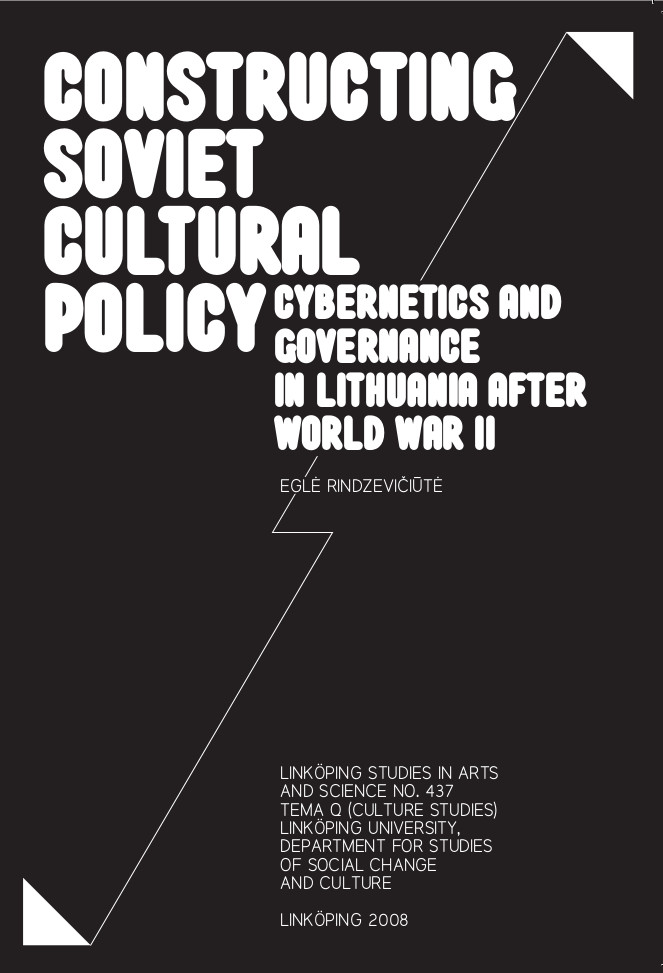
After World War I, the Soviet Union was one of the first modern states to engage explicitly in the governance of culture, which was formalised and institutionalised as state cultural policy. In this process of governance, sciences and technologies provided the state with conceptual and material resources, which were used to define both the process and the object of governance. After World War II, scientific and technological progress gave birth to a new science of control and communication, Norbert Wiener’s cybernetics, which was widely used not only in engineering, but also in the conceptualisation of humans, machines and societies. This thesis explores how cybernetics influenced the construction of cultural policy in the Soviet Union. It focuses particularly on the Soviet republic of Lithuania. The main argument is that since the 1950s a particularly powerful discourse of cybernetic governance was formed in the Soviet Union. A result of translation from techno-science, this discourse not only served the purposes of authoritarian rule, but was also used as a resource by cultural operators to criticise the Soviet government itself. By analysing organisational practices and official and public discourses, the study reveals the complexity of the relationship between governance, culture and sciences and technologies.
Doctoral thesis
Faculty of Arts and Sciences, Linköping University, 2008
274 pages
Bernard Dionysus Geoghegan: The Cybernetic Apparatus: Media, Liberalism, and the Reform of the Human Sciences (2012)
Filed under thesis | Tags: · cybernetics, history of technology, liberalism, linguistics, structuralism, technology
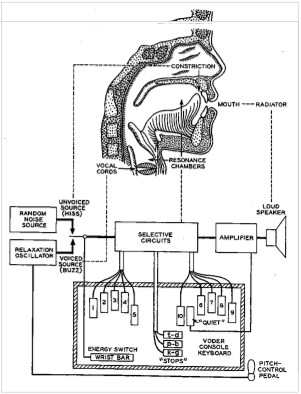
“The Cybernetic Apparatus examines efforts to reform the human sciences through new forms of technical media. It demonstrates how 19th-century political ideals shaped mid-20th-century programs for cybernetic research and global science sponsored by the Rockefeller Foundation. Through archival research and textual analysis, it reconstructs how and why new media, especially digital technologies, were understood as part of a neutral and impartial apparatus for transcending disciplinary, ethnic, regional, and economic differences. The result is a new account of the role of new media technologies in facilitating international and interdisciplinary collaboration (and critique) in the latter half of the twentieth century.
Chapter one examines how political conceptions of communications and technology in the United States in the nineteenth century conditioned the understanding and deployment of media in the twentieth century, arguing that American liberals conceived of technical media as part of a neutral apparatus for overcoming ethnic, geographic, and economic difference in the rapidly expanding nation. Chapter two examines the development of new media instruments as technologies for reforming the natural and human sciences from the 1910s through the 1940s, with particular attention to programs administered by the Rockefeller Foundation. Chapters three and four examine the rise, in the 1940s and 1950s, of cybernetics and information theory as an ideal of scientific neutrality and political orderliness. These chapters demonstrate how programs sponsored by the Rockefeller Foundation, MIT, and other institutions shaped linguist Roman Jakobson’s and anthropologist Claude Lévi-Strauss’s efforts to redefine their fields as communication sciences. Chapter five considers how critics of cybernetics, including Noam Chomsky, Claude Shannon, and Roland Barthes, critically re-evaluated the claims of cybernetics to redefine the relations between technical research and the human sciences.”
PhD dissertation
Northwestern University & Bauhaus-Universität Weimar, 2012
262 pages
Author
Related paper by the author: From Information Theory to French Theory: Jakobson, Lévi-Strauss, and the Cybernetic Apparatus (Critical Inquiry 38, Autumn 2011)
PDF (6 MB, updated on 2021-3-9)
EPUB (2 MB, added on 2021-3-9)