

Gregory Sholette: Dark Matter: Art and Politics in the Age of Enterprise Culture (2011)
Filed under book | Tags: · art, art system, capitalism, photography, politics
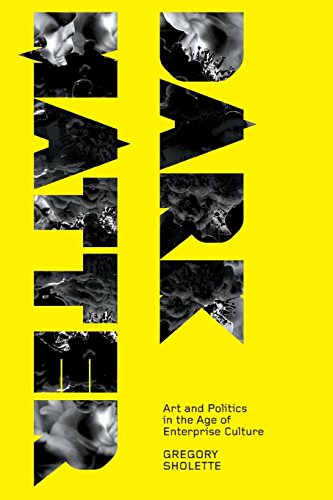
“Art is big business, with some artists able to command huge sums of money for their works, while the vast majority are ignored or dismissed by critics. This book shows that these marginalised artists, the ‘dark matter’ of the art world, are essential to the survival of the mainstream and that they frequently organize in opposition to it.
Gregory Sholette, a politically engaged artist, argues that imagination and creativity in the art world originate thrive in the non-commercial sector shut off from prestigious galleries and champagne receptions. This broader creative culture feeds the mainstream with new forms and styles that can be commodified and used to sustain the few artists admitted into the elite.
This dependency, and the advent of inexpensive communication, audio and video technology, has allowed this ‘dark matter’ of the alternative art world to increasingly subvert the mainstream and intervene politically as both new and old forms of non-capitalist, public art. This book is essential for anyone interested in interventionist art, collectivism, and the political economy of the art world.”
Publisher Pluto Press, London, 2011
Marxism and Culture series
ISBN 0745327524, 9780745327525
304 pages
Reviews: Nicholas Merzoeff (Afterimage, 2011), Larne Abse Gogarty (Art Monthly, 2011), Marc James Léger (Monthly Review, 2012), Stefan Szczelkun (Mute, 2012), Dave Beech (J Modern Craft, 2012), Bruce Barber (Reviews in Culture, 2012), Molly Hankwitz (Otherzine, 2013), Theo Reeves-Evison (review31, n.d.).
PDF (updated on 2019-12-18)
Comment (0)Yve Alain Bois, Rosalind E. Krauss: Formless: A User’s Guide (1996/1997)
Filed under book | Tags: · aesthetics, art, art criticism, art history, entropy, form, kitsch, painting, photography

“In a work that will become indispensable to anyone seriously interested in modern art, Yve-Alain Bois and Rosalind Krauss convincingly introduce a new constellation of concepts to our understanding of avant-garde and modernist art practices. Formless constitutes a decisive and dramatic transformation of the study of twentieth-century culture. Although it has been over sixty years since Georges Bataille undertook his philosophical development of the term informe, only in recent years has the idea of the “formless” been deployed in theorizing and reconfiguring the very field of twentieth-century art. This is partly because that field has most often been crudely set up as a battle between form and content, whereas “formless” constitutes a third term that stands outside the opposition of form and content, outside the binary thinking that is itself formal.
In Formless, Bois and Krauss, two of the most influential and respected art historians of our time, present a rich and compelling panorama of the formless. They map out its persistence within a history of modernism that has always repressed it in the interest of privileging formal mastery, and they assess its destiny within current artistic production. In the domain of practice, they analyze it as an operational tool, the structural cunning of which has repeatedly been suppressed in the service of a thematics of art. Neither theme nor form, formless is, as Bataille himself expressed it, a “job.” The job of Formless is to explore the power of the informe. A stunning new map of twentieth-century art emerges from this innovative reconceptualization and from the brilliantly original analyses of the work of Jackson Pollock, Andy Warhol, Cy Twombly, Lucio Fontana, Cindy Sherman, Claes Oldenburg, Jean Dubuffet, Robert Smithson, and Gordon Matta-Clark, among others.”
First published as L’Informe: mode d’emploi, Centre Georges Pompidou, Paris, 1996.
Publisher Zone Books, 1997
ISBN 0942299434, 9780942299434
304 pages
PDF (updated on 2013-1-15)
Comments (3)Michael North: Camera Works: Photography and the Twentieth-Century Word (2005)
Filed under book | Tags: · art, avant-garde, cinema, film, film history, history of photography, literature, modernity, photography

Camera Works is about the impact of photography and film on modern art and literature. For many artists and writers, these new media offered hope of new means of representation, neither linguistic nor pictorial, but hovering in a kind of utopian space between. At the same time, the new media introduced a dramatic element of novelty into the age-old evidence of the senses. For the avant-garde, the challenges of the new media were the modern in its most concentrated form, but even for aesthetically unadventurous writers they constituted an element of modern experience that could hardly be ignored.
Camera Works thus traces some of the more utopian projects of transatlantic avant-garde, including the Readie machine of Bob Brown, which was to turn stories and poems into strips of linguistic film. The influence of photography and film on the avant-garde is traced from the early days of Camera Work, through the enthusiasm of Eugene Jolas and the contributors to his magazine transition, to the crisis created by the introduction of sound in the late 1920’s.
Subseguent chapters describe the entirely new kind of sensory enjoyment brought into modern American fiction by the new media. What Fitzgerald calls “spectroscopic gayety,” the enjoyable diorientation of the senses by machine perception, turns out to be a powerful force in much American fiction. The revolutionary possibilities of this new spectatorship and its limitations are pursued through a number of examples, including Dos Passos, James Weldon Johnson, and Hemingway. Together, these chapters offer a new and substantially different account of the relationship between modern American literature and the mediatized society of the early twentieth century.
With a comprehensive introduction and detailed particular readings, Camera Works substantiates a new understanding of the formal and historical bases of modernism. It argues that when modern literature and art respond to modernity, on a formal level, they are responding to the intervention of technology in the transmission of meaning, an intervention that unsettles all the terms in the essential relationship of human consciousness to the world of phenomena.
Publisher Oxford University Press US, 2005
ISBN 0195173562, 9780195173567
255 pages
PDF (updated on 2013-2-24)
Comment (0)