Kristoffer Gansing: Transversal Media Practices: Media Archaeology, Art and Technological Development (2013)

9 May 2013, dusan

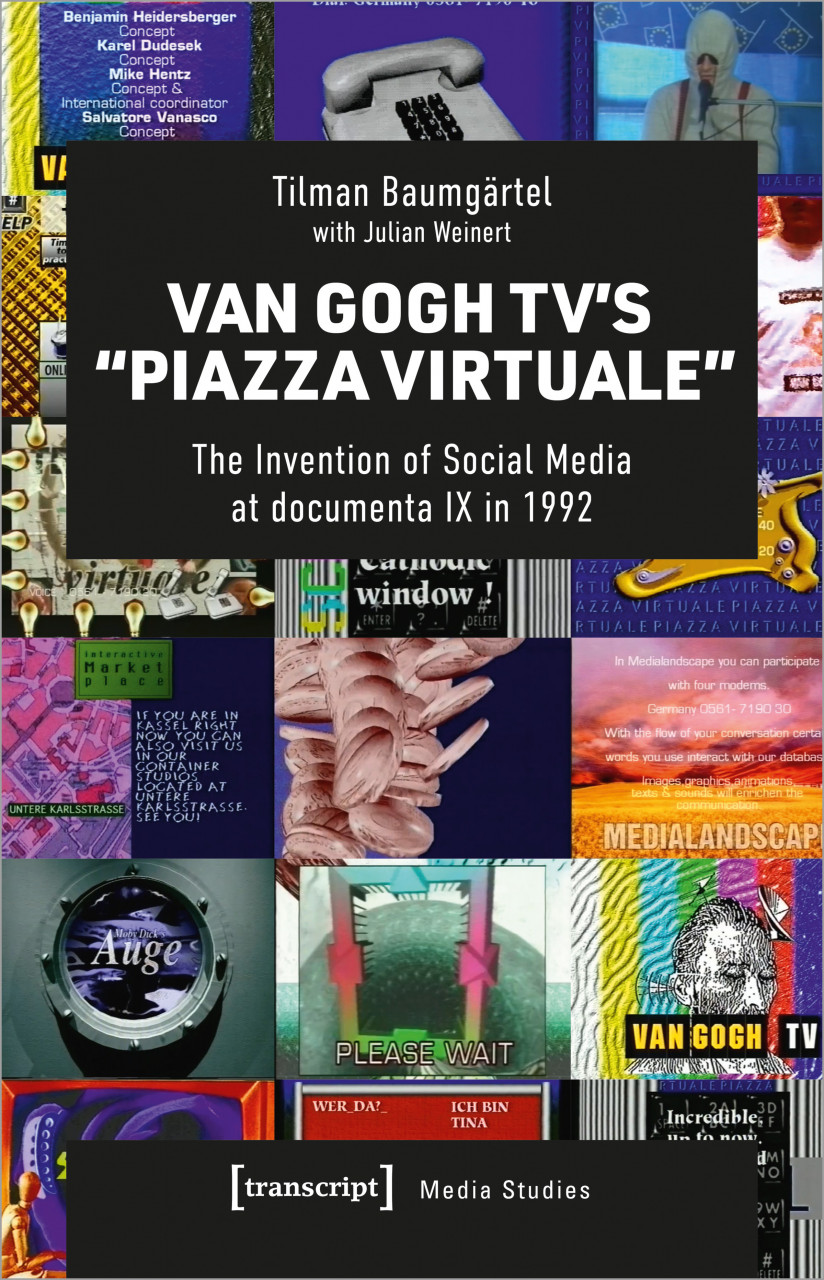
Transversal Media Practices work across specific situations of technological development, critically examining and redefining the terms of production in different media by bringing heterogeneous histories, institutions, actors and materialities into play with one another. This dissertation is all about trying out and refining the methodologies of such transversal media practices, in the end outlining a conceptual set of tools for further development.

Following the technological hype of the “digital revolution” of the mid-1990s, the field of new media studies gained popularity over a ten year period. This dissertation takes its cue from a historical turn in new media theory, and argues that it is time leave behind strict polarisations between old and new as well as analogue and digital. The study unfolds through two case-studies. The first, “The World’s Last Television Studio”, looks at tv-tv, an art and media-activist project that negotiates the sociocultural and material changes of the “old” and institutionalised mass medium of television. In the second case study, “The Art of the Overhead”, another old medium is engaged: the overhead projector – a quintessential 20th century institutional medium here presented as a device for rethinking the new through the old. The problematic of technological development, i.e. dealing with questions of how (media) technologies develop over time, forms the background to these two case studies. A key issue being how cultural and artistic practices dealing with the interaction of old and new media invite us to conceptualise technological development in new ways.

The emerging field of media archaeology is employed as a methodology in media studies and cultural production, comprising a theoretical and applied analysis of media history, materiality and practice. This transversal approach allows media archaeologists to deal with the relation between the old and the new in a non-linear way as well as to pay attention to the technical materiality of media. It is argued that the transversality of the media-archaeological approach should be seen in contrast to other conceptions of media history and technological development, such as progressivist, mono-medial and evolutionary ones. In this study, the author tries out the potential of media archaeology to reform our conception of media technologies, and eventually formulates a set of concepts for thinking and doing media archaeology as a transversal media practice. These tools are about the imaginary, residual and renewable dimensions of media technologies and are meant to assist in the opening up and intervening into processes of standardised media development.

On a general level the resulting set of tools for transversal media practices builds a bridge between theory and practice: they can be used for further research and cultural analysis where objects of study speak back to analytical concepts. At the same time these are tools for transversality that expand this form of cultural analysis in that the travelling between disciplines here also means a travelling between theory and practice. On a specific level, the tools enable this travel between theory and practice in media- and communication studies, and as such they contribute to the development of new practice-based methodologies in media research.

Doctoral dissertation in Media and Communications Studies
School of Arts and Communication, K3; Faculty of Culture and Society; Malmö University
Dissertation series in New Media, Public Spheres and Forms of Expression
Creative Commons Attribution-NonCommercial 3.0 Unported License
ISBN 9789171044815
350 pages

publisher
public defense of dissertation (17 May 2013, Malmö)
Media archaeology at Monoskop wiki (incl. source bibliography)

Download (updated on 2013-5-14)

Ben F. Laposky: Electronic Abstractions: A New Approach to Design (1953)

30 March 2013, dusan

“In 1950 American draftsman, graphic artist and mathematician Benjamin F. Laposky of Cherokee, Iowa, first used a cathode ray oscilloscope with sine wave generators and various other electrical and electronic circuits to create abstract art, which he called ‘electrical compositions’. The electrical vibrations shown on the screen of the oscilloscope, which included Lissajous figures, he recorded by still photography. Some of Laposky’s images were published in Scripta Mathematica in 1952.

In 1953 Laposky exhibited fifty images that called ‘Oscillons’ (or oscillogram designs) at the Sanford Museum in Cherokee, Iowa. To record this exhibition Laposky published an exhibition catalogue entitled electronic abstractions. Because of this exhibition Laposky is credited as the earliest pioneer in electronic art, more specifically in the analog vector medium. In later work Laposky also incorporated motorized rotating filters of variable speed to color the patterns. He never programmed computers to create images.

A version of Laposky’s electronic abstractions show was exhibited across the United States, in France at LeMons, and other places by the Cultural Relations Section of the United States from 1953 to 1961.” (source)

Self-published, Cherokee, Iowa
16 pages
via Vasulka Archive

garments inspired by Laposky’s oscillons, designed by Kim Hagelind

Download
Download (additional material, 5 pages)

Edmund Carpenter, Marshall McLuhan (eds.): Explorations in Communication: An Anthology (1960)

25 March 2013, dusan

“This book explores the form and dynamics of communication to discover how it works – how human beings exchange feelings, facts, fancy. What makes words, sentences and grammars meaningful? What is the difference between the private world of reading and the instant “togetherness” of television audiences? How does the inner structure of communication vary from society to society?

These essays by world-famed scholars and artists cover the whole range of communications media — from skin touch to voice inflection, from newsprint to electronic devices, from primitive grammars to films. Here we step outside the various media by examining one through another. Print is seen from the perspective of electronics; television is analyzed through print — and thus literacy’s role in shaping man is brought into sharp new focus.

The contemporary revolution in the packaging and distribution of ideas and feelings makes a new view of communication imperative. To give voice to such views, the journal Explorations was begun in Toronto in 1953, financed by the Ford Foundation and the Toronto Telegram. From the start, the magazine won high praise from the academic world. The articles in this book, all of which appeared in Explorations, represent some of the most original research now in print on problems that will confront us for many years to come.” (from front flap)

With contributions by Ray L. Birdwhistell, Edmund Carpenter, H. J. Chaytor, Lawrence K. Frank, Northrop Frye, Arthur Gibson, Sigfried Giedion, Stephen Gilman, Robert Graves, Stanley Edgar Hyman, Dorothy Lee, Fernand Léger, Marshall McLuhan, David Riesman, W. R. Rodgers, Gilbert Seldes, Jean Shepherd, Daisetz T. Suzuki, Jacqueline Tyrwhitt.

Publisher Beacon Press, Boston, 1960
Issue 218 of Beacon series in Contemporary Communications
210 pages
via Archive.org

google books

Download (hi-res, 181 MB, no OCR)
Download (lower res, 67 MB, OCR, via Steve McLaughlin)
other formats

Colin MacCabe: Godard: Images, Sounds, Politics (1980)

8 March 2013, dusan

Godard: Images, Sounds, Politics is an important step in making Godard’s experiments in image and sound beyond the institutions of cinema and television visible. It reads the earlier films through the more recent work, focusing on politics, technology and sexuality. These insistent themes dominate Godard’s investigation of our representation in the image, a representation always inflected by sound. These terms enable us to understand more critical the circulation of money and images in which we participate, a circulation which Godard’s work cuts across.” (from the back cover)

Includes essays by Colin MacCabe, Laura Mulvey, and Mick Eaton. Also features interviews with Godard, a filmography, and a selected bibliography. Printed in black-and-white.

With Mick Eaton and Laura Mulvey
Design Richard Hollis
Publisher The Macmillan Press, London and Basingstoke, 1980
British Film Institute Cinema series
ISBN 0333290739, 9780333290736
175 pages

review of the book’s design (Eye Magazine)

Download

Journal of Sonic Studies, Vol. 3: Rethinking Theories of Television Sound (2012)

9 February 2013, dusan

“The essays collected in this special issue of the Journal of Sonic Studies are intended to rethink the existing theories of television sound by offering a reexamination of some of the most persistent accounts of television sound from the 1980s to the present. These essays examine the technological and aesthetic changes that have accompanied the rise of new technologies, production practices, and listening perspectives over the past few decades, and they draw on a wide range of genres and categories of television sound, including commentary, voice-over, sound effects, and music soundtracks.” (from the Editorial)

Edited by Carolyn Birdsall, Anthony Enns
Publisher Leiden University Press

View online (HTML articles)
Previous two issues

New German Critique, No. 78, Special Issue on German Media Studies (1999)

18 January 2013, dusan

With texts by Michael Geisler and Michelle Mattson, Peter Humphreys, Knut Hickethier, Michael Geisler, Norbert Bolz, Siegfried Zielinski, Heidemarie Schumacher, Tom Huhn.

Edited by Michael Geisler and Michelle Mattson
Publisher Telos Press, New York, Fall 1999
196 pages

Download

New German Critique, No. 49, Special Issue on Alexander Kluge (1990)

18 January 2013, dusan

With texts by Alexander Kluge, Eric Rentschler, Timothy Corrigan, Helke Sander, Heide Schluepmann, Gertrud Koch, Richard Wolin, John Rajchman, and Marc Silberman.

Editors: David Bathrick, Helen Fehervary, Miriam Hansen, Andreas Huyssen, Anson Rabinbach, Jack Zipes
Publisher Telos Press, New York, Winter 1990
196 pages

Download

Recent comments
Recent entries
More resources