

Discourse 31(1/2): On The Genealogy of Media (2009)
Filed under journal | Tags: · media, media technology, media theory, mediality, philosophy, technology
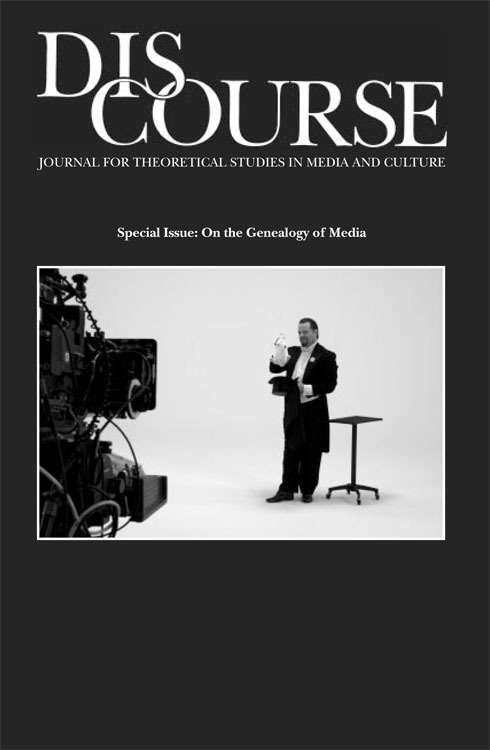
“‘On the Genealogy of Media’ invokes a tradition for thinking about technology, which passes from Nietzsche through Heidegger and Freud. As a collection on media, however, these texts gathered together in this special issue include few Nietzsche readings—or even Nietzsche references—in their thread count. Indeed, Nietzsche is not typically considered a thinker of media technologies. But his genealogical interpretation of the Mass media as being on one uncanny continuum of valuation from Christianity to nihilism influenced, together with either Freud’s or Heidegger’s input, the media essays of Walter Benjamin as much as the media oeuvre of Friedrich Kittler. Following Nietzsche, then, a genealogy of media means, as in Heidegger’s questioning of technicity, that whatever technology may be it presupposes assumption of a certain (discursive) ready positioning for (and before) its advent as actual machines to which the understanding of technologization cannot be reduced. Freudian psychoanalysis views media technologies as prosthetically modeled after body parts and partings. A primary relationship to loss (as the always-new frontier of mourning where reality, the future, the other begin or begin again) is, on Freud’s turf and terms, the psychic ready position that is there before the event or advent of machinic externalities.” (from the Introduction)
With texts by Friedrich A. Kittler, Klaus Theweleit, Craig Saper, Gregory L. Ulmer, Rebecca Comay, Laurence A. Rickels, Barbara Stiegler, Tom Cohen and Avital Ronell.
Guest Editor: Laurence A. Rickels
Publisher Wayne State University Press, 2009
ISSN 1522-5321
182 pages
via Project Muse
Journal of Visual Culture 12(3): The Archives Issue (2013)
Filed under journal | Tags: · archive, publishing, visual culture

With contributions from Shezad Dawood, Oliver Grau, Gary Hall, Chris Horrocks, Tom Holert, Juliette Kristenesen, susan pui san lok, Sas Mays, Joanne Morra, Nooney, Uriel Orlow, Hans-Ulrich Obrist, Trevor Paglen, Vivian Rehberg, Marquard Smith, and Nina Lager Vestberg.
Edited by Juliette Kristensen and Marquard Smith
ISSN 1470-4129
174 pages
PDF (updated on 2019-10-13)
Comment (0)Mind! A Unique Review (1901)
Filed under journal | Tags: · analytic philosophy, parody, philosophy, pragmatism
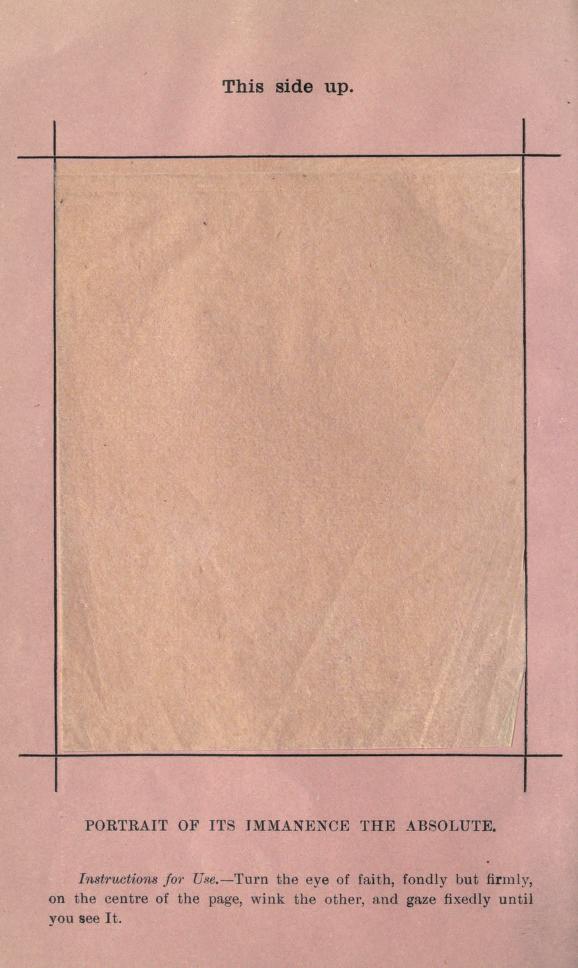
Frontispiece
The philosophical journal Mind was first published in Oxford in 1876 with George Croom Robertson as editor. Back then philosophy in Britain was under the sway of Hegelians like Thomas Hill Green. F H Bradley and J.M.E. McTaggart. In the twentieth century Mind would be the home of the new analytical school, carrying articles by G.E. Moore (like “The Refutation of Idealism” in 1903), P F Strawson, Alan Turing and John Searle.
Just as philosophy in Britain was swinging from imperially-minded idealism, to the more pragmatic and cynical scepticism of the Cold War, the journal Mind was challenged from within. ‘A. Troglodyte’ was the pseudonym under which the Anglo-German philosopher and himself the treasurer of the Mind Association from 1900 to 1936, F.C.S. Schiller (1864-1937), brought out a special issue under the title Mind!. (adapted from a commentary by Heartfield, Mute, November 2013)
Mind! is subtitled the “Special Illustrated Christmas Number”, substituting the volume 10, number 4 of Mind. At a first glance it looks exactly like the “real” periodical with same colour of wrappers and same typography, but at a second glance, all of the contents are sarcastic. There are articles like “The Critique of Pure Rot” by I. Cant; “New Platonic Dialogues. I. the “Aporia” of the “Lysis”; II. A Sequel to the “Republic”; III. “Congratulations” “; “Zur Phänomenologie des absoluten Unsinns” by Prof. Dr. G. W. Flegel; “Pholisophy’s Last Word” by I.M. Greening; or New Aphorisms of Herakleitos (like “Asses prefer the sweepings of the lecture rooms to my original researches”, “There is a way to lecture and a way not. But the drier way is better than the damper”, “There is a way to lecture and a way from lecture; and the way to and the way from are the same: it is a short cut”).
Edited by A. Troglodyte, with the cooperation of The Absolute and others
Publisher Williams and Norgate, London, 1901
141 pages
PDF (b/w version)
View online (Archive.org)