

Wolfgang Sützl, Geoff Cox (eds.): Creating Insecurity: Art and Culture in the Age of Security (2009)
Filed under book | Tags: · art, biopolitics, floss, free software, internet, knowledge, labour, open source, security, software, technology
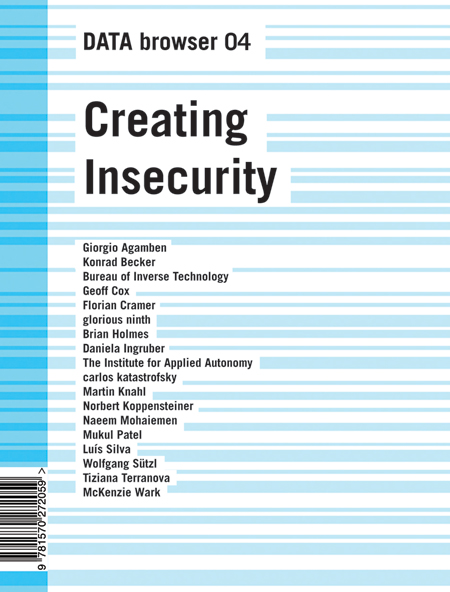
“Today we are facing extreme and most dangerous developments in the thought of security. In the course of a gradual neutralization of politics and the progressive surrender of traditional tasks of the state, security imposes itself as the basic principle of state activity. What used to be one among several decisive measures of public administration until the first half of the twentieth century, now becomes the sole criterion of political legitimation. The thought of security entails an essential risk. A state which has security as its sole task and source of legitimacy is a fragile organism; it can always be provoked by terrorism to become itself terrorist.
Following the words of Giorgio Agamben (from his 2001 article “On Security and Terror”), security has become the basic principle of international politics after 9/11, and the “sole criterion of political legitimation.” But security — reducing plural, spontaneous and surprising phenomena to a level of calculability — also seems to operate against a political legitimacy based on possibilities of dissent, and stands in clear opposition to artistic creativity. Being uncalculable by nature, art is often incompatible with the demands of security and consequently viewed as a “risk,” leading to the arrest of artists, and a neutralization of innovative environments for the sake of security.
Yet precisely the position of art outside the calculable seems to bring about a new politicization of art, and some speak of art as “politics by other means.” Has art become the last remaining enclave of a critique of violence? Yet how “risky” can art be?”
Contributions from Giorgio Agamben, Konrad Becker, Bureau of Inverse Technology, Geoff Cox, Florian Cramer, glorious ninth, Brian Holmes, carlos katastrofsky, Martin Knahl, Norbert Koppensteiner, Daniela Ingruber, The Institute for Applied Autonomy, Naeem Mohaiemen, Mukul Patel, Luis Silva, Wolfgang Sützl, Tiziana Terranova, and McKenzie Wark.
Publisher Autonomedia/I-DAT, 2009
Creative Commons license
DATA browser series, 4
ISBN 9781570272059
208 pages
PDFs (updated on 2016-12-12)
Comment (0)Rethinking Marxism: Special Issue on the Common and the Forms of the Commune (2010)
Filed under journal | Tags: · biopolitics, commons, communism, community, education, marxism, political economy, politics
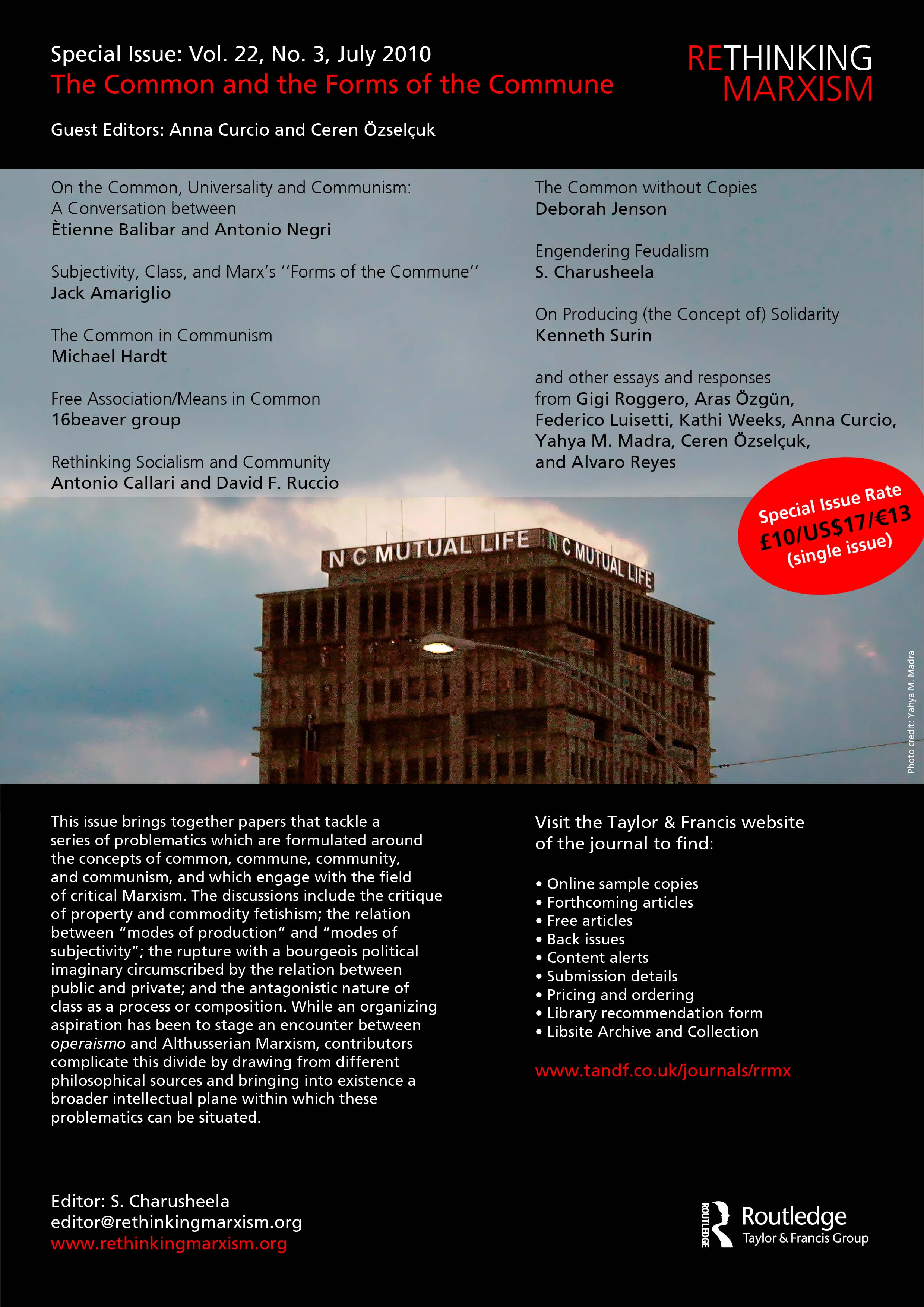
This issue brings together papers that tackle a series of problematics which are formulated around the concepts of common, commune, community, and communism, and which engage with the field of critical Marxism. The discussions include the critique of property and commodity fetishism; the relation between ‘modes of production’ and ‘modes of subjectivity’; the rupture with a bourgeois political imaginary circumscribed by the relation between public and private; and the antagonistic nature of class as a process or composition. While an organizing aspiration has been to stage an encounter between operaismo and Althusserian Marxism, contributors complicate this divide by drawing from different philosophical sources and bringing into existence a broader intellectual plane within which these problematics can be situated.
Rethinking Marxism, Volume 22, Issue 3, 2010
Editor: S. Charusheela
Guest editors: Anna Curcio and Ceren Özselçuk
more (flyer)
Comment (0)Praktyka Teoretyczna, No. 1-3 (2010-2011) [Polish]
Filed under journal | Tags: · biopolitics, commons, philosophy, society, theory

No. 2-3: Biopolityka, 2011

No. 1: Wspólnota, 2010
“Theoretical practice is what interests us most: to continuously question the relation between theory and practice. We consider the tension that arises from combining those two variant “practices” a mere source of both forms of activity: “theoretical” (philosophy, sciences) and “practical” (politics, technology, arts). Staying in a domain of broadly understood philosophy, we are attempting to develop it in correlation with the whole abundance of practices, but equally with a reference to the sciences building those practices. For us, philosophy is an element that develops all practice, but also interrupts this very theory and practice, as they exist only in a fundamental relation with their exterior (matter, life, time and space). We are interested in a possibility of enriching that philosophical element with notions and figures excluded from it, as well as reflecting upon a necessity of reinterpreting exhausted ideologies and discourses. We wish for our own teoretical practice to stay in a continuous reference with material and symbolic aspects of our existence, with time and space in which we think. We also want it not to be blind to the conditions of life in which others live.
We are aiming for a development of an ability to practice the theory: rebuilding and deconstruction of the existing theoretical vocabularies, finding new spaces for application of theorems in developing sciences, penetrating newborn inter- and transdisciplinary scientific discourses, interpretation of social and technological changes. Our objective is also to create circumstances in which young researchers, Master and Ph.D. students, could practice their theories. This offer is especially aimed at those, who are not scared to cross boundaries of disciplines they study.”
Editor-in-chief: Krystian Szadkowski
The board: Piotr Juskowiak, Agnieszka Kowalczyk, Wiktor Marzec, Mikolaj Ratajczak, Krystian Szadkowski, Maciej Szlinder, Anna Wojczyńska
Publisher: Międzywydziałowa „Pracownia Pytań Granicznych” UAM, Poznań
ISSN: 2081-8130
Published under Creative Commons 3.0 BY SA licence