

Manuel Castells: The Rise of the Network Society, 2nd ed. (2000/2009)
Filed under book | Tags: · city, economy, internet, network society, society, technology
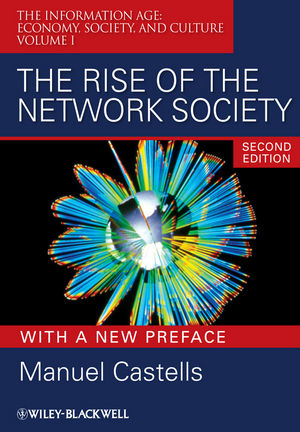
This first book in Castells’ groundbreaking trilogy, with a substantial new preface, highlights the economic and social dynamics of the information age and shows how the network society has now fully risen on a global scale.
* Groundbreaking volume on the impact of the age of information on all aspects of society
* Includes coverage of the influence of the internet and the net-economy
* Describes the accelerating pace of innovation and social transformation
* Based on research in the USA, Asia, Latin America, and Europe
2nd Edition with a New Preface
Publisher John Wiley and Sons, 2009
Volume 1 of Information Age: Economy, Society, and Culture
ISBN 1405196866, 9781405196864
Length 656 pages
Manuel Castells: End of Millennium, 2nd ed. (1998/2010)
Filed under book | Tags: · culture, economy, globalisation, labour, network society, networks, politics, society, statism

This final volume in Manuel Castells’ trilogy, with a substantial new preface, is devoted to processes of global social change induced by the transition from the old industrial society to the emerging global network society.
* Explains why China, rather than Japan, is the economic and political actor that is revolutionizing the global system
* Reflects on the contradictions of European unification, proposing the concept of the network state
* Substantial new preface assesses the validity of the theoretical construction presented in the conclusion of the trilogy, proposing some conceptual modifications in light of the observed experience
With a New Preface
Publisher Wiley-Blackwell, 2000
Volume 3 of The Information Age: Economy, Society and Culture
ISBN 1405196882, 9781405196888
488 pages
Manuel DeLanda: A New Philosophy of Society: Assemblage Theory and Social Complexity (2006)
Filed under book | Tags: · assemblage, complexity, deterritorialization, ontology, philosophy, rhizome, social theory, society, sociology

Manuel DeLanda is a distinguished writer, artist and philosopher. In his new book, he offers a fascinating look at how the contemporary world is characterized by an extraordinary social complexity. Since most social entitles, from small communities to large nation-states, would disappear altogether if human minds ceased to exist, Delanda proposes a novel approach to social ontology that asserts the autonomy of social entities from the conceptions we have of them. This highly original and important book takes the reader on a journey that starts with personal relations and climbs up one scale at a time all the way to territorial states and beyond. Only by experiencing this upward movement can we get a sense of the irreducible social complexity that characterizes the contemporary world.
Publisher Continuum International Publishing Group, 2006
ISBN 0826491693, 9780826491695
142 pages
Keywords and phrases
deterritorialization, Gilles Deleuze, Fernand Braudel, Manuel DeLanda, Thousand Plateaus, Felix Guattari, Anthony Giddens, Charles Tilly, causal, Max Weber, Ian Hacking, emergent properties, Pierre Bourdieu, nation-states, assemblage theory, economies of agglomeration, interac, phase space, linguistic, Michel Foucault
review (Steven Shaviro)
commentary from DeLanda reading group: Introduction (Levi Bryant); Chapter I (Levi Bryant); Chapter II (Alex Reid); Chapter III (Michael~); Chapter IV, part 1 & part 2 (Mark Edward); Chapter V
PDF (no OCR; updated on 2012-7-17)
Comment (0)