

Derek Jarman: Chroma: A Book of Color (1995)
Filed under book | Tags: · alchemy, art, colour, film, light
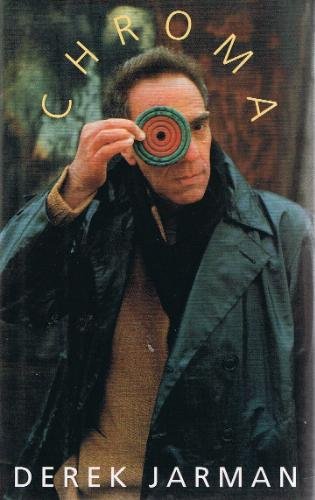
“Chroma is a meditation on the color spectrum by the celebrated late artist and filmmaker Derek Jarman. From the explosions of image and color in In The Shadow of the Sun, The Last of England, The Garden and Wittgenstein, to the somber blacks of his collages and tar paintings, Jarman has consistently used color in unprecedented ways, making his ideas on the subject of interest to filmmakers, film audiences, artists and students alike. Blue, his most personal and innovative film, consists of a compelling soundtrack accompanied by a monochrome blue image and is, among other things, a comment on Jarman’s diminishing eyesight due to AIDS. In his signature style, a lyrical combination of classical theory, anecdote, and poetry, Jarman takes the reader through the spectrum, introducing each color as an embodiment of an emotion, evoking memories or dreams. He explains the use of color in Medieval painting through the Renaissance to the modernists and draws on the great color theorists from Pliny to Leonardo. He writes too about the meanings of color in literature, science, philosophy, psychology, religion and alchemy. Read either as a work on color, or a distillation of Jarman’s artistic vision, Chroma presents an exciting perspective on the subject.”
Publisher Overlook Press, Woodstock, New York, 1995
ISBN 0879515740, 978-0879515744
151 pages
PDF (English, updated on 2018-1-30)
PDF (Russian)
Gary Indiana: Utopia’s Debris: Selected Essays (2008)
Filed under book | Tags: · architecture, art, cinema, film, literature, popular culture

Gary Indiana is one of America’s leading cultural critics—a public intellectual who has written key essays on every aspect of American culture. Utopia’s Debris comprises selections of his very best work, revealing him to be an enormously acute, frequently scabrous, and always brilliant observer of the best and worst America has to offer. His writings range from popular culture—trash novels, architectural wonders and horrors—to appreciations of the best of modern literature, art, and cinema. They include his convincing (and highly entertaining) debunking of fashionable conspiracy theories, a spirited and contrarian defense of Bill Clinton’s autobiography, a Mencken-like examination of the rise of Arnold Schwarzenegger and the politics of celebrity in what Indiana calls the Age of Contempt. A postmodern Emerson, Indiana wields scalpel-sharp wit and a fealty to logic on issues in which, all too often, irrationalism and emotionalism hold sway. At times rigorously serious, at other times whimsical, Indiana’s most conspicuous feature is skepticism—his wildly satirical contempt for conventional wisdom.
Publisher Basic Books, 2008
ISBN 046500248X, 9780465002481
315 pages
Alexander Kluge: Raw Materials for the Imagination (2012)
Filed under book | Tags: · art, cinema, documentary film, experimental film, film, film theory, opera, politics, public sphere, television

“Alexander Kluge is best known as a founding member of the New German Cinema. His work, however, spans a diverse range of fields and, over the last fifty years, he has been active as a filmmaker, writer and television producer. This book – the first of its kind in English – comprises a wide selection of texts, including articles and stories by Kluge, television transcripts, critical essays by renowned international scholars, and interviews with Kluge himself. It will be a valuable resource for students and scholars in the fields of film, television, and literary studies, as well as those interested in exploring the intersections between art, politics, and social change.”
Edited by Tara Forrest
Publisher Amsterdam University Press, 2012
Film Culture in Transition series
Creative Commons BY-NC-ND 3.0 License
ISBN 9089642722, 9789089642721
440 pages
PDF (15 MB)
Comment (0)