

Marie-Françoise Plissart, Jacques Derrida: Droit de regards (1985)
Filed under book | Tags: · philosophy, photography

Fin du siècle dernier. Dans des décors princiers, dont les ruines sont devenues des théâtres fragiles, des femmes s”aiment, se poursuivent et se perdent. Dans les parcs, au bout des couloirs et sous les lustres fanés, des scènes troublantes s”entrecroisent. Autant d”énigmes que chaque regard — le vôtre – peut résoudre — ou pas. Droit de regards se lit comme de la poésie: littéralement et dans tous les sens. Le roman-photo est suivi d”une lecture de Jacques Derrida, qui en prolonge les multiples ramifications.
Photography by Marie-Françoise Plissart
Script and montage by Benoît Peeters and Marie-Françoise Plissart
Essay by Jacques Derrida
Publisher Minuit, Paris, 1985
ISBN 2707310190, 9782707310194
99 + 36 pages
via Scripted
Commentary (Alexandra Koeniguer, Textyles, 2011, in French)
PDF (139 MB)
Comment (0)Benjamin Noys: Malign Velocities: Accelerationism and Capitalism (2014)
Filed under book | Tags: · accelerationism, capitalism, communism, cyberpunk, futurism, labour, machine, marxism, movement, philosophy, speed, technology
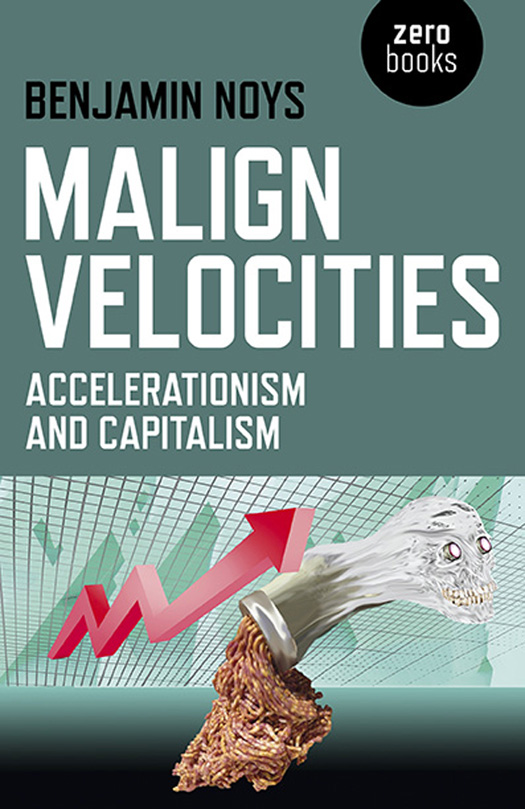
“We are told our lives are too fast, subject to the accelerating demand that we innovate more, work more, enjoy more, produce more, and consume more. That’s one familiar story. Another, stranger, story is told here: of those who think we haven’t gone fast enough. Instead of rejecting the increasing tempo of capitalist production they argue that we should embrace and accelerate it. Rejecting this conclusion, Malign Velocities tracks this ‘accelerationism‘ as the symptom of the misery and pain of labour under capitalism. Retracing a series of historical moments of accelerationism – the Italian Futurism; communist accelerationism after the Russian Revolution; the ‘cyberpunk phuturism’ of the ’90s and ’00s; the unconscious fantasies of our integration with machines; the apocalyptic accelerationism of the post-2008 moment of crisis; and the terminal moment of negative accelerationism – suggests the pleasures and pains of speed signal the need to disengage, negate, and develop a new politics that truly challenges the supposed pleasures of speed.”
Publisher Zero Books, 2014
ISBN 1782793003, 9781782793007
130 pages
EPUB, EPUB (updated on 2019-6-9)
Comment (0)Plato: The Republic (c380-360 BCE–)
Filed under book | Tags: · democracy, governance, justice, law, philosophy, politics
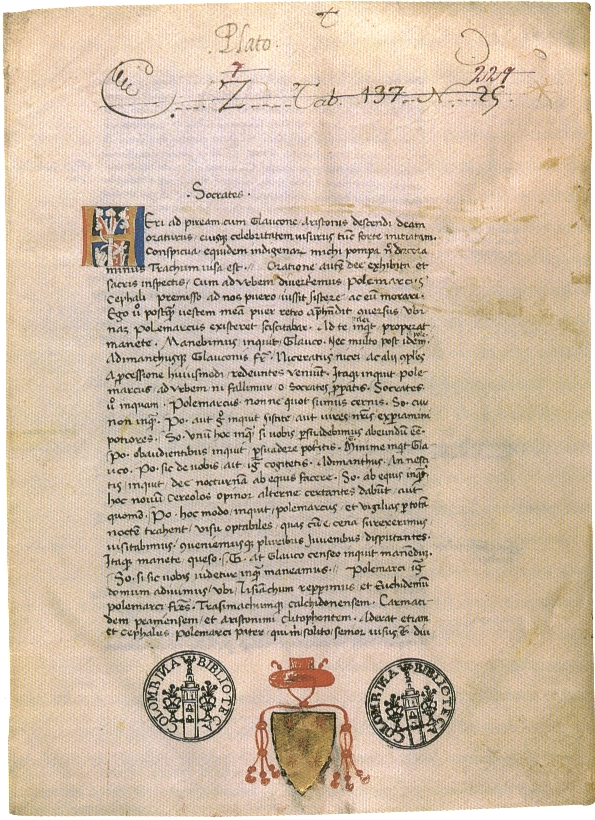
The Republic (Περὶ πολιτείας; Peri politeias) is Plato’s best-known work and has proven to be one of the most intellectually and historically influential works of philosophy and political theory. In it, Socrates along with various Athenians and foreigners discuss the meaning of justice and examine whether or not the just man is happier than the unjust man by considering a series of different cities coming into existence “in speech”, culminating in a city (Kallipolis) ruled by philosopher-kings; and by examining the nature of existing regimes. The participants also discuss the theory of forms, the immortality of the soul, and the roles of the philosopher and of poetics in society.
Passages, manuscripts, editions, translations and studies (Monoskop wiki)
Comment (0)