

John Mullarkey: Refractions of Reality: Philosophy and the Moving Image (2009)
Filed under book | Tags: · cognition, film, film theory, non-philosophy, ontology, philosophy, philosophy of film

Why is film becoming increasingly important to philosophers? Is it because it can be a helpful tool in teaching philosophy, in illustrating it? Or is it because film can also think for itself, can create its own philosophy? Indeed many film-philosophers claim that film does more than merely illustrate philosophical texts: rather, film itself can philosophize in direct audio-visual terms. Too often, however, when philosophers claim to find indigenous philosophical value in cinema, it is only on account of refracting it through their own thought: film philosophizes because it accords with a favoured kind of extant philosophy.
Refractions of Reality: Philosophy and the Moving Image is the first book to examine all the central issues surrounding the vexed relationship between the film-image and philosophy. In it, John Mullarkey tackles the work of particular philosophers and theorists (Žižek, Deleuze, Cavell, Bordwell, Badiou, Branigan, Rancière, Frampton, and many others) as well as general philosophical positions (Analytical and Continental, Cognitivist and Culturalist, Psychoanalytic and Phenomenological). Moreover, he also offers an incisive analysis and explanation of several prominent forms of film theorizing, providing a meta logical account of their mutual advantages and deficiencies that will prove immensely useful to anyone interested in the details of particular theories of film presently circulating, as well as correcting, revising, and re-visioning the field of film theory as a whole.
Throughout, Mullarkey asks whether the reduction of film to text is unavoidable. In particular: must philosophy (and theory) always transform film into pre-texts for illustration? What would it take to imagine how film might itself theorise without reducing it to standard forms of thought and philosophy? Finally, and fundamentally, must we change our definition of philosophy and even of thought itself in order to accommodate the specificities that come with the claim that film can produce philosophical theory?
Publisher Palgrave Macmillan, 2009
ISBN 0230002471, 9780230002470
282 pages
Gal Kirn, Dubravka Sekulić, Žiga Testen (eds.): Surfing the Black: Yugoslav Black Wave Cinema and Its Transgressive Moments (2012)
Filed under book | Tags: · 1960s, 1970s, cinema, film, film history, film theory, yugoslavia
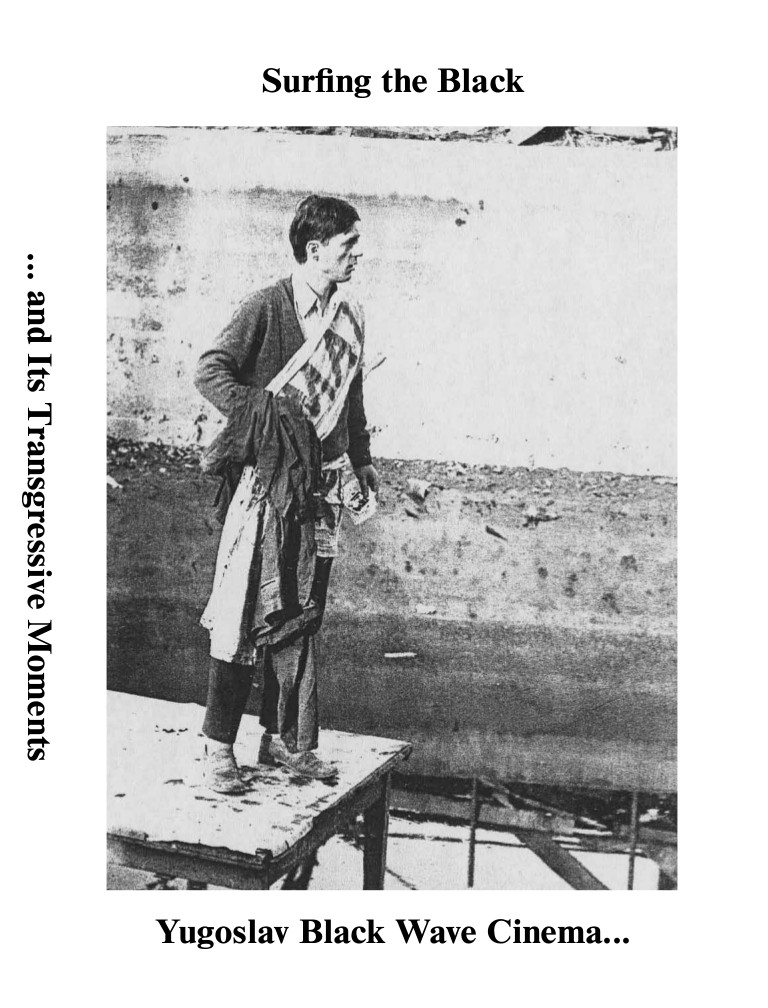
The Yugoslav black wave cinema of the sixties and the seventies is one of the grand, though hidden, chapters of cinema history. Talented young authors, working under the sign of individual expression and aesthetic experimentation, pushed and explored the limits of the constraints of a socialist state. Their efforts lead to a new path of visual expression, so outstanding by its social and political engagement, its formal invention and its courage.
This book is the result of a multi-disciplinary research attempting to cross over politics, philosophy, design, art, architecture, and some speculative thinking. Starting from archival work, interviews, seminars, screenings and a conference, Surfing the Black has found its (temporary) conclusion in a publication consisting of six theoretical essays and three fanzines that open up the black wave film experience to current affairs. This is Yugoslavia, and modern cinema, at its blackest and brightest.
With six theoretical essays (by Boris Buden, Pavle Levi and Owen Hatherly, among others) and fanzines comprising an interview with one of the most important Yugoslav filmmakers, Želimir Žilnik, and a comprehensive glossary of terms that belong to the period and field of Yugoslav culture and politics, this is the first book on the subject in the English-speaking world.
With contributions by Sezgin Boynik, Boris Buden, Mladen Dolar, Owen Hatherly, Ana Janevski, Gal Kirn, Pavle Levi, Nicholas Matranga, Peter Rauch, Dubravka Sekulić, Žiga Testen and Samo Tomšič.
Edited by Gal Kirn, Dubravka Sekulić and Žiga Testen
Publisher Jan van Eyck Academie, Maastricht, The Netherlands
ISBN 9072076516, 9789072076472
216 pages
PDF (updated on 2012-9-4)
Comment (0)Shelley Rice (ed.): Inverted Odysseys: Claude Cahun, Maya Deren, Cindy Sherman (1999)
Filed under book | Tags: · art, art history, film, literature, self

Claude Cahun, Maya Deren, and Cindy Sherman were born in different countries, in different generations—Cahun in France in 1894, Deren in Russia in 1917, and Sherman in the United States in 1954. Yet they share a deeply theatrical obsession that shatters any notion of a unified self. All three try out identities from different social classes and geographic environments, extend their temporal range into the past and future, and transform themselves into heroes and villains, mythological creatures, and sex goddesses. The premise of Inverted Odysseys is that this expanded concept of the self—this playful urge to “try on” other roles-is more than a feminist or psychological issue. It is central to our global culture, to our definition of human identity in a world where the individual exists in a multicultural and multitemporal environment. This book is an “odyssey” through historical, theoretical, critical, and literary perspectives on the three artists viewed in the context of these issues. Contributors include Lynn Gumpert, Lucy Lippard, Jonas Mekas, Ted Mooney, Shelley Rice, and Abigail Solomon-Godeau.
Central to the book is Claude Cahun’s “Heroines” manuscript, a series of fifteen stream-of-consciousness monologues written in the voices of major women of literature and history, such as the Virgin Mary, Sappho, Cinderella, Penelope, Delilah, and Helen of Troy. Translated by Norman MacAfee, these perverse and hilarious vignettes make their English-language debut here. This is also the first time that Cahun’s text has appeared in its entirety.
The book accompanies an exhibit cocurated by Lynn Gumpert and Shelley Rice at the Grey Art Gallery, New York University.
Publisher MIT Press, in cooperation with the Grey Art Gallery, New York University, 1999
ISBN 0262681064, 9780262681063
168 pages