

Chris Kraus, Sylvère Lotringer (eds.): Hatred of Capitalism: A Reader (2001)
Filed under book | Tags: · activism, capitalism, cultural resistance, philosophy, subjectivity, theory
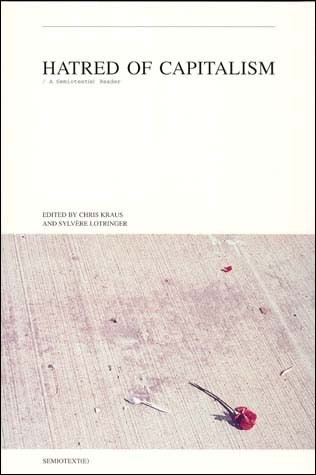
“Compiled in 2001 to commemorate the passing of an era, Hatred of Capitalism brings together highlights of Semiotext(e)’s most beloved and prescient works. Founded by French theorist and critic Sylvère Lotringer as a scholarly journal in 1974, Semiotext(e) quickly took on the mission of melding French theory with the American art world and punk underground. Its Foreign Agents, Native Agents, Active Agents and Double Agents imprints have brought together thinkers and writers as diverse as Gilles Deleuze, Assata Shakur, Bob Flanagan, Paul Virillio, Kate Millet, Jean Baudrillard, Michelle Tea, William S. Burroughs, Eileen Myles, Ulrike Meinhof, and Fanny Howe. In Hatred of Capitalism, editors Kraus and Lotringer bring these people together in the same volume for the first time.”
Assistant editors: Shannon Durbin and Tessa Laird
Publisher Semiotext(e), Los Angeles, 2001
Double Agents series
ISBN 1584350121, 9781584350125
421 pages
Review: Brian Dillon (Mute, 2002).
Interview with editor (Leo Edelstein, Log, 2001).
PDF (12 MB, updated on 2019-2-25)
Comment (0)Turbulence journal 1-5 (2007-2009)
Filed under journal | Tags: · activism, capitalism, climate crisis, neoliberalism, networks, politics
Turbulence is a journal/newspaper that we hope will become an ongoing space in which to think through, debate and articulate the political, social, economic and cultural theories of our movements, as well as the networks of diverse practices and alternatives that surround them.

What would it mean to win?
Turbulence 1, 2007
The Turbulence collective produced 7,000 copies of a free 32-page newspaper distributed at the camps, blockades and alternative summits that made up the mobilisation against the G8 summit in Heiligendamm in June 2007. The theme of the 14 articles from individuals and groups from across the world tackled the difficult question of ‘What would it mean to win?’.
PDF (original tabloid format, 289 x 380mm)
PDF (journal format, 152 x 229mm)
Move into the light?
Turbulence 3, December 2007
6,000 copies were printed in English, with a further 4,000 in German.
PDF (A6 booklet)
PDF (German version)
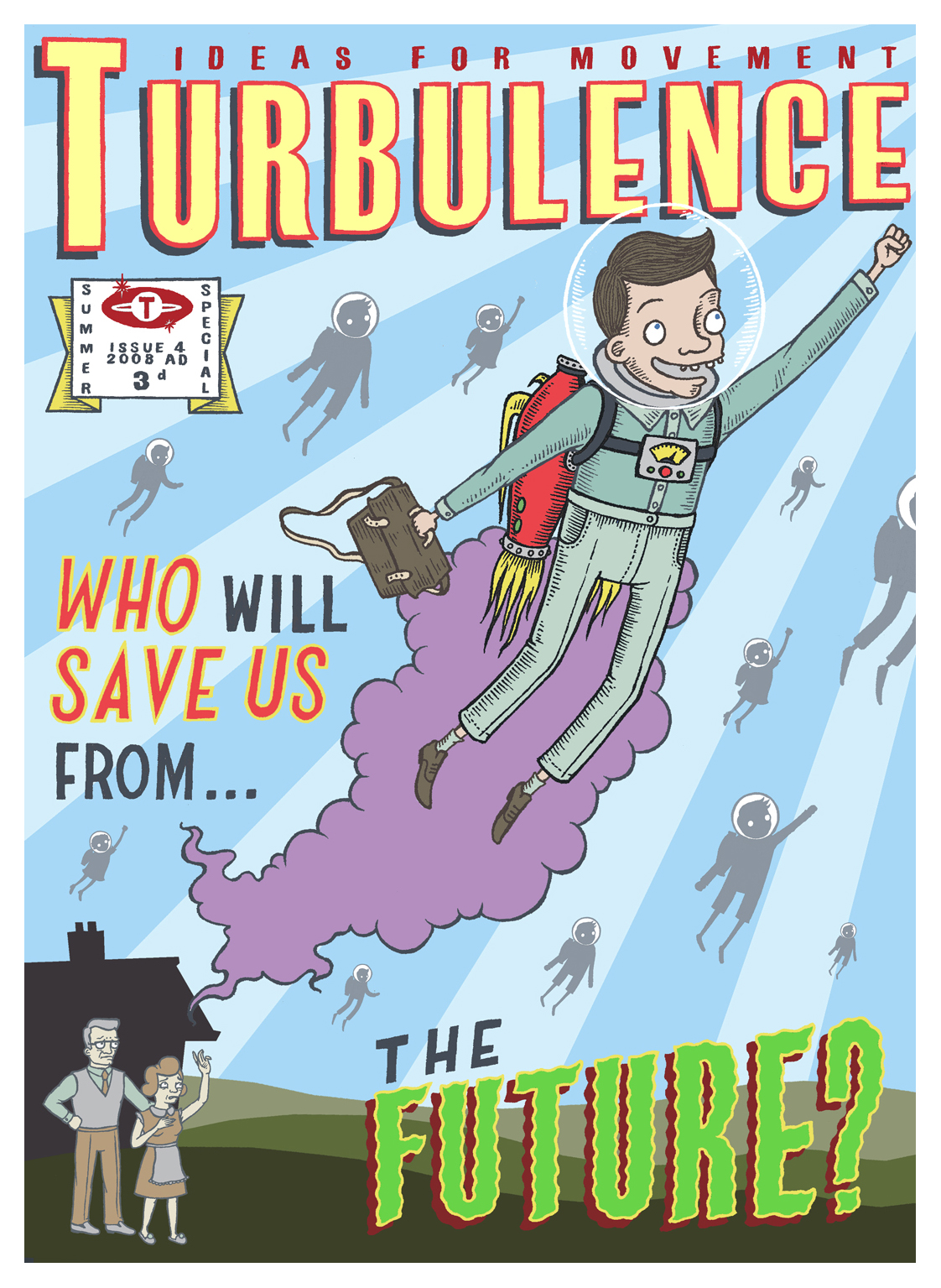
Who can save us from the future?
Turbulence 4, Summer 2008
Today, the very act of thinking about the future has become a problem. What both capitalism and ‘really existing socialism’ had in common was the belief in a future where infinite happiness would spring from the infinite expansion of production: sacrifices made in the present could always be justified in terms of a brighter future. And now? The socialist future has been dead since the fall of the Berlin wall. After that we seemed to live in a world where only the capitalist future existed (even when it was under attack). But now this future, too, is having its obituaries composed, and impending doom is the talk of the town. The ‘crisis of the future’ – that is, of our capacity to think about the future – is born out of these twin deaths: today it is easier to imagine the end of the world than the end of capitalism.

And Now for Something Completely Different?
Turbulence 5, December 2009
Until recently, anyone who suggested nationalising the banks would have been derided as a ‘quack’ and a ‘crank’, as lacking the most basic understanding of the functioning of a ‘complex, globalised world’. The grip of ‘orthodoxy’ disqualified the idea, and many more, without the need even to offer a counter-argument.
And yet, in this time of intersecting crises, when it seems like everything could, and should, have changed, it paradoxically feels as though very little has. Individuals and companies have hunkered down to try and ride out the crisis. Nationalisations and government spending have been used to prevent change, not initiate it. Anger and protest have erupted around different aspects of the crises, but no common or consistent reaction has seemed able to cohere. We appear unable to move on.
For many years, social movements could meet and recognise one another on the common ground of rejecting neoliberalism, society’s old middle ground – those discources and practices that defined the centre of the political field. The crisis of the middle has meant a crumbling of the common.
And what now? Will neoliberalism continue to stumble on without direction, zombie-like? Or, is it time for something completely different?
Comment (0)Michael Hardt, Antonio Negri: Multitude: War and Democracy in the Age of Empire (2004)
Filed under book | Tags: · activism, biopolitics, capitalism, commons, democracy, empire, multitude, politics, war

The world-renowned authors of the international best-seller “Empire” follow with an astonishing, politically energizing manifesto that argues that some of the most troubling aspects of the new world order contain the seeds of radical global social transformation.
With “Empire,” Michael Hardt and Antonio Negri established themselves as visionary theoreticians of the new global order. They presented a profound new vision of a world in which the old system of nation-states has surrendered much of its hegemony to a supranational, multidimensional network of power they call empire. Empire penetrates into more aspects of life over more of the world than any traditional empire before it, and it cannot be beheaded for it is multinoded. The network is the empire and the empire is the network.
Now, in “Multitude,” Hardt and Negri offer up an inspiring vision of how the people of the world can use the structures of empire against empire itself. With the enormous intellectual depth, historical perspective, and positive, enabling spirit that are the authors’ hallmark, “Multitude” lays down in three parts a powerful case for hope. Part I, “War,” examines the darkest aspects of empire. We are at a crisis point in human affairs, when the new circuits of power have grown beyond the ability of existing circuits of political sovereignty and social justice to contain them. A mind-set of perpetual war predominates in which all wars are police actions and all police actions are wars-counterinsurgencies against the enemies of empire. In Part II, the book’s central section, “Multitude,” they explain how empire, by colonizing and interconnecting more areas of human life ever more deeply, has actuallycreated the possibility for democracy of a sort never before seen. Brought together in a multinoded commons of resistance, different groups combine and recombine in fluid new matrices of resistance. No longer the silent, oppressed “masses,” they form a multitude. Hardt and Negri argue that the accelerating integration of economic, social, political, and cultural forces into a complex network they call the biopolitical is actually the most radical step in the liberation of humankind since the Industrial Revolution broke up the old feudal order. Finally, in “Democracy,” the authors put forward their agenda for how the global multitude can form a robust biopolitical commons in which democracy can truly thrive on a global scale. Exhilarating in its ambition, range, and depth of interpretive insight, “Multitude” consolidates Michael Hardt and Antonio Negri’s stature as the most exciting and important political philosophers at work in the world today.
Publisher Penguin Press, 2004
ISBN 1594200246, 9781594200243
427 pages
review (Tom Nairn, London Review of Books)
review (Eric Mason, Multitudes)
review (Thomas N Hale and Anne-Marie Slaughter, openDemocracy)
review (Bruce Robbins, n+1)
review (John Giuffo, Village Voice)
review (Nicholas Spencer, Electronic Book Review)
wikipedia
publisher
google books
PDF (updated on 2012-7-27)
Comment (0)