
Francesco Cangiullo: Piedigrotta (1916) [Italian]
Filed under artist publishing | Tags: · futurism, poetry, visual poetry
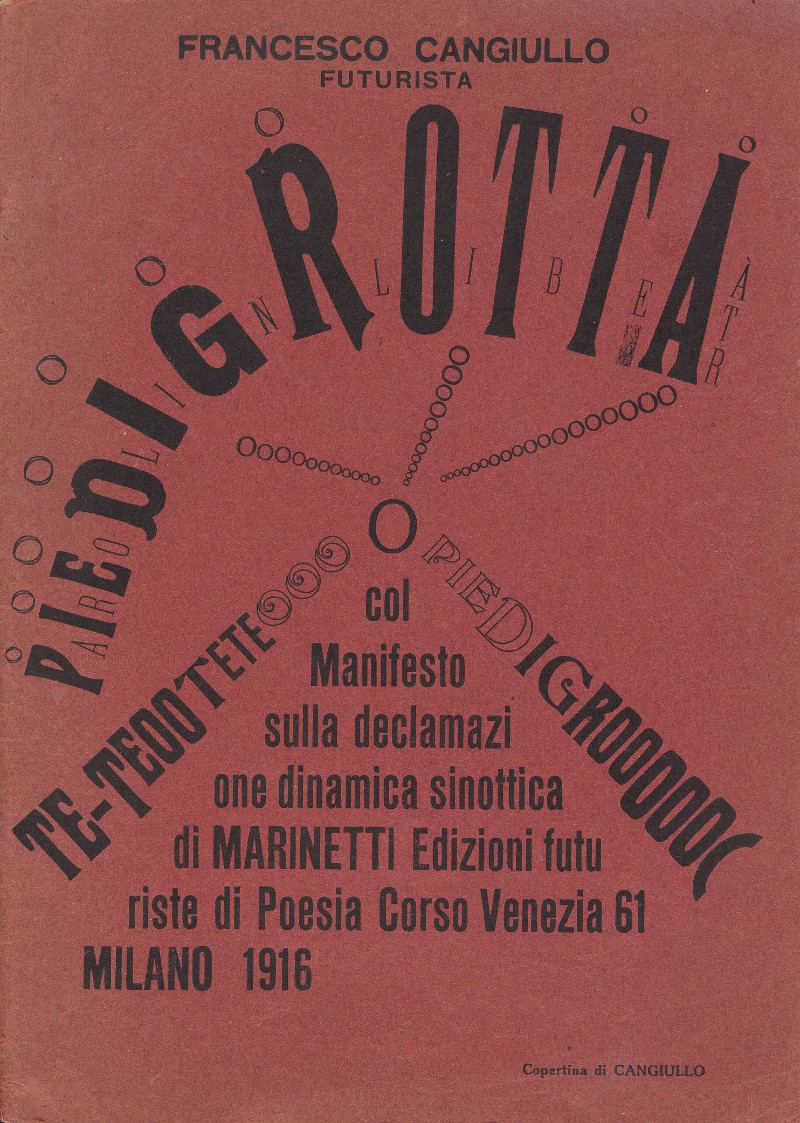
“Francesco Cangiullo, from Naples, was essentially a comedian; his theatrical attitude towards life that turned whatever he did into a performance. For this reason, Cangiullo could have equally well been a Futurist, a Dadaist, or a Surrealist. Indeed, in 1916, Cangiullo’s writings were published on the pages of the Zurich Dadaist journal Cabaret Voltaire. This volume featured many “words-in-freedom” of hilarious and ludic tone, with a dramatic and almost surrealistic bend. Cangiullo’s Piedigrotta: Manifesto on the Dynamic and Synoptic Declamation theorizes a kind of robotic and syncopated declamation.
The title and cover illustration, Piedigrotta, come from an annual Naples folk tradition, a pyrotechnic feast with extraordinary fireworks. These elements suggest the explosive thrust of Mt. Vesuvius, the volcano that stands over the gulf of Naples. Futurist evenings were also explosive. Originally introduced as literary and artistic evenings, they often turned into riots with people fighting, screaming and throwing all kinds of objects onto the stage. Cangiullo’s Piedigrotta features both explosive content and form.” (Source)
Piedigrotta: col manifesto sulla declamazi one dinamica sinottica
Publisher Edizioni Futuriste di Poesia, Milan, 1916
28 pages
via Beinecke Rare Book & Manuscript Library
Commentary: Mladen Ovadija (2013).
PDF (127 MB)
Comment (0)John Cage: M: Writings ’67-’72 (1973)
Filed under poetry | Tags: · visual poetry

62 word drawings by John Cage. Mainly mesostics inspired by music, mushrooms, Marcel Duchamp, Merce Cunningham, Marshall McCluhan, etc. and includes “Mureau”-composed from the writings of Henry David Thoreau.
Publisher Wesleyan University Press, 1973
ISBN 0891560359
217 pages
via Headphonetones
Alan Riddell (ed.): Typewriter Art (1975)
Filed under book | Tags: · art, concrete poetry, poetry, typewriter, visual poetry

In this dazzling “tribute to the typewriter and its particular qualities,” Alan Riddell compiled 119 works by 65 practitioners from 18 countries. The opening pages are devoted to three pioneers of the 1920s — Hendrik Nicolaas Werkman, Pietro de Saga (the pseudonym of Stefi Kiesler, wife of the Austrian architect Friedrich Kiesler) and an unidentified Bauhaus student of Josef Albers’. They are followed by ‘typewriter art’, concrete poems and typewritten constructivist, systems art, op and gestural abstraction works by Stefan Themerson, Dom Sylvester Houédard, Paula Claire, Richard Kostelanetz, Jiří Kolář, Jiří Valoch, Josef Hiršal, Václav Havel, Henri Chopin, Tom Edmonds, Steve McCaffery and others. The book is a follow-up to the catalogue Typewriter Art, Half a Century of Experiment published in two editions for the exhibitions in Edinburgh, 1973, and London, 1974.
Edited and with an Introduction by Alan Riddell
Publisher London Magazine Editions, London, 1975
ISBN 900626992
157 pages
via Lori Emerson, HT Derek Holzer
PDF (33 MB)
Internet Archive (high resolution, added on 2018-12-27)