

Peter Sloterdijk: The Art of Philosophy: Wisdom as a Practice (2010/2012)
Filed under book | Tags: · asceticism, epistemology, phenomenology, philosophy, theory

In his best-selling book You Must Change Your Life, Peter Sloterdijk argued exercise and practice were crucial to the human condition. In The Art of Philosophy, he extends this critique to academic science and scholarship, casting the training processes of academic study as key to the production of sophisticated thought. Infused with humor and provocative insight, The Art of Philosophy further integrates philosophy and human existence, richly detailing the foundations of this relationship and its transformative role in making the postmodern self.
Sloterdijk begins with Plato’s description of Socrates, whose internal monologues were so absorbing they often rooted the philosopher in place. The original academy, Sloterdijk argues, taught scholars to lose themselves in thought, and today’s universities continue this tradition by offering scope for Plato’s “accommodations for absences.” By training scholars to practice thinking as an occupation transcending daily time and space, universities create the environment in which thought makes wisdom possible. Traversing the history of asceticism, the concept of suspended animation, and the theory of the neutral observer, Sloterdijk traces the evolution of philosophical practice from ancient times to today, showing how scholars can remain true to the tradition of “the examined life” even when the temporal dimension no longer corresponds to the eternal. Building on the work of Husserl, Heidegger, Nietzsche, Arendt, and other practitioners of the life of theory, Sloterdijk launches a posthumanist defense of philosophical inquiry and its everyday, therapeutic value.
Originally published as Scheintod im Denken, Suhrkamp Verlag, Berlin, 2010
Translated by Karen Margolis
Publisher Columbia University Press, New York, 2012
ISBN 0231158718, 9780231158718
107 pages
PDF (EPUB)
Comment (1)Paul Feyerabend: Against Method (1975–) [EN, ES]
Filed under book | Tags: · anarchism, epistemology, history of science, knowledge, philosophy of science, science

Beyond Popper and Kuhn to an anarchist philosophy of science.
Paul Feyerabend’s globally acclaimed work, which sparked and continues to stimulate fierce debate, examines the deficiencies of many widespread ideas about scientific progress and the nature of knowledge. Feyerabend argues that scientific advances can only be understood in a historical context. He looks at the way the philosophy of science has consistently overemphasized practice over method, and considers the possibility that anarchism could replace rationalism in the theory of knowledge.
First published by New Left Books, 1975
Publisher Verso, London/New York, 1993
ISBN 0860916464, 9780860916468
279 pages
wikipedia (EN)
publisher (EN, 2010 edition)
google books (EN)
Against Method (English, Third edition, 1975/1993)
Against Method (English, original manuscript, no OCR)
Tratado contra el metodo: Esquema de una teoria anarquista del conocimiento (Spanish).pdf (Spanish, trans. Diego Ribes, 1986, added on 2013-9-26)
Steven Shapin, Simon Schaffer: Leviathan and the Air-Pump: Hobbes, Boyle, and the Experimental Life (1985)
Filed under book | Tags: · air, epistemology, experiment, history of science, knowledge, metaphysics, natural philosophy, philosophy, physics, pneumatics, science
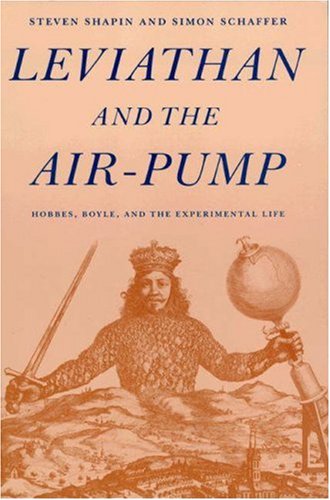
“In the aftermath of the English Civil War, as people were groping for new forms of political order, Robert Boyle built an air-pump to do experiments. Does the story of Roundheads and Restoration have something to do with the origins of experimental science? Schaffer and Shapin believed it does.
Focusing on the debates between Boyle and his archcritic Thomas Hobbes over the air-pump, the authors proposed that ‘solutions to the problem of knowledge are solutions to the problem of social order.’ Both Boyle and Hobbes were looking for ways of establishing knowledge that did not decay into ad hominem attacks and political division. Boyle proposed the experiment as cure. He argued that facts should be manufactured by machines like the air-pump so that gentlemen could witness the experiments and produce knowledge that everyone agreed on. Hobbes, by contrast, looked for natural law and viewed experiments as the artificial, unreliable products of an exclusive guild.
The new approaches taken in Leviathan and the Air-Pump have been enormously influential on historical studies of science. Shapin and Schaffer found a moment of scientific revolution and showed how key scientific givens–facts, interpretations, experiment, truth–were fundamental to a new political order. Shapin and Schaffer were also innovative in their ethnographic approach. Attempting to understand the work habits, rituals, and social structures of a remote, unfamiliar group, they argued that politics were tied up in what scientists did, rather than what they said.”
Including a Translation of Thomas Hobbes’ Dialogus Physicus de Natura Aeris by Simon Schaffer
Publisher Princeton University Press, 1985
ISBN 0691083932, 9780691083933
xiv+440 pages
Reviews: Richard C. Jennings (British Journal for Philosophy of Science), Anna Marie Roos (H-Ideas), Richard Tuck (London Review of Books), J.L. Heilbron (Medical History), Katherine Pandora (UCLA Historical Journal), Aloysius Martinich (Journal of the History of Philosophy), Bruno Latour (Studies in the History and Philosophy of Science), P.B. Wood (History of Science), David Oldroyd (Social Epistemology, reply by William Lynch, reply by Oldroyd), Robert Kargon (Albion), I. Bernard Cohen (American Historical Review), Lawrence Busch (Science & Technology Studies), Mordechai Feingold (English Historical Review), Margaret C. Jacob (Isis), Owen Hannaway (Technology and Culture), Ian Hacking (British Journal for the History of Sciences), James G. Traynham (Journal of Interdisciplinary History), Richard S. Westfall (Philosophy of Science).
PDF
See also Introduction to 2011 edition.