

Benedict de Spinoza: A Spinoza Reader: The Ethics and Other Works (1994)
Filed under book | Tags: · ethics, philosophy, religion, science
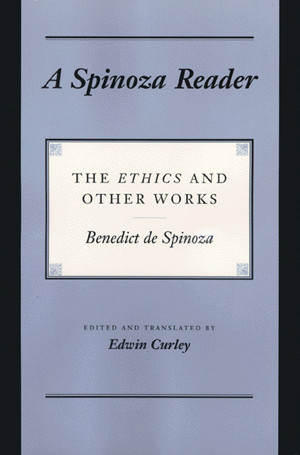
“This anthology of the work of Baruch de Spinoza (1632-1677) presents the text of Spinoza’s masterwork, the Ethics, in what is now the standard translation by Edwin Curley. Also included are selections from other works by Spinoza, chosen by Curley to make the Ethics easier to understand, and a substantial introduction that gives an overview of Spinoza’s life and the main themes of his philosophy. Perfect for course use, the Spinoza Reader is a practical tool with which to approach one of the world’s greatest but most difficult thinkers, a passionate seeker of the truth who has been viewed by some as an atheist and by others as a religious mystic.
The anthology begins with the opening section of the Treatise on the Emendation of the Intellect, which has always moved readers by its description of the young Spinoza’s spiritual quest, his dissatisfaction with the things people ordinarily strive for–wealth, honor, and sensual pleasure–and his hope that the pursuit of knowledge would lead him to discover the true good. The emphasis throughout these selections is on metaphysical, epistemological, and religious issues: the existence and nature of God, his relation to the world, the nature of the human mind and its relation to the body, and the theory of demonstration, axioms, and definitions. For each of these topics, the editor supplements the rigorous discussions in the Ethics with informal treatments from Spinoza’s other works.”
Edited and translated by Edwin M. Curley
Publisher Princeton University Press, 1994
ISBN 0691000670, 9780691000671
280 pages
PDF (11 MB, updated on 2021-6-23)
Comments (2)#public_life: Digitale Intimität, die Privatsphäre und das Netz (2011) [German]
Filed under book | Tags: · democracy, internet, intimacy, networks, privacy, public sphere, web, web 2.0

Immer mehr Menschen äußern sich im Internet nicht nur zu politischen Fragen, sondern auch zu ihrem Konsumverhalten oder ihren sexuellen Vorlieben, sie zeigen das Innere und Äußere ihrer Wohnung, lassen uns an den kleinen und großen Dingen ihres Lebens teilhaben. Gleichzeitig wird es durch die entsprechende Software immer leichter, Nutzerprofile zu erstellen, die den Menschen durchsichtig machen und marktförmig. So oder so: Die Grenzen zwischen dem Privaten und dem Öffentlichen verschwimmen, die Sphären durchdringen einander. Bleiben bei diesem Prozess die Persönlichkeitsrechte und das Politische auf der Strecke?
Die Beiträge im vorliegenden Sammelband #public_life untersuchen vor dem Hintergrund der digitalen Drift die Bedeutung von Privatheit und Öffentlichkeit heute. Die Gegensätzlichkeit der Positionen, die an Privatsphäre und Kontrollanspruch festhalten oder das Zeitalter von Post-Privacy ausrufen, scheuen sie dabei nicht.
Mit Beiträgen u. a. von Clive Thompson, Danah Boyd, Helen Nissenbaum, Daniel J. Solove, Malte Spitz, M. Ryan Calo, Francesca Schmidt, Jan Schallaböck und Michael Seemann.
Editor: Simon Edwin Dittrich
Publisher: Heinrich-Böll-Stiftung, Berlin, April 2011
Schriften zu Bildung und Kultur series, Nr. 8
ISBN 978-3-86928-052-3
128 pages
Licensed under Creative Commons License BY-NC-ND 3.0 DE
Lisa Gitelman, Geoffrey B. Pingree (eds.): New Media, 1740-1915 (2003)
Filed under book | Tags: · history of technology, media, media archeology, media history, new media, phonograph, stereoscope, telephone

Reminding us that all media were once new, this book challenges the notion that to study new media is to study exclusively today’s new media. Examining a variety of media in their historic contexts, it explores those moments of transition when new media were not yet fully defined and their significance was still in flux. Examples range from familiar devices such as the telephone and phonograph to unfamiliar curiosities such as the physiognotrace and the zograscope. Moving beyond the story of technological innovation, the book considers emergent media as sites of ongoing cultural exchange. It considers how habits and structures of communication can frame a collective sense of public and private and how they inform our apprehensions of the “real.” By recovering different (and past) senses of media in transition, New Media, 1740-1915 promises to deepen our historical understanding of all media and thus to sharpen our critical awareness of how they acquire their meaning and power.
Contributors:
Wendy Bellion, Erin C. Blake, Patricia Crain, Ellen Gruber Garvey, Lisa Gitelman, Geoffrey B. Pingree, Gregory Radick, Laura Burd Schiavo, Katherine Stubbs, Diane Zimmerman Umble, Paul Young.
Publisher MIT Press, 2003
Media in Transition series
ISBN 0262072459, 9780262072458
271 pages
Download (removed on 2013-11-12 upon request of the publisher)
Comment (0)