

Richard Noble (ed.): Utopias (2009)
Filed under book | Tags: · art, art criticism, art history, avant-garde, capitalism, communism, ideology, politics, revolution, utopia

“Throughout its diverse manifestations, the utopian entails two related but contradictory elements: the aspiration to a better world, and the acknowledgment that its form may only ever live in our imaginations. Furthermore, we are as haunted by the failures of utopian enterprise as we are inspired by the desire to repair the failed and build the new. Contemporary art reflects this general ambivalence. The utopian impulse informs politically activist and relational art, practices that fuse elements of art, design, and architecture, and collaborative projects aspiring to progressive social or political change. Two other tendencies have emerged in recent art: a looking backward to investigate the utopian elements of previous eras, and the imaginative modeling of alternative worlds as intimations of possibility. This anthology contextualizes these utopian currents in relation to political thought, viewing the utopian as a key term in the artistic lineage of modernity. It illuminates how the exploration of utopian themes in art today contributes to our understanding of contemporary cultures, and the possibilities for shaping their futures.”
Artists surveyed include: Joseph Beuys, Paul Chan, Guy Debord, Jeremy Deller, Liam Gillick, Antony Gormley, Dan Graham, Thomas Hirschhorn, Ilya and Emilia Kabakov, Bodys Isek Kingelez, Paul McCarthy, Constant A. Nieuwenheuys, Paul Noble, Nils Norman, Philippe Parreno, Pil and Galia Kollectiv, Superflex, Rirkrit Tiravanija, Mark Titchner, Atelier van Lieshout, Jeff Wall, Andy Warhol, Wochenklauser, Carey Young
Writers include: Theodor Adorno, Jennifer Allen, Catherine Bernard, Ernst Bloch, Yve-Alain Bois, Nicolas Bourriaud, Benjamin H.D. Buchloh, Alex Farquharson, Hal Foster, Michel Foucault, Alison Green, Fredric Jameson, Rosalind Krauss, Hari Kunzru, Donald Kuspit, Dermis P. Leon, Karl Marx, Jeremy Millar, Thomas More, William Morris, Molly Nesbit, Hans Ulrich Obrist, George Orwell, Jacques Rancière, Stephanie Rosenthal, Beatrix Ruf
Publisher MIT Press; with Whitechapel Gallery, London, 2009
Documents of Contemporary Arts series
ISBN 0262640694, 9780262640695
238 pages
PDF (no OCR; updated on 2023-6-30)
Comments (2)Richard Gilman-Opalsky: Spectacular Capitalism: Guy Debord and the Practice of Radical Philosophy (2011)
Filed under book | Tags: · art, capitalism, philosophy, situationists, socialism, spectacle, theory

Despite recent crises in the financial system, uprisings in Greece, France, Tunisia, and Bolivia, worldwide decline of faith in neoliberal trade policies, deepening ecological catastrophes, and global deficits of realized democracy, we still live in an era of “spectacular capitalism.” But what is “spectacular capitalism”? Spectacular capitalism is the dominant mythology of capitalism that disguises its internal logic and denies the macroeconomic reality of the actually existing capitalist world. Taking on this elusive mythology, and those who too easily accept it, Richard Gilman-Opalsky exposes the manipulative and self-serving narrative of spectacular capitalism.
Drawing on the work of Guy Debord, Gilman-Opalsky argues that the theory of practice and practice of theory are superseded by upheavals that do the work of philosophy. One could ask: Who better raises questions about public and private spheres of influence and control, Jürgen Habermas or the water war activists who made a rebellion in Cochabamba, Bolivia in the spring of 2000? Or, has any sociological theorist done better than the Zapatistas to reframe and raise questions about indigenous identity? Spectacular Capitalism makes the case not only for a new philosophy of praxis, but for praxis itself as the delivery mechanism for philosophy – for the field of human action, of contestation and conflict, to raise directly the most irresistible questions about the truth and morality of the existing state of affairs.
Published by Minor Compositions, June 2011
ISBN 157027228X, 978-1570272288
136 pages
Anti-copyright
PDF
View online (Scribd)
Mute, 3(1): Double Negative Feedback (2011)
Filed under magazine | Tags: · architecture, art, capitalism, contemporary art, cultural politics, economics, financial crisis, journalism, music, neoliberalism, networks, politics, uk, wikileaks
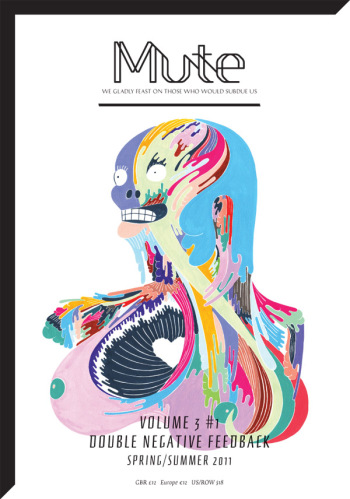
“‘Double Negative Feedback’ expresses the hope that the chaos unleashed by the cybernetic loops of financialisation, post-Fordist production and networked life might not only be entropic and exploitative. The noise generated by ‘positive feedback’ also takes the form of the explosions we are seeing in the Arab world, the anti-disciplinary uses of cybernetic control systems, the ‘shared precarity’ of compositional improvising, and the ripples of a political organising that no longer assumes a common identity but instead acknowledges our common vulnerability. This issue scouts out such double-negative loops in a landscape dominated by the relentless, if often misfiring attempt to put feedback to work.”
Edited by Josephine Berry Slater
Publisher Mute, London, June 2011