

Art Silverblatt: Genre Studies in Mass Media: A Handbook (2007)
Filed under book | Tags: · genre, mass media, media literacy, popular culture, reality television, science fiction, television, video games, voyeurism, youth

The study of various types of programming is essential for critical analysis of the media and also offers revealing perspectives on society’s cultural values, preoccupations, behavior, and myths. This handbook provides a systematic, in-depth approach to the study of media genres–including reality programs, game shows, situation comedies, soap operas, film noir, news programs, and more. The author addresses such questions as: Have there been shifts in the formula of particular genres over time? What do these shifts reveal about changes in culture? How and why do new genres–such as reality TV shows–appear? Are there differences in genres from one country to another?
Combining theoretical approaches with concrete examples, the book reinforces one’s understanding of the importance of genre to the creation, evolution, and consumption of media content. Each chapter in this reader-friendly book contains a detailed discussion of one of the theoretical approaches to genre studies, followed by Lines of Inquiry, which summarizes the major points of the discussion and suggests directions for analysis and further study. Each chapter also includes an example that illustrates how the particular theoretical approach can be applied in the analysis of genre. The author’s careful linkage of different genres to the real world makes the book widely useful for those interested in genre study as well as media and culture, television studies, film studies, and media literacy.
Publisher M.E. Sharpe, 2007
ISBN 076561670X, 9780765616708
Length 258 pages
More info (publisher)
More info (google books)
Dennis Redmond: The World is Watching. Video as Multinational Aesthetics, 1968-1995 (2004)
Filed under book | Tags: · mass media, media culture, neoliberalism, television, video

Evolving rapidly from the movie screen to the television screen to the computer screen, video culture has blossomed from its origins as an obscure spin-off of the 1960s Anglo-American media culture into one of the leading art forms of the late twentieth century. And as such, video culture has grown from being the dominion of small but dedicated cult followings to becoming a near mainstream cinematic interest. The World Is Watching: Video as Multinational Aesthetics, 1968–1995 explores the origins and implications of this powerful visual medium which crosses national, cultural, and political boundaries to present provocative tales of the highest quality. Dennis Redmond’s probing study is rooted in close readings of three stylish and highly successful video efforts—The Prisoner (1967), The Decalogue (1988), and Neon Genesis: Evangelion (1995).
Irish director and star Patrick McGoohan’s classic science fiction vision, The Prisoner, established many of the basic conventions of video for such elements as shot selection, set design, scripting, scoring, and editing techniques. In The Prisoner, a government agent has resigned his position only to be immediately abducted and confined to an isolated town. Thus imprisoned, the agent faces the sinister and surreal efforts of his captors to break him and learn the secret cause of his resignation. Saturated with Cold War allegory, this seventeen-part series was groundbreaking in its exploration of new types of global content, ranging from gender and ethnic identity to the politics of information. Part futuristic thriller, part James Bond parody, the cult series remains hugely popular among partisans of science fiction, and has had an indelible influence on its mainstream descendants.
Set in a Polish housing complex, each episode of The Decalogue examines one of the ten commandments. The provocative series synthesized elements of the Eastern European auteur film with the consumerism of its Western European counterparts, establishing the new genre of Eurovideo. Paying special attention to director Krzysztof Kieslowski’s micropolitics of gender, as well as his innovations in scripting, lighting, and framing, Redmond locates The Decalogue within the broader context of Polish filmmaking and as a harbinger of the subsequent Velvet Revolutions of Eastern Europe. Now available on DVD for English-speaking audiences, The Decalogue remains a stunning specimen of video artistry.
Aided by transcripts that are far superior to the flawed English dubbing in some video versions, Redmond’s analysis of Hideaki Anno’s acclaimed television series Neon Genesis: Evangelion explores the increasingly popular narrative form of anime. This animated series is set in the post-apocalyptic future, where young pilots in robotic battle suits combat alien invaders. In discussing this twenty-six part epic undertaking, Redmond identifies the impact of the Godzilla narratives, videogame culture, the Japanese mecha, the Hong Kong action thriller and the American sci-fi blockbuster on the formation of a uniquely East Asian identity and aesthetic sensibility. Anime is proving itself to be exceedingly apt and able at crossing national borders and is now enjoying mass popularity among global audiences, thus making it an ideal subject for Redmond’s telling assessment of the impact of video culture worldwide.
Publisher SIU Press, 2004
ISBN 0809325357, 9780809325351
202 pages
More info (publisher)
More info (google books)
Derrick De Kerckhove: The Skin of Culture: Investigating the New Electronic Reality (1995/1997)
Filed under book | Tags: · cyberculture, mass media, new media, technology, television, virtual reality
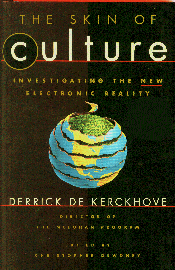
This is a bold vision of the electronic media and the nature of reality in a world increasingly wired to technology. It proposes and explores concepts such as: whether democracy is outmoded and must be redesigned to reflect how technology affects power structures; whether the electronic media have extended our psychology as well as our nervous systems and our bodies; whether art must redress the balance with science and reclaim technology; and whether electronic media are reversing the effects of language, literacy and the alphabet, and whether this is a good thing.
Editor Christopher Dewdney
Publisher Kogan Page Publishers, 1997
ISBN 074942480X, 9780749424800
226 pages
PDF (no OCR; some pages missing; updated on 2012-12-5)
Comment (0)