

Paul Klee: Pedagogical Sketchbook (1925–) [DE, EN, GR, RU]
Filed under book | Tags: · art, art education, bauhaus, colour, design, drawing, painting, theory
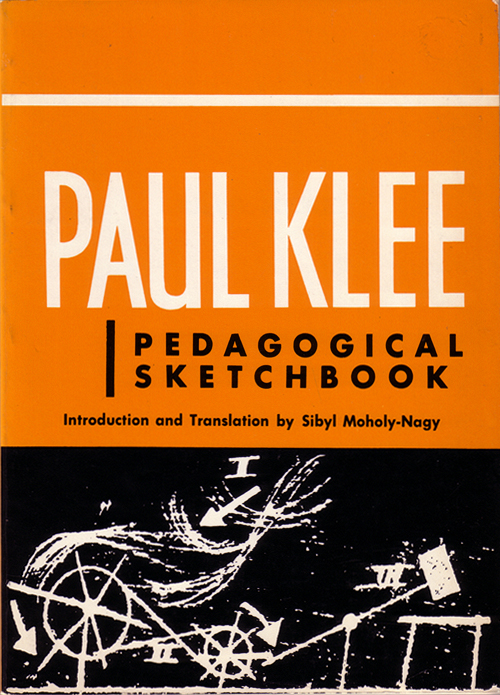
“Paul Klee occupies a unique position among the creators of modern art. Although he shed all ties with conventional presentation, he developed a closer and deeper relationship to reality than did most painters of his time. Without any attempt at imitation or idealization, he recorded proportion, motion, and depth in space as the fundamental attributes of the visual world.
Klee collected his observations in his Pedagogical Sketchbook intended as the basis for the course in design theory at the famous Bauhaus art school in Germany. From the simple phenomenon of interweaving lines, his work leads to the comprehension of defined planes-of structure, dimension, equilibrium, and motion. But he employs no abstract formulas. The student remains in the familiar world-a world that acquires new significance through the straight forward approach of Klee’s simple, lucid drawings and his precise captions. Chessboard, bone, muscle, heart, a water wheel, a plant, railroad ties, a tightrope walker-these serve as examples for the forty-three design lessons.
Pedagogical Sketchbook is a vital contribution toward a more human, more universal goal in design education the work of a visionary painter who dedicated himself to the practical task of making people see.” (from the Back cover)
Publisher Albert Langen, Munich, 1925
Volume 2 of Bauhausbücher series
50 pages
English edition
Introduction and Translation by Sibyl Moholy-Nagy
Publisher Frederick A. Praeger, New York, 1953
The original layout by L. Moholy-Nagy has been retained
65 pages
Pädagogisches Skizzenbuch (German, 33 MB, via Bibliothèque Kandinsky, added on 2014-8-17, updated on 2022-4-13)
Pädagogisches Skizzenbuch (German, PDF, JPG, in Heidelberg U Library, added on 2019-7-7)
Pedagogical Sketchbook (English, 1953 edition, no OCR)
Pedagogical Sketchbook (English, 1960 edition, 7th printing from 1972)
Παιδαγωγικό Σημειωματάριο (Greek, trans. Β. Λαγοπούλου, 1976)
Pedagogikheskie eskizy (Russian, trans. N. Druzhkovoy, 2005, added on 2014-3-6)
See also other titles in the Bauhaus Books series, as well as Klee’s class notes in manuscript and an edited version of his Notebooks.
Comments (10)Paul Betts: The Authority of Everyday Objects: A Cultural History of West German Industrial Design (2004)
Filed under book | Tags: · aesthetics, bauhaus, cold war, design, germany, industrial design, weimar republic

From the Werkbund to the Bauhaus to Braun, from furniture to automobiles to consumer appliances, twentieth-century industrial design is closely associated with Germany. In this pathbreaking study, Paul Betts brings to light the crucial role that design played in building a progressive West German industrial culture atop the charred remains of the past. The Authority of Everyday Objects details how the postwar period gave rise to a new design culture comprising a sprawling network of diverse interest groups—including the state and industry, architects and designers, consumer groups and museums, as well as publicists and women’s organizations—who all identified industrial design as a vital means of economic recovery, social reform, and even moral regeneration. These cultural battles took on heightened importance precisely because the stakes were nothing less than the very shape and significance of West German domestic modernity. Betts tells the rich and far-reaching story of how and why commodity aesthetics became a focal point for fashioning a certain West German cultural identity. This book is situated at the very crossroads of German industry and aesthetics, Cold War politics and international modernism, institutional life and visual culture.
Publisher University of California Press, 2004
Weimar and Now: German Cultural Criticism Series
ISBN 0520240049, 9780520240049
348 pages
Jeffrey Saletnik, Robin Schuldenfrei (eds.): Bauhaus Construct: Fashioning Identity, Discourse and Modernism (2009)
Filed under book | Tags: · architecture, art, bauhaus, copyright, critical theory, design, painting, photography

Reconsidering the status and meaning of Bauhaus objects in relation to the multiple re-tellings of the school’s history, this volume positions art objects of the Bauhaus within the theoretical, artistic, historical, and cultural concerns in which they were produced and received.
Contributions from leading scholars writing in the field today – including Frederic J. Schwartz, Magdalena Droste, and Alina Payne – offer an entirely new treatment of the Bauhaus. Issues such as art and design pedagogy, the practice of photography, copyright law, and critical theory are discussed. Through a strong thematic structure, new archival research and innovative methodologies, the questions and subsequent conclusions presented here re-examine the history of the Bauhaus and its continuing legacy. Essential reading for anyone studying the Bauhaus, modern art and design.
Publisher Routledge, an imprint of Taylor & Francis, 2009
ISBN 0415778360, 9780415778367
304 pages