

Friedrich Georg Jünger: The Failure of Technology: Perfection Without Purpose (1946–)
Filed under book | Tags: · automation, critique of technology, environment, philosophy of technology, technology
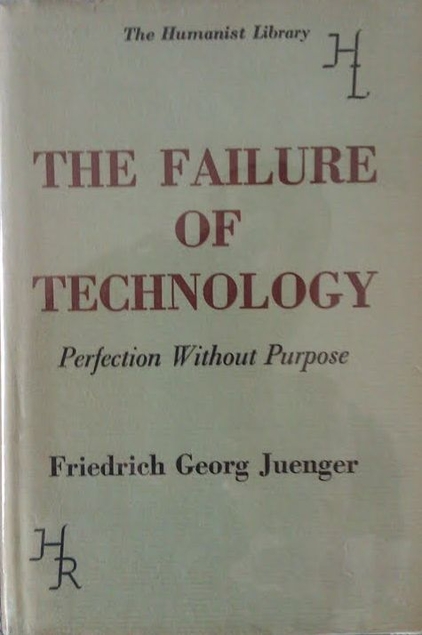
Written in the spring and early summer of 1939 and “first published in German as Die Perfektion der Technik in 1946, F.G. Jünger argues that technology has become second nature and will bring “the downfall of the state”. F.G. Jünger, a literary writer and essayist, was the brother of Ernst Jünger. Both represented the intellectual right-wing of the ‘conservative revolution’ in the Weimar Republic and had ambivalent relations to the Third Reich.
The Failure of Technology was a major source for Heidegger’s 1950s turn towards a philosophy of technology in which technology, as second nature, determines human existence.” (FC)
Translated by F.D. Wieck
Introduction by Frederick D. Wilhelmsen
Publisher H. Regnery, Hinsdale, IL, 1949
New edition, 1956
xvi+189 pages
via FC
EPUB
PDF (Introduction missing)
Tom Cohen, Claire Colebrook, J. Hillis Miller: Twilight of the Anthropocene Idols (2016)
Filed under book | Tags: · anthropocene, climate crisis, ecocriticism, environment, human, literature, theory
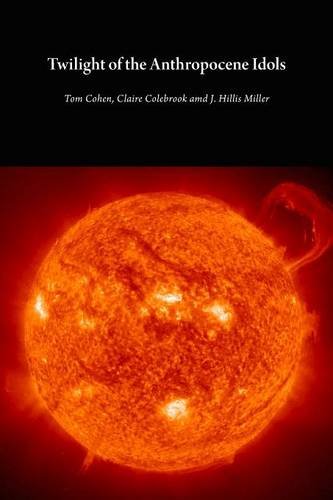
“Following on from Theory and the Disappearing Future, Cohen, Colebrook and Miller turn their attention to the eco-critical and environmental humanities’ newest and most fashionable of concepts, the Anthropocene. The question that has escaped focus, as “tipping points” are acknowledged as passed, is how language, mnemo-technologies, and the epistemology of tropes appear to guide the accelerating ecocide, and how that implies a mutation within reading itself—from the era of extinction events.
Only in this moment of seeming finality, the authors argue, does there arise an opportunity to be done with mourning and begin reading. Drawing freely on Paul de Man’s theory of reading, anthropomorphism and the sublime, Twilight of the Anthropocene Idols argues for a mode of critical activism liberated from all-too-human joys and anxieties regarding the future. It was quite a few decades ago (1983) that Jurgen Habermas declared that ‘master thinkers had fallen on hard times.’ His pronouncement of hard times was premature. For master thinkers it is the best of times. Not only is the world, supposedly, falling into a complete absence of care, thought and frugality, a few hyper-masters have emerged to tell us that these hard times should be the best of times. It is precisely because we face the end that we should embrace our power to geo-engineer, stage the revolution, return to profound thinking, reinvent the subject, and recognize ourselves fully as one global humanity. Enter anthropos.”
Publisher Open Humanities Press, 2016
Critical Climate Change series
Creative Commons BY-SA 4.0 License
ISBN 9781785420153 (Print), 9781785420160 (PDF)
220 pages
PDF, PDF, PDF (3 MB, updated on 2016-7-19)
Comment (0)Rosa B, 5: Environment and Design (2014) [French/English]
Filed under magazine | Tags: · design, design history, ecology, environment
 |
“Rosa B 5 deals with relations between the environment and design following the Aspen conference in 1970.
Around 1970, in France and on an international level, in all industrialized countries, the environment became a primordial question. Debates aiming to define principles and ways of approaching the issue gave rise to theoretical and conceptual tension. They crystallized the economic and political problems born of the connection taking shape between modernity and nature. In France in 1968 the Ministère des Affaires Culturelles founded the Institut de l’Environnement, a center for education and research proposing a new approach to teaching urban planning, architecture, design and communication, in response to new challenges intrinsic to a “sensitive environment.”
In 1970, the IDCA (the International Design Conference in Aspen) presented a program called Environment by design. In response to an invitation by the IDCA, the French delegation, led by designer Roger Tallon, took a position through a declaration written by Jean Baudrillard. The French delegation’s declaration, in association with the reactions and demonstrations of students and environmental activists at the conference, marked a turning point for the Aspen meetings.
Issue no. 5 of Rosa B takes the form of an archive, updating historical documents that put current debates on the fabrication of the environment into perspective. With texts and contributions by Peio Aguirre, Martin Beck, Gilles de Bure, Sheila Levrant de Breteville, Monique Eleb, Pierre Lascoumes, Jeanne Quéheillard, and a ‘carte blanche’ to Benjamin Tong with the calarts archives.” (from announcement)
Conceived by Peio Aguirre and Jeanne Quéheillard
Publisher Guadalupe Echevarria & Charlotte Laubard, Bordeaux, 2014
HTML (English, updated on 2017-11-29)
HTML (French, updated on 2017-11-29)