

Daniel Domscheit-Berg: Inside WikiLeaks: My Time at the World’s Most Dangerous Website (2011)
Filed under book | Tags: · activism, diplomacy, internet, media activism, military, politics, war, wikileaks

What has been made public so far about WikiLeaks is only a small fraction of the truth. With his insider knowledge, Daniel Domscheit-Berg is uniquely able to tell the full story.
Since its launch in 2006, WikiLeaks has rapidly grown into the most powerful and influential whistleblowing organisation ever. Its status as a repository and publisher of leaked sensitive and confidential documents — while preserving the anonymity and untraceability of its contributors — as well as the statements and behaviour of its leader, Julian Assange, have made WikiLeaks daily front-page news and a topic of enormous controversy.
In this eye-opening account, Daniel Domscheit-Berg, who joined WikiLeaks in its early days and became its spokesman, reveals never-disclosed details about the inner workings of the organisation that has struck fear into governments and businesses worldwide. He also provides a remarkably up-close portrait of Julian Assange himself.
Under the pseudonym Daniel Schmitt, Domscheit-Berg was effectively No. 2 at WikiLeaks and the organisation’s most public face after Julian Assange. In this book, he tells the backstories of major leaks, and reveals the evolution, finances, and inner tensions of the whistleblower organisation, beginning with his first meeting with Assange in December 2007. He also describes what led to his September 2010 withdrawal from WikiLeaks, including his disenchantment with the organisation’s lack of transparency, its abandonment of political neutrality, and Assange’s increasing concentration of power.
Publisher Scribe Publications, 2011
ISBN 1921844051, 9781921844058
305 pages
PDF (EPUB; updated on 2012-8-5)
Comment (0)Yochai Benkler: A Free Irresponsible Press: Wikileaks and the Battle Over the Soul of the Networked Fourth Estate (draft, 2011)
Filed under paper | Tags: · internet, journalism, mass media, network culture, networks, politics, wikileaks
A study of the events surrounding the Wikileaks document releases in 2010 provides a rich set of insights about the weaknesses and sources of resilience of the emerging networked fourth estate. It marks the emergence of a new model of watchdog function, one that is neither purely networked nor purely traditional, but is rather a mutualistic interaction between the two. It identifies the peculiar risks to, and sources of resilience of, the networked fourth estate in a multidimensional system of expression and restraint, and suggests the need to resolve a major potential vulnerability—the extralegal cooperation between the government and private infrastructure companies to restrict speech without being bound by the constraints of legality. Finally, it offers a richly detailed event study of the complexity of the emerging networked fourth estate, and the interaction, both constructive and destructive, between the surviving elements of the traditional model and the emerging elements of the new. It teaches us that the traditional, managerial-professional sources of responsibility in a free press function imperfectly under present market conditions, while the distributed models of mutual criticism and universal skeptical reading, so typical of the Net, are far from powerless to deliver effective criticism and self-correction where necessary. The future likely is, as the Guardian described its own experience with Wikileaks, “a new model of co-operation,” between surviving elements of the traditional, mass-mediated fourth estate, and its emerging networked models. The transition to this new model will likely be anything but smooth.
Working Paper of article forthcoming in the Harvard Civil Rights – Civil Liberties Law Review.
8 February 2011 version.
66 pages
PDF
Update: PDF (current version)
Geert Lovink, Rachel Somers Miles (eds.): Video Vortex Reader II: Moving Images Beyond YouTube (2011)
Filed under book | Tags: · aesthetics, human rights, internet, media activism, network culture, online video, politics, theory, video, video art, youtube
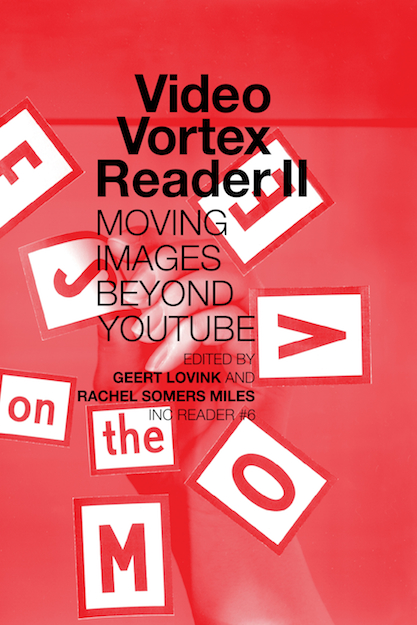
“Video Vortex Reader II is the Institute of Network Cultures’ second collection of texts that critically explore the rapidly changing landscape of online video and its use. With the success of YouTube (’2 billion views per day’) and the rise of other online video sharing platforms, the moving image has become expansively more popular on the Web, significantly contributing to the culture and ecology of the internet and our everyday lives. In response, the Video Vortex project continues to examine critical issues that are emerging around the production and distribution of online video content.
Following the success of the mailing list, the website and first Video Vortex Reader in 2008, recent Video Vortex conferences in Ankara (October 2008), Split (May 2009) and Brussels (November 2009) have sparked a number of new insights, debates and conversations regarding the politics, aesthetics, and artistic possibilities of online video. Through contributions from scholars, artists, activists and many more, Video Vortex Reader II asks what is occurring within and beyond the bounds of Google’s YouTube? How are the possibilities of online video, from the accessibility of reusable content to the internet as a distribution channel, being distinctly shaped by the increasing diversity of users taking part in creating and sharing moving images over the web?”
Contributors: Perry Bard, Natalie Bookchin, Vito Campanelli, Andrew Clay, Alexandra Crosby, Alejandro Duque, Sandra Fauconnier, Albert Figurt, Sam Gregory, Cecilia Guida, Stefan Heidenreich, Larissa Hjorth, Mél Hogan, Nuraini Juliastuti, Sarah Késenne, Elizabeth Losh, Geert Lovink, Andrew Lowenthal, Rosa Menkman, Gabriel Menotti, Rachel Somers Miles, Andrew Gryf Paterson, Teague Schneiter, Jan Simons, Evelin Stermitz, Blake Stimson, David Teh, Ferdiansyah Thajib, Andreas Treske, Robrecht Vanderbeeken, Linda Wallace, Brian Willems, Matthew Williamson, Tara Zepel.
Publisher Institute of Network Cultures, Amsterdam, 2011
Creative Commons Attribution Noncommercial No Derivative Works 3.0 Netherlands License
ISBN 9789078146124
378 pages
PDF, PDF (updated on 2017-4-11)
Comment (0)