
Catherine Malabou, Jacques Derrida: Counterpath: Traveling with Jacques Derrida (1999/2004)
Filed under book | Tags: · deconstruction, geography, language, literary criticism, metaphysics, philosophy, travel
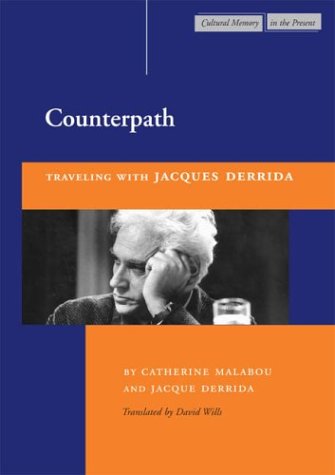
“Counterpath is a collaborative work by Catherine Malabou and Jacques Derrida that answers to the gamble inherent in the idea of “travelling with” the philosopher of deconstruction. Malabou’s readerly text of quotations and commentary demonstrates how Derrida’s work, while appearing to be anything but a travelogue, is nevertheless replete with references to geographical and topographical locations, and functions as a kind of counter-Odyssey through meaning, theorizing, and thematizing notions of arrival, drifting, derivation, and catastrophe. In fact, by going straight to the heart of the Derridean idea of “spacing,” she finally makes it seem as though Derrida has never written about anything but travel.
Malabou’s text is punctuated by a series of postcards received by Derrida from destinations such as Istanbul and Porto, Laguna Beach and Athens, which are inspired by his reading of her evolving discussion. Writing in a familiar and unguarded manner, as if he were “on vacation” from his own writing, Derrida still remains totally faithful to that work and invites the reader to reflect on much of what haunts his texts as well as his daily life, questions of distance and death, the relation to the other, and exile..”
First published as La Contre-allee, 1999.
Translated by David Wills
Publisher Stanford University Press, 2004
Cultural Memory in the Present series
ISBN 0804740410, 9780804740418
330 pages
PDF (updated on 2017-10-5)
Comment (0)Christoph Menke: The Sovereignty of Art: Aesthetic Negativity in Adorno and Derrida (1988–)
Filed under book | Tags: · aesthetics, art, deconstruction, literary criticism, literary theory, metaphysics, mimesis, philosophy

“Recent discussions of aesthetics, whether in the hermeneutic or the analytic tradition, understand the place of art and aesthetic experience according to a model of “autonomy”—as just one among the many modes of experience that make up the realm of reason, situated beside the other “spheres of value.” In contrast, Theodor Adorno and Jacques Derrida view art and aesthetic experience as a medium for the dissolution of nonaesthetic reason, an experientially enacted critique of reason. Art is not only autonomous, following its own law, different from nonaesthetic reason, but sovereign: it subverts the rule of reason.
In this book Christoph Menke attempts to explain art’s sovereign power to subvert reason without falling into an error common to Adorno’s negative dialectics and Derrida’s deconstruction. The error, which already appeared in romanticism, is to conceive of the sovereignty of art as reflecting the superiority of its knowledge. For art entails no knowledge and its negativity toward reason cannot be articulated as an insight into the nature of reason: art is sovereign not despite, but because of, its autonomy. Menke brings to his arguments a firm grounding in both philosophy and literary studies, as well as familiarity with German, French, and American sources.”
First published in German as Die Souveränität der Kunst: Ästhetische Erfahrung nach Adorno und Derrida, Athenäum, Frankfurt am Main, 1988.
Translated by Neil Solomon
Publisher MIT Press, 1998
Studies in Contemporary German Social Thought series
ISBN 0262631954, 9780262631952
310 pages
PDF (updated on 2021-7-12)
Comments (2)Alain Badiou: On Beckett (2003)
Filed under book | Tags: · literary criticism, ontology, philosophy, theatre

“This collection of Alain Badiou’s essays on Samuel Beckett is a deliberate intellectual challenge to conventional Beckett scholarship. These essays trace the development of Beckett’s artfrom his first works through the claustrophobic world of The Unnameable to a final engagement with questions of Other and Love. Badiou rejects the stereotypical view of Beckett as the dark existentialist; rather, he claims that the lesson of Beckett is one of moderation, precision, and courage.”
Translation, introduction and selection by Nina Power and Alberto Toscano
Publisher Clinamen Press, Manchester, 2003
ISBN 1903083265, 9781903083260
164 pages
PDF (updated on 2020-7-5)
Comment (0)