

Juan Carlos Romero: Cartografías del cuerpo, asperezas de la palabra, catalogue (2009) [Spanish]
Filed under catalogue | Tags: · activism, argentina, art, political art, politics

A catalogue of an exhibition curated by Fernando Davis, held in Buenos Aires in September-November 2009.
“La producción de Juan Carlos Romero se inscribe en zonas de intervención diversas y superpuestas: grabador y performer, poeta visual y artista-correo, editor de revistas experimentales y otras publicaciones autogestionadas, archivista y organizador de exposiciones, artista grupal, docente y militante. Desde posicionamientos múltiples y simultáneos, Romero trama un complejo dispositivo crítico cuyo irregular despliegue desarma la integración retrospectiva de su obra en un relato coherente y unitario.
En las estrategias poético-políticas que activa, la producción de Romero cruza diferentes problemáticas. La puesta en cuestión del grabado en sus fundamentos conceptuales y técnicos y la opción de la imagen múltiple como dispositivo político en la transformación de los modos de vida. La intervención en espacios alternativos a los circuitos artísticos institucionales y la búsqueda de una mayor participación del espectador. Las interferencias mutuas entre grabado artístico, imagen mediática y gráfica popular. La palabra como registro opaco, abierto a turbulencias de la significación que desorganizan los pactos de sentido hegemónicos fijados por la “transparencia” neoliberal. La incorporación del cuerpo como territorio de inscripción de las relaciones (conflictivas) de poder que reglamentan el orden individual y social.
La exposición 1. Juan Carlos Romero. Cartografías del cuerpo, asperezas de la palabra interpela estos problemas en un conjunto de obras que abarca más de cuarenta años (1966-2009) de la producción del artista. Cuerpo y palabra constituyen las dos dimensiones que la exposición tensiona en los trayectos cruzados que diagrama al interrogar la densidad conflictual de esta serie de obras. Desde esta perspectiva, no se trata de presentar un recorrido exhaustivo y acabado de la obra de Romero. En el recorte conscientemente parcial que propone como apuesta interpretativa, esta muestra no pretende fijar un relato, sino, por el contrario, hacer explícitas las tensiones y derivas, las fricciones e interferencias que dicho cuerpo de producción activa en la potencia crítica de sus accidentes y porosidades, para, lejos de clausurar su espesor disruptivo en la “llamada al orden” de su ordenamiento retrospectivo, abrirlo a los desfases e intermitencias de sentido que lo animan.
En este marco, la exposición busca incidir críticamente en otros dos debates. Por un lado, el referido a las problemáticas relaciones entre práctica artística y política. En una dirección que se aparta de su reducción como ámbitos mutuamente excluyentes –solo conciliables en tanto hay un afuera-del-arte que reclama su “politización”-, esta muestra propone pensar la relación arte / política en el territorio movedizo en el que ambas dimensiones se interpelan de manera recíproca.” (Fernando Davis)
Publisher Espacio de Arte Fundacion OSDE, Buenos Aires, 2009
64 pages
Julian Assange, et al.: Cypherpunks: Freedom and the Future of the Internet (2012)
Filed under book | Tags: · activism, anonymity, censorship, code, cryptography, cypherpunk, encryption, free software, hacking, internet, internet activism, politics, privacy, software, surveillance, transparency, wikileaks
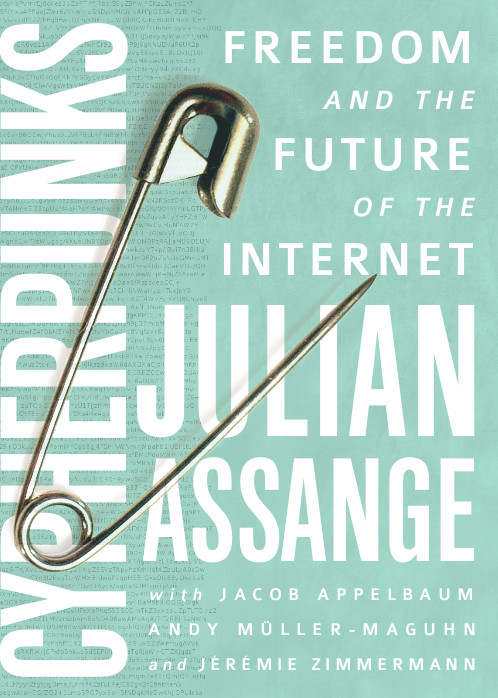
Cypherpunks are activists who advocate the widespread use of strong cryptography (writing in code) as a route to progressive change. Julian Assange, the editor-in-chief of and visionary behind WikiLeaks, has been a leading voice in the cypherpunk movement since its inception in the 1980s.
Now, in what is sure to be a wave-making new book, Assange brings together a small group of cutting-edge thinkers and activists from the front line of the battle for cyber-space to discuss whether electronic communications will emancipate or enslave us. Among the topics addressed are: Do Facebook and Google constitute “the greatest surveillance machine that ever existed,” perpetually tracking our location, our contacts and our lives? Far from being victims of that surveillance, are most of us willing collaborators? Are there legitimate forms of surveillance, for instance in relation to the “Four Horsemen of the Infopocalypse” (money laundering, drugs, terrorism and pornography)? And do we have the ability, through conscious action and technological savvy, to resist this tide and secure a world where freedom is something which the Internet helps bring about?
The harassment of WikiLeaks and other Internet activists, together with attempts to introduce anti-file sharing legislation such as SOPA and ACTA, indicate that the politics of the Internet have reached a crossroads. In one direction lies a future that guarantees, in the watchwords of the cypherpunks, “privacy for the weak and transparency for the powerful”; in the other lies an Internet that allows government and large corporations to discover ever more about internet users while hiding their own activities. Assange and his co-discussants unpick the complex issues surrounding this crucial choice with clarity and engaging enthusiasm.
With Jacob Appelbaum, Andy Müller-Maguhn, and Jérémie Zimmermann
Publisher OR Books, New York/London, November 2012
ISBN 9781939293008
192 pages
Interview with Assange where he also speaks about the book (video, DemocracyNow!, 29 November 2012)
Commentary (The Guardian)
Review (Cryptome.org)
PDF (PDF)
PDF (EPUB)
PDF (MOBI)
PDF (torrent, all 3 formats)
Video of Assange’s TV show The World Tomorrow interview the book is based on, Part 1, Part 2 (Youtube.com)
Charles Tilly: Regimes and Repertoires (2006)
Filed under book | Tags: · activism, democracy, politics, revolution, social movements, violence

The means by which people protest—that is, their repertoires of contention—vary radically from one political regime to the next. Highly capable undemocratic regimes such as China’s show no visible signs of popular social movements, yet produce many citizen protests against arbitrary, predatory government. Less effective and undemocratic governments like the Sudan’s, meanwhile, often experience regional insurgencies and even civil wars. In Regimes and Repertoires, Charles Tilly offers a fascinating and wide-ranging case-by-case study of various types of government and the equally various styles of protests they foster.
Using examples drawn from many areas—G8 summit and anti-globalization protests, Hindu activism in 1980s India, nineteenth-century English Chartists organizing on behalf of workers’ rights, the revolutions of 1848, and civil wars in Angola, Chechnya, and Kosovo—Tilly masterfully shows that such episodes of contentious politics unfold like loosely scripted theater. Along the way, Tilly also brings forth powerful tools to sort out the reasons why certain political regimes vary and change, how the people living under them make claims on their government, and what connections can be drawn between regime change and the character of contentious politics.
Publisher University of Chicago Press, 2006
ISBN 0226803503, 9780226803500
266 pages
review (Tim Lacy, H-Net)
review (Adham Saouli, Political Studies Review)