

Alexander R. Galloway, Eugene Thacker: The Exploit: A Theory of Networks (2007)
Filed under book | Tags: · internet, network culture, networks, ontology, philosophy, politics, theory

“The network has become the core organizational structure for postmodern politics, culture, and life, replacing the modern era’s hierarchical systems. From peer-to-peer file sharing and massive multiplayer online games to contagion vectors of digital or biological viruses and global affiliations of terrorist organizations, the network form has become so invasive that nearly every aspect of contemporary society can be located within it.
Borrowing their title from the hacker term for a program that takes advantage of a flaw in a network system, Alexander R. Galloway and Eugene Thacker challenge the widespread assumption that networks are inherently egalitarian. Instead, they contend that there exist new modes of control entirely native to networks, modes that are at once highly centralized and dispersed, corporate and subversive.
In this provocative book-length essay, Galloway and Thacker argue that a whole new topology must be invented to resist and reshape the network form, one that is as asymmetrical in relationship to networks as the network is in relation to hierarchy.”
Publisher University of Minnesota Press, 2007
ISBN 0816650446, 9780816650446
196 pages
Reviews: Daniel Gilfillan, Nathaniel Tkacz.
PDF (updated on 2012-7-8)
Comment (0)Geert Lovink, Sabine Niederer (eds.): Video Vortex Reader: Responses to Youtube (2008)
Filed under book | Tags: · aesthetics, human rights, internet, media activism, network culture, online video, politics, theory, video, video art, youtube
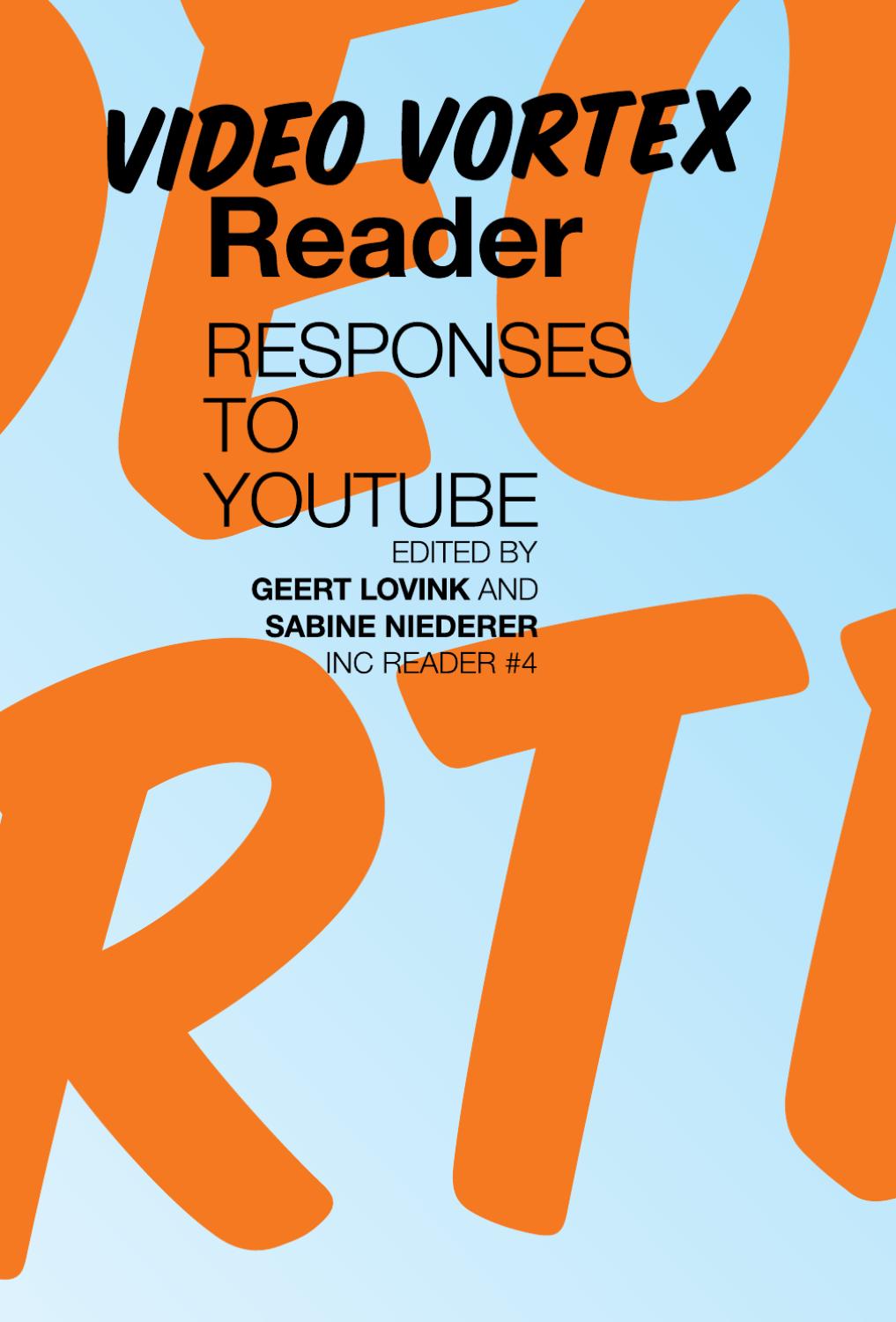
“The Video Vortex Reader is the first collection of critical texts to deal with the rapidly emerging world of online video – from its explosive rise in 2005 with YouTube, to its future as a significant form of personal media. After years of talk about digital convergence and crossmedia platforms we now witness the merger of the Internet and television at a pace no-one predicted. These contributions from scholars, artists and curators evolved from the first two Video Vortex conferences in Brussels and Amsterdam in 2007 which focused on responses to YouTube, and address key issues around independent production and distribution of online video content. What does this new distribution platform mean for artists and activists? What are the alternatives?”
Contributors: Tilman Baumgärtel, Jean Burgess, Dominick Chen, Sarah Cook, Sean Cubitt, Stefaan Decostere, Thomas Elsaesser, David Garcia, Alexandra Juhasz, Nelli Kambouri and Pavlos Hatzopoulos, Minke Kampman, Seth Keen, Sarah Késenne, Marsha Kinder, Patricia Lange, Elizabeth Losh, Geert Lovink, Andrew Lowenthal, Lev Manovich, Adrian Miles, Matthew Mitchem, Sabine Niederer, Ana Peraica, Birgit Richard, Keith Sanborn, Florian Schneider, Tom Sherman, Jan Simons, Thomas Thiel, Vera Tollmann, Andreas Treske, Peter Westenberg.
Editorial assistance: Marije van Eck and Margreet Riphagen
Publisher Institute of Network Cultures, Amsterdam, 2008
INC Reader series, 4
Creative Commons BY-NC-ND 2.5 Netherlands License
ISBN 9789078146056
315 pages
PDF, PDF (updated on 2017-4-11)
Comments (2)