

Georg Flachbart, Peter Weibel (eds.): Disappearing Architecture: From Real to Virtual to Quantum (2005)
Filed under book | Tags: · architecture, environment, quantum computing, ubiquitous computing

“The creation of new environments through the use of developments in Information Technology is significantly altering not only architecture itself but also the roles and tasks of the architects. Architecture can no longer be described in the terms we are familiar with since it no longer corresponds to the form of architecture as we know it: an inclusive and exclusive structure, clearly defined, with a single interior and a single exterior. For architects, the challenge of the future will increasingly lie in creatively coming to terms with hybrid environments, understanding and exploiting the design potential of digital spaces within the physical world, and redefining the role of architecture within a visually dominated culture. This volume presents a valuable and attractive contribution to the contemporary discussion on this subject.”
Publisher Springer, 2005
ISBN 3764372753, 9783764372750
272 pages
Key words and phrases
qubit, quantum computing, Mixed Reality, Utility Fog, Point Cloud, Smart Dust, autonomic computing, active world, Grid computing, computer-aided design, quantum mechanics, Virtools, multiverse, Monika Fleischmann, Wolfgang Strauss, peer-to-peer, Shor’s algorithm, LHC Computing Grid, quantum dots, Ubiquitous Computing
PDF (92 MB, updated on 2015-7-2)
Comment (0)Bruce Sterling: Shaping Things (2005)
Filed under book | Tags: · design, environment, gadgets, machine, things
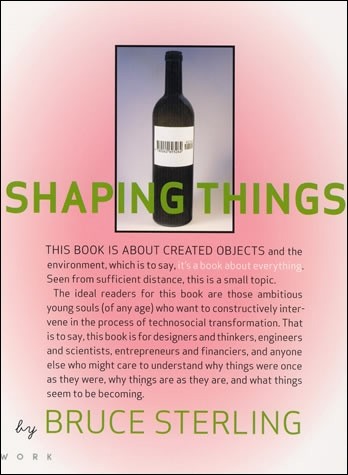
“‘Shaping Things is about created objects and the environment, which is to say, it’s about everything,’ writes Bruce Sterling in this addition to the Mediawork Pamphlet series. He adds, ‘Seen from sufficient distance, this is a small topic.’
Sterling offers a history of shaped things. We have moved from an age of artifacts, made by hand, through complex machines, to the current era of ‘gizmos.’ New forms of design and manufacture are appearing that lack historical precedent, he writes; but the production methods, using archaic forms of energy and materials that are finite and toxic, are not sustainable. The future will see a new kind of object—we have the primitive forms of them now in our pockets and briefcases: user-alterable, baroquely multi-featured, and programmable—that will be sustainable, enhanceable, and uniquely identifiable. Sterling coins the term ‘spime’ for them, these future manufactured objects with informational support so extensive and rich that they are regarded as material instantiations of an immaterial system. Spimes are designed on screens, fabricated by digital means, and precisely tracked through space and time. They are made of substances that can be folded back into the production stream of future spimes, challenging all of us to become involved in their production. Spimes are coming, says Sterling. We will need these objects in order to live; we won’t be able to surrender their advantages without awful consequences.”
Designed by Lorraine Wild
Publisher MIT Press, 2005
Mediaworks Pamphlets series
ISBN 026219533X, 9780262195331
149 pages
PDF (updated on 2020-4-12)
Comment (0)