

Charles Chaplin: My Autobiography (1964)
Filed under book | Tags: · acting, biography, cinema, film

“Born into a theatrical family, Chaplin’s father died of drink while his mother, unable to bear the poverty, suffered from bouts of insanity, Chaplin embarked on a film-making career which won him success, as well as intense controversy. His autobiography was written almost entirely without reference to documentation – simply as a feat of memory by a 75 year old man. It is a vivid reconstruction of a poor London childhood, the music hall and then his prodigious life in the movies.”
First published by Simon and Schuster, 1964
Publisher Pocket Books, New York, 1966
560 pages
Review (F.W. Dupee, The New York Review of Books, 1964)
Comment (0)Friedrich Kittler: Short Cuts (2002) [German]
Filed under book | Tags: · computing, film, literary theory, literature, machine, media, media theory, military, music, surveillance, technology
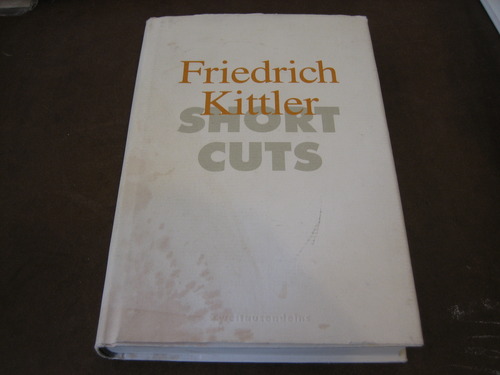
A collection of essays and interviews.
Dass er seit eineinhalb Jahrzehnten den Geisteswissenschaften ihren Computer-Analphabetismus vorbuchstabiert, hat Friedrich Kittler vor allen akademischen Ehren den Titel des “Enfant incompatible der Humanities” eingebracht. Aus dem Inhalt: Interviews mit Alexander Kluge, Über Michel Foucault, Computeranalphabetismus, Das Jahrhundert der Landvermesser, Der Kopf schrumpft, Der Schleier des Luftkrieges, Gespräch mit Paul Virilio, Die Zukunft auf Siliziumbasis, Interview mit Peter Weibel, Jeder kennt den CIA, Krieg im Schaltkreis, Medien und Drogen in Pynchons Zweitem Weltkrieg, Memories are made of you, Provisorische Maschinen, provisorische Moral, Rock Musik: Ein Missbrauch von Heeresgerät.
Edited by Peter Gente and Martin Weinmann
Publisher Zweitausendeins, Frankfurt am Main, 2002
Short Cuts series, 6
ISBN 3861504243, 9783861504245
288 pages
Kittler’s bibliography at Monoskop wiki
Comment (1)Fr. Kalivoda (ed.): Telehor 1-2: Special Issue on L. Moholy-Nagy (1936) [CZ/DE/EN/FR]
Filed under magazine | Tags: · art, avant-garde, colour, design, film, light, photography, vision
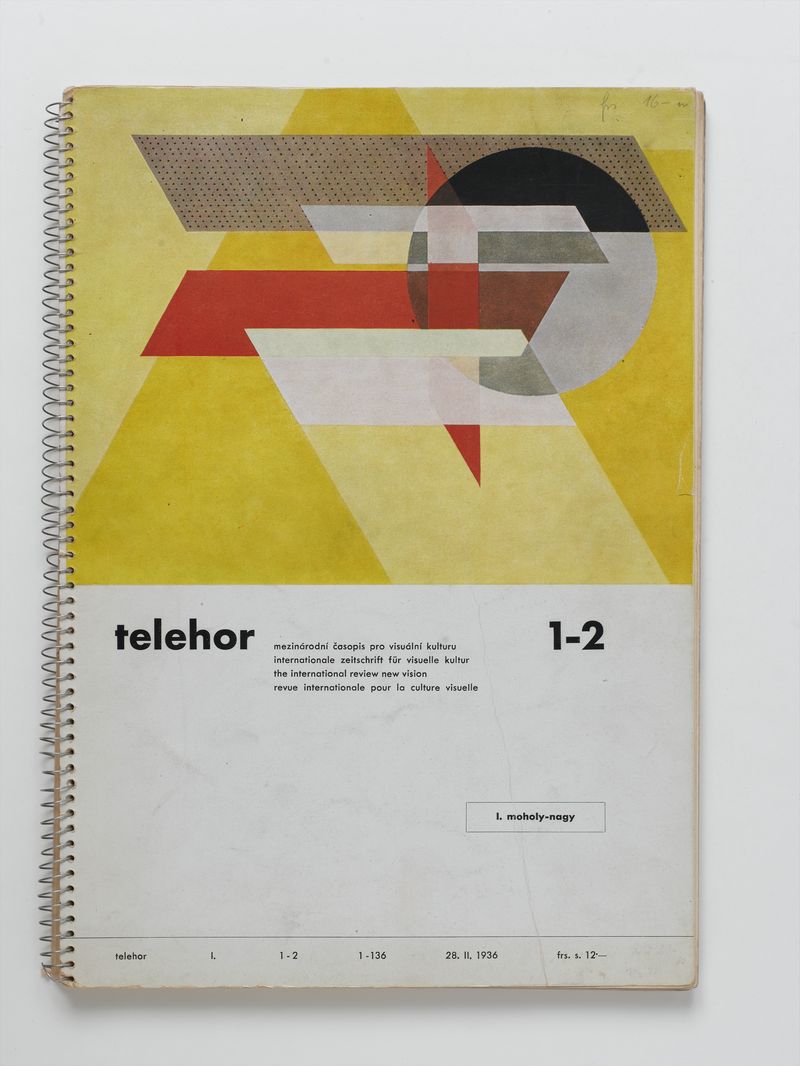
Telehor was a project by Czech functionalist architect, theorist and educator, František Kalivoda, who planned it as a 64-page illustrated quarterly dedicated to visual culture. As an editor and publisher, Kalivoda had established an impressive network of collaborators across Europe, however his plans never fully took off.

Its only issue appeared as a book-length publication on the work of artist and Bauhaus teacher László Moholy-Nagy who was at the time already living in London. The magazine has, in the internationalist fashion, sections in several languages, including French, English, Czech, and German.
Contents of the English section: Foreword by Siegfried Giedion, 1935 (pp 27-29), Letter from Moholy-Nagy to Kalivoda, June 1934 (30-32), Moholy-Nagy’s essays “From Pigment to Light”, 1923-26 (32-34), “A New Instrument of Vision”, 1932 (34-36), “Problems of the Modern Film”, 1928-30 (37-40), “Supplementary Remarks on the Sound and Colour Film”, 1935 (41-42), “Once a Chicken, Always a Chicken”, a film script on a motif from Kurt Schwitter’s “Auguste Bolte”, 1925-30 (43-45), Postscript by Kalivoda, 1936 (45-46).
The reproductions run from page 49 through 112.
Publisher Fr. Kalivoda, Brno, 1936
Typography Fr. Kalivoda
Print Typia Press, Brno
138 pages, 69 ills., 29.7 × 21 cm
via Bibliothèque Kandinsky, in the Unlimited Edition
Moholy-Nagy at Monoskop wiki
Kalivoda at Monoskop wiki
PDF, PDF (variant with black cover, 149 MB)
Comment (1)