

Sergei Eisenstein: Nonindifferent Nature (1987)
Filed under book | Tags: · aesthetics, architecture, art, cinema, film, literature, painting, theory
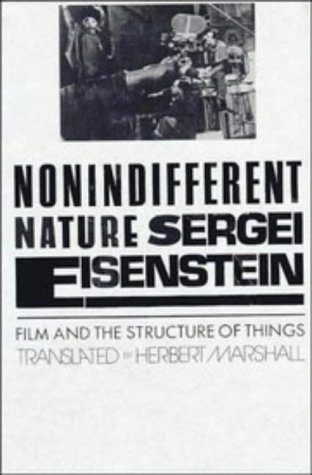
“This is the first publication in English of Eisenstein‘s major theoretical work from the last decade of his life. Almost completed but unrevised at the time of his death in 1948, it comprises three articles from 1939-41 rewritten for the book, together with a substantial text from the period 1945-47. More than a treatise of film theory (though its immediate impetus is clearly the films that Eisenstein worked on at this time, Alexander Nevsky and Ivan the Terrible Parts I and II), Nonindifferent Nature aspires to the status of a contribution to general aesthetics, and its numerous examples are drawn more from the other arts than from cinema. Indeed, apart from analysing, in retrospect, his own work, Eisenstein scarcely touches on film at all. Instead he deals with the novel (Zola, Tolstoy, Wilkie Collins), painting (El Greco, Chinese landscapes), architecture (Chartres Cathedral, Mayan temples), etching (Piranesi), opera (Wagner), poetry (Pushkin), acting (Frederick Lemaitre), music (Bach, jazz), even cartooning (Saul Steinberg).” (from a review by Russell Campbell)
Translated by Herbert Marshall
Publisher Cambridge University Press, 1987
ISBN 0521324157, 9780521324151
xxv+428 pages
via jchill, land
Reviews: Ronald R. Levaco (Los Angeles Times, 1987), Russell Campbell (New Zealand Slavonic Journal, 1991).
PDF (Introduction missing, 7 MB, no OCR)
Comment (0)Sean Cubitt, Daniel Palmer, Nathaniel Tkacz (eds.): Digital Light (2015)
Filed under book | Tags: · aesthetics, art, cinema, digital, film, image, light, optics, photography, screen, technology, vision
“Light symbolises the highest good, it enables all visual art, and today it lies at the heart of billion-dollar industries. The control of light forms the foundation of contemporary vision. Digital Light brings together artists, curators, technologists and media archaeologists to study the historical evolution of digital light-based technologies. Digital Light provides a critical account of the capacities and limitations of contemporary digital light-based technologies and techniques by tracing their genealogies and comparing them with their predecessor media. As digital light remediates multiple historical forms (photography, print, film, video, projection, paint), the collection draws from all of these histories, connecting them to the digital present and placing them in dialogue with one another.
Light is at once universal and deeply historical. The invention of mechanical media (including photography and cinematography) allied with changing print technologies (half-tone, lithography) helped structure the emerging electronic media of television and video, which in turn shaped the bitmap processing and raster display of digital visual media. Digital light is, as Stephen Jones points out in his contribution, an oxymoron: light is photons, particulate and discrete, and therefore always digital. But photons are also waveforms, subject to manipulation in myriad ways. From Fourier transforms to chip design, colour management to the translation of vector graphics into arithmetic displays, light is constantly disciplined to human purposes. In the form of fibre optics, light is now the infrastructure of all our media; in urban plazas and handheld devices, screens have become ubiquitous, and also standardised. This collection addresses how this occurred, what it means, and how artists, curators and engineers confront and challenge the constraints of increasingly normalised digital visual media.
While various art pieces and other content are considered throughout the collection, the focus is specifically on what such pieces suggest about the intersection of technique and technology. Including accounts by prominent artists and professionals, the collection emphasises the centrality of use and experimentation in the shaping of technological platforms. Indeed, a recurring theme is how techniques of previous media become technologies, inscribed in both digital software and hardware. Contributions include considerations of image-oriented software and file formats; screen technologies; projection and urban screen surfaces; histories of computer graphics, 2D and 3D image editing software, photography and cinematic art; and transformations of light-based art resulting from the distributed architectures of the internet and the logic of the database.”
Publisher Open Humanities Press, London, 2015
Fibreculture Books series
Creative Commons BY-SA 4.0 License
ISBN 1785420089, 9781785420085
224 pages
Review: Mathias Denecke (Culture Machine, 2016).
PDF, PDF, PDF (4 MB, updated on 2016-7-19)
Comment (0)Carl Andre, Hollis Frampton: 12 Dialogues, 1962–1963 (1980)
Filed under book | Tags: · aesthetics, art, art criticism, avant-garde, film, literature, music, painting, photography, sculpture
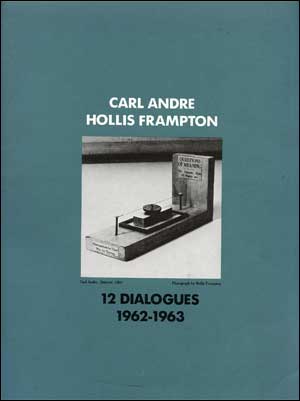
Twelve conversations between the minimalist sculptor Carl Andre and his close friend, photographer-filmmaker Hollis Frampton, about sculpture, photography, painting, music, literature, poetry and film. The two generated the dialogues over the course of a year, from October 1962 to September 1963 mostly on evenings and weekends in Andre’s one-room apartment in Brooklyn. A number of the dialogues begin with a discussion of recently shared art encounters, proceeding to examine a wide range of topics, including the development of avant-garde aesthetics, the significance of Duchamp, the legacy of the New York School, the relevance of photography, etc.
Edited and annotated by Benjamin H.D. Buchloh
Publisher The Press of the Nova Scotia College of Art and Design and New York University Press, 1980
ISBN 0919616178, 9780919616172
134 pages
via x
PDF (first 93 of 134 pages, 24 MB)
Comment (0)