

Cinema Comparat/ive Cinema journal, Nos. 1–2: Programming/Montage & Forms in Revolution (2012–13) [EN/ES/CAT]
Filed under journal | Tags: · cinema, film, film criticism, film history, film theory
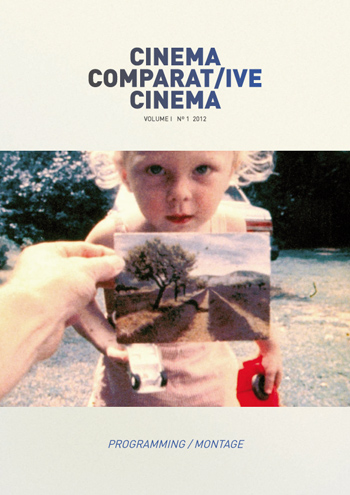
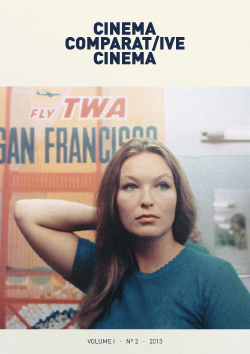
Cinema Comparat/ive Cinema is a biannual publication founded in 2012. It focuses on comparative cinema and the reception and interpretation of film in different social and political contexts. Each issue investigates the conceptual and formal relationships between films, material processes and production and exhibition practices, the history of ideas and film criticism.
Cinema Comparat/ive Cinema addresses an original area of research, developing a series of methodologies for a comparative study of cinema. With this aim, it also explores the relationship between cinema and comparative literature as well as other contemporary arts such as painting, photography, music or dance, and audio-visual media.
Edited by Colectivo de Investigación Estética de los Medios Audiovisuales (CINEMA) at the Universitat Pompeu Fabra (UPF), Barcelona
Creative Commons Attribution-NonCommercial-ShareAlike 3.0 Unported License
ISSN 2014-8933
Volume 1, Nº 1, «Programming/Montage», 2012
PDF (English), Spanish, Catalan.
View online (HTML articles, English), Spanish, Catalan.
Volume 1, Nº 2, «Forms in revolution», 2013
PDF (English), Spanish, Catalan.
View online (HTML articles, English), Spanish, Catalan.
Alain Badiou: Cinema (2010–)
Filed under book | Tags: · cinema, film, philosophy

“For Alain Badiou, films think, and it is the task of the philosopher to transcribe that thinking. What is the subject to which the film gives expressive form? This is the question that lies at the heart of Badiou’s account of cinema.
He contends that cinema is an art form that bears witness to the Other and renders human presence visible, thus testifying to the universal value of human existence and human freedom. Through the experience of viewing, the movement of thought that constitutes the film is passed on to the viewer, who thereby encounters an aspect of the world and its exaltation and vitality as well as its difficulty and complexity. Cinema is an impure art cannibalizing its times, the other arts, and people – a major art precisely because it is the locus of the indiscernibility between art and non-art. It is this, argues Badiou, that makes cinema the social and political art par excellence, the best indicator of our civilization, in the way that Greek tragedy, the coming-of-age novel and the operetta were in their respective eras.”
First published in French as Cinéma, Nova Editions, 2010
Texts selected and introduced by Antoine de Baecque
Translated by Susan Spitzer
Publisher Polity, 2013
ISBN 10074565567X, 9780745655673
269 pages
PDF (updated on 2020-7-5)
Comment (0)Friedrich Kittler: Draculas Vermächtnis: Technische Schriften (1993) [German]
Filed under book | Tags: · film, literary theory, media theory, philosophy, radio, writing

A collection of essays by Friedrich Kittler, including his famous reading of Dracula.
Essays zu den „Effekten der Sprengung des Schriftmonopols“, zu den Analogmedien Schallplatte, Film und Radio sowie „technische Schriften, die numerisch oder algebraisch verfasst sind“.
Publisher Reclam, Leipzig, 1993
ISBN 3379014761, 9783379014762
259 pages
via poshumano
Review (Geert Lovink, Mediamatic)
PDF
See also Kittler at Monoskop wiki