

Fredric Jameson: The Geopolitical Aesthetic: Cinema and Space in the World System (1992)
Filed under book | Tags: · aesthetics, capitalism, cinema, film, film theory, narrative, philosophy, politics, postmodern

Taking contemporary films from the United States, Russia, Taiwan, France, and the Philippines, The Geopolitical Aesthetic offers a reading of some of the most interesting films of the last decade and a general account of filmic representation in the postmodern world. Fredric Jameson poses some essential questions: How does representation function in contemporary film? How does contemporary cinema represent an ever more complex and international social reality? Jameson’s sophisticated and theoretically informed readings stress the ways in which disparate films—for example, Godard’s Passion, Pakula’s All the President’s Men, Yang’s The Terrorizer, Tahimik’s The Perfumed Nightmare, Tarkovsky’s Andrei Roublev—confront similar problems of representation. The solutions vary widely but the drive remains the same—the desire to find adequate allegories for our social existence.
The Geopolitical Aesthetic, a refinement and development of the arguments put forward in Jameson’s seminal work The Political Unconscious, is crucial reading for everyone interested in both film analysis and cultural studies.
Publisher Indiana University Press, 1992
Perspectives Series
ISBN 0253330939, 9780253330932
220 pages
Gerard Malanga, Andy Warhol: Screen Tests / A Diary (1967)
Filed under artist publishing | Tags: · film, photography, poetry
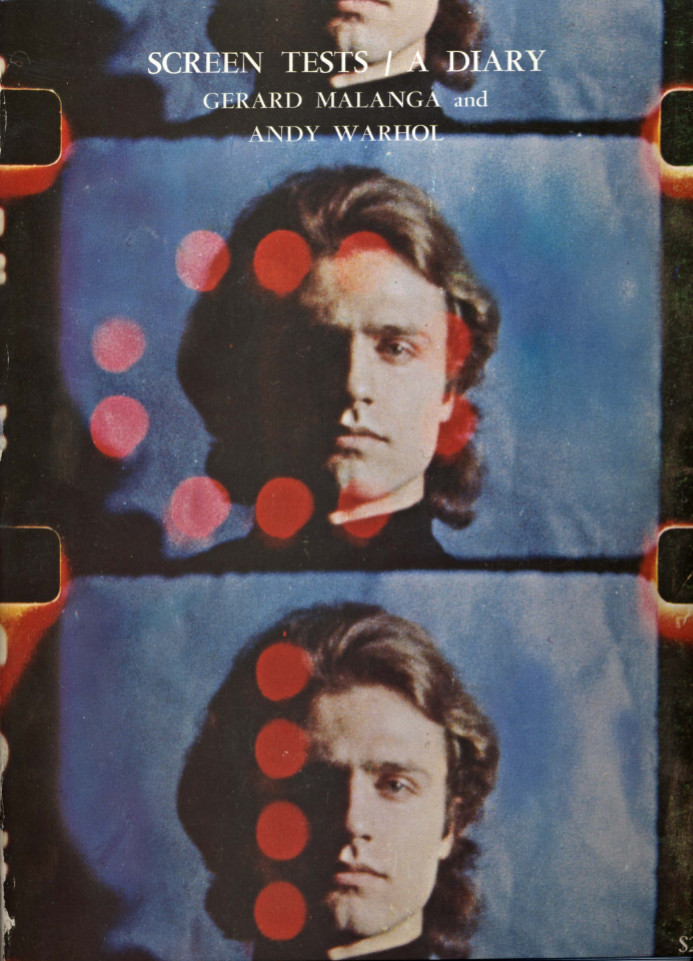
“The 54 stills of Screen Tests/A Diary–which picture actors and poets, socialites and thieves, models, consumers of amphetamine, painters, filmmakers, and musicians–are frame enlargements from short black-and-white silent-film portraits made between 1964 and 1966 by Andy Warhol with the assistance of Gerard Malanga and/or Billy Linich, also known as Billy Name, who lived at the Factory. Each still consists of one or two entire frames from the film footage, and part of either one or two additional frames.” (source).
The stills featuring Salvador Dali, Allen Ginsberg, Jane Holzer, Jonas Mekas, Paul Morrissey, Nico, Lou Reed, Edie Sedgwick, and many others, are accompanied by Malanga’s poetry.
Publisher Kulchur Press, New York, 1967
115 pages
Commentary:
Collaboration as Social Exchange: Screen Tests/A Diary by Gerard Malanga and Andy Warhol (Reva Wolf, Art Journal, 1993)
Andy Warhol’s Screen Tests (Gary Comenas, warholstars.org, 2005)
Michel Gondry: You’ll Like This Film Because You’re in It: The Be Kind Rewind Protocol (2008)
Filed under book | Tags: · diy, film, participation

Michel Gondry’s debut book is a functional memoir of his quest to put the tools of filmmaking in the hands of as many people as possible. At Deitch Projects in 2008 Gondry emulated the example of his characters, constructing a do-it-yourself film studio in which any visitor could assemble their own film from extant plot summaries and rent the results. This book chronicles Gondry’s journey towards what he calls “The Be Kind Rewind Protocol”.
Publisher Picture Box, Brooklyn, 2008
ISBN 0979415381, 9780979415388
80 pages
PDF (no OCR)
Comment (0)