

David E. James (ed.): Stan Brakhage: Filmmaker (2005)
Filed under book | Tags: · avant-garde, cinema, experimental film, film, structural film

“Stan Brakhage: Filmmaker is a collection of essays, photographs, personal statements, and reminiscences about the celebrated avant-garde filmmaker who died in 2003. The director of nearly four hundred short films, including Dog Star Man, Parts I-IV, and the Roman Numeral Series, Brakhage is widely recognized as one of the great artists of the medium. His shorts eschewed traditional narrative structure, and his innovations in fast cutting, hand-held camerawork, and multiple superimpositions created an unprecedentedly rich texture of images that provided the vocabulary for the explosion of independent filmmaking in the 1960s.
Stan Brakhage: Filmmaker chronicles both the director’s personal and formal development. The essays in this book—by historians, filmmakers, and other artists—assess Brakhage’s contributions to the aesthetic and political history of filmmaking, from his emergence on the film scene and the establishment of his reputation, to the early-1980s. The result is a remarkable tribute to this lyrical, visionary artist.”
Publisher Temple University Press, 2005
Wide Angle Books series
ISBN 1592132723, 9781592132720
240 pages
PDF (36 MB, updated on 2016-12-23)
Comment (1)Stevphen Shukaitis: Imaginal Machines: Autonomy & Self-Organization in the Revolutions of Everyday Life (2009)
Filed under book | Tags: · avant-garde, everyday, left, life, machine, philosophy, politics, revolution, social movements
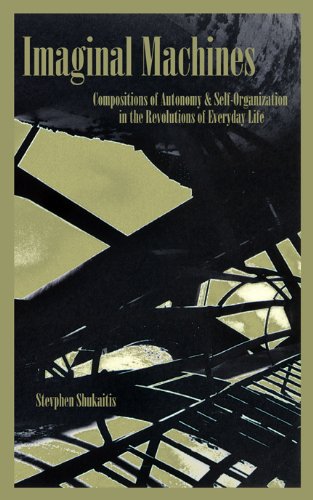
“All power to the imagination? Over the past forty years to invoke the imagination as a basis for radical politics has become a cliché: a rhetorical utilization of ideas already in circulation, invoking the mythic unfolding of this self-institutionalizing process. But what exactly is radical imagination? Drawing from autonomist politics, class composition analysis, and avant-garde arts, Imaginal Machines explores the emergence, functioning, and constant breakdown of the embodied forms of radical imagination.
What does it mean to invoke the power of the imagination when it seems that the imagination has already seized power through the power of the spectacle? Does any subversive potentiality remain? Perhaps it is only honest to think in terms of a temporally-bounded subversive power. It might be that imaginal machines only work by breaking down. That is, their functioning is only possible, paradoxically, by their malfunctioning. By reopening the question of recuperation, the inevitable drive to integrate the power of social insurgency back into the working of capital and the state, we create possibilities for a politics continually reconstituted against and through the dynamics of recuperation: to keep open an antagonism without closure.”
Publisher Minor Compositions, London/NYC/Port Watson, 2009
ISBN 1570272085, 9781570272080
255 pages
PDF (updated on 2016-2-21)
EPUB (added on 2016-2-21)
ARG (added on 2016-2-21)
Scribd
Camilla Gray: The Russian Experiment in Art, 1863-1922 (1962–) [EN, SC]
Filed under book | Tags: · art, art criticism, art history, avant-garde, constructivism, cubism, futurism, graphic design, painting, russia, sculpture, suprematism, theatre, typography
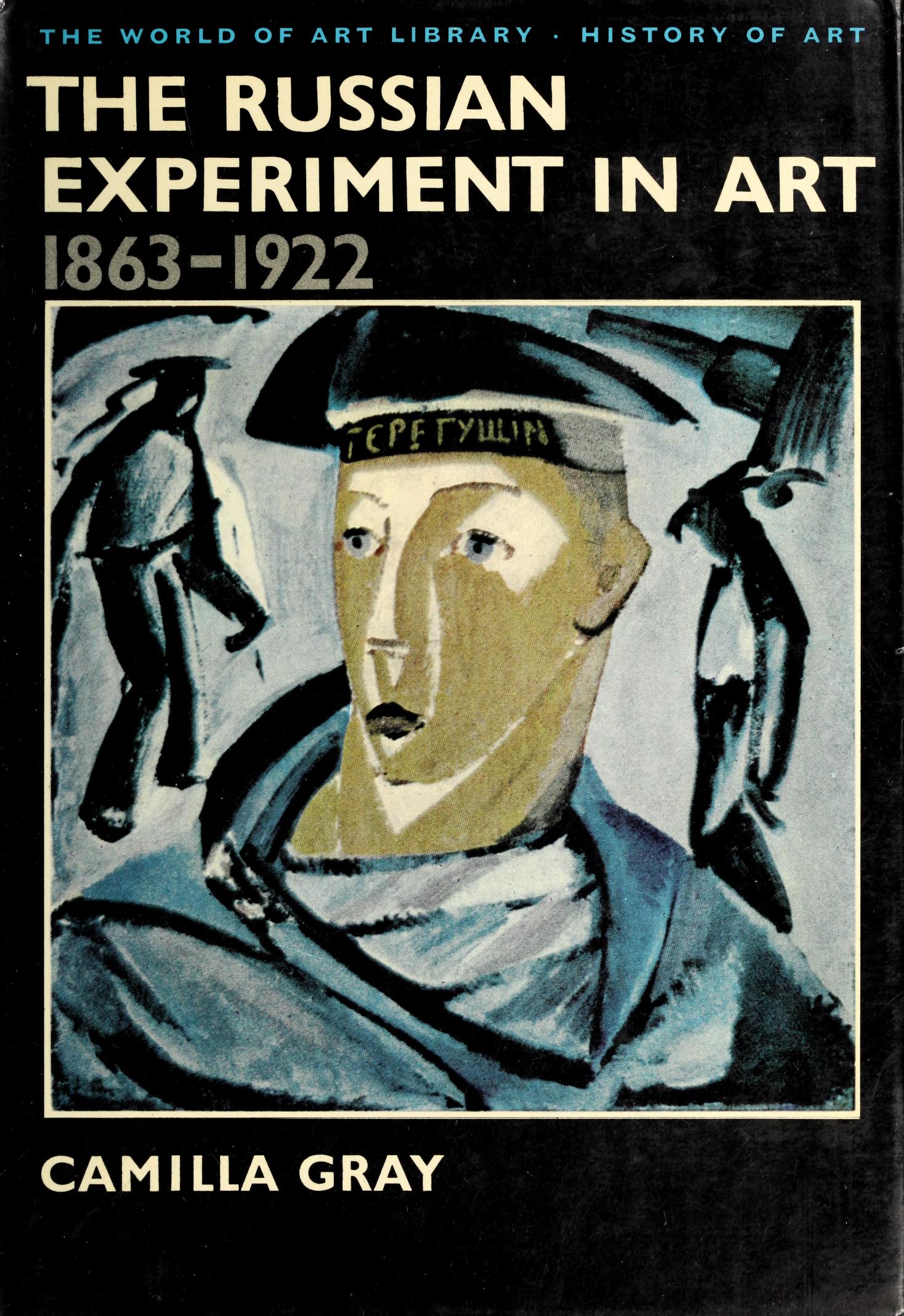
When the original edition of this book was published, John Russell hailed it as a ‘massive contribution to our knowledge of one of the most fascinating and mysterious episodes in the history of modern art.’ It still remains the most compact survey of sixty years of creative dynamic activity that profoundly influenced the progress of Western art and architecture.
Publisher Thames and Hudson, 1962, 1970
Revised and enlarged edition by Marian Burleigh-Motley, 1986
ISBN 0500202079, 9780500202074
324 pages
Reviews: Wladimir Weidlé (Slavic Review 1963), Vyacheslav Zavalishin (Russian Review 1963), Nina Juviler (Slavic and East European Journal 1964).
PDF (1970 US edition, 45 MB; added on 2014-3-2)
PDF (1971 UK edition, 111 MB, no OCR; added on 2018-11-4)
PDF (1986 UK edition, 35 MB, no OCR; updated on 2012-7-17)
PDF (Serbo-Croatian, 1978, 28 MB, added on 2024-2-17)