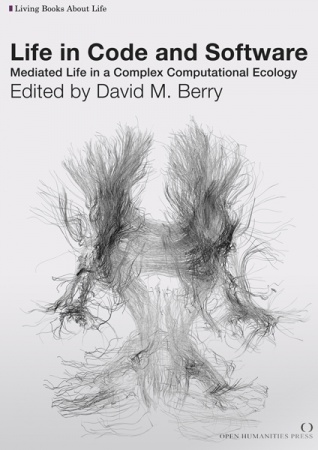

David M. Berry (ed.): Life in Code and Software: Mediated Life in a Complex Computational Ecology (2012)

17 July 2012, dusan

The essays in this collection, edited by David M. Berry, Senior Lecturer in Digital Media in the Department of Political and Cultural Studies at Swansea University, explore the relationship between living, code and software. For Berry, technologies of code and software increasingly make up an important part of our urban environment – indeed, their reach stretches to even quite remote areas of the world. Life in Code and Software introduces and explores the way in which code and software are becoming the conditions of possibility for human living, crucially forming a computational ecology, made up of disparate software ecologies we inhabit. As such we need to take account of this new computational environment, Berry argues, and think about how today we live in a highly mediated, code-based world – a world where computational concepts and ideas are foundational, and within which, code and software become the paradigmatic forms of knowing and doing.

Publisher Open Humanities Press, July 2012
Living Books About Life series
ISBN 9781607852834

View online (wiki/PDF/HTML articles/videos)
Download (PDF’d Introduction with hyperlinked articles)

Bill Stewart: Living Internet (2000)

27 February 2012, dusan

An in-depth reference about the Internet.

The site was written from 1996 through 1999, first published on the web on January 7, 2000, and updated regularly. It has more than 700 pages, 2,000 intra-site links, and 2,000 external links to some of the world’s best online content about the Internet.

The site is authored by Bill Stewart who has used the Internet since 1988, and first appreciated the power of the medium during the Tiananmen Square rebellion in China in 1989, when he saw how the net kept Chinese communities around the world in touch with the events through email and newsgroups, bypassing all government censorship.

View online (HTML)

Philippe Aigrain: Sharing: Culture and the Economy in the Internet Age (2012)

3 February 2012, dusan

In the past fifteen years, file sharing of digital cultural works between individuals has been at the center of a number of debates on the future of culture itself. To some, sharing constitutes piracy, to be fought against and eradicated. Others see it as unavoidable, and table proposals to compensate for its harmful effects. Meanwhile, little progress has been made towards addressing the real challenges facing culture in a digital world.

Sharing: Culture and the Economy in the Internet Age offers a counterpoint to the dominant view that file sharing is piracy, analyzing it rather as the modern form of long recognized rights to share in culture. Sharing starts from a radically different viewpoint, namely that the non-market sharing of digital works is both legitimate and useful. Philippe Aigrain looks at the benefits of file sharing, which allows unknown writers and artists to be appreciated more easily. It supports this premise with empirical research, demonstrating that non-market sharing leads to more diversity in the attention given to various works.

Concentrating not only on the cultural enrichment caused by widely shared digital media, Sharing also discusses new financing models that would allow works to be shared freely by individuals without aim at profit. Aigrain carefully balances the needs to support and reward creative activity with a suitable respect for the cultural common good and proposes a new interpretation of the digital landscape.

With contribution of Suzanne Aigrain
Publisher Amsterdam University Press
Creative Commons BY-NC-ND License
ISBN 9789089643858
244 pages

author
publisher
publisher

Download
Download datasets

David Parry (ed.): Ubiquitous Surveillance (2011-)

19 November 2011, dusan

“In 1996 when John Perry Barlow wrote A Cyberspace Independence Declaration, internet pioneers hoped that the online world Bartlow was describing would come to pass. While Barlow’s rhetoric was admittedly ‘grandiose,’ his central claim, that the internet was a place of freedom separate from the limits of the physical world, reflected the utopic atmosphere of the time. The technological revolution, in particular the rise of the digital network, seemed to point to a future ‘where anyone, anywhere may express his or her beliefs, no matter how singular, without fear of being coerced into silence or conformity’ (Barlow, 1996). While not everyone in the late 90s could be characterized as a cyberutopian, the dominant mood harbored a sense that the digital network would bring with it newfound, unregulatable freedoms.” (from Introduction)

Publisher Open Humanities Press
Living Books About Life series

View online (wiki/PDF/HTML articles)
View online (map interface to the articles)
Direct download (PDF’d Introduction with hyperlinked articles)

Gary Hall (ed.): Digitize Me, Visualize Me, Search Me: Open Science and its Discontents (2011-)

11 November 2011, dusan

“One of the aims of the Living Books About Life series is to provide a ‘bridge’ or point of connection, translation, even interrogation and contestation, between the humanities and the sciences. Accordingly, this introduction to Digitize Me, Visualize Me, Search Me takes as its starting point the so-called ‘computational turn’ to data-intensive scholarship in the humanities.

The phrase ‘the computational turn’ has been adopted to refer to the process whereby techniques and methodologies drawn from computer science and related fields – including science visualization, interactive information visualization, image processing, network analysis, statistical data analysis, and the management, manipulation and mining of data – are being increasingly used to produce new ways of approaching and understanding texts in the humanities – what is sometimes thought of as ‘the digital humanities’.” (from Introduction)

Publisher Open Humanities Press
Living Books About Life series

View online (wiki/PDF/HTML articles/videos)
Direct download (PDF’d Introduction with hyperlinked articles)

Jussi Parikka (ed.): Medianatures: The Materiality of Information Technology and Electronic Waste (2011-)

7 November 2011, dusan

“Medianatures picks up from Donna Haraway’s idea of naturecultures – the topological continuum between nature and culture, the material entwining and enfolding of various agencies, meanings and interactions. Medianatures gives the concept of naturecultures a specific emphasis, and that emphasis is at the core of this living book. It is a useful concept and framework for investigating some of the ways in which our electronic and high-tech media culture is entwined with a variety of material agencies. The notion of ‘materiality’ is taken here in a literal sense to refer, for instance, to ‘plasma reactions and ion implantation’ (Yoshida, 1994: 105) – as in processes of semiconductor fabrication, or to an alternative list of media studies objects and components which are studied from an e-waste management perspective: ‘metal, motor/compressor, cooling, plastic, insulation, glass, LCD, rubber, wiring/electrical, concrete, transformer, magnetron, textile, circuit board, fluorescent lamp, incandescent lamp, heating element, thermostat, brominated flamed retardant (BFR)-containing plastic, batteries, CFC/HCFC/HFC/HC, external electric cables, refractory ceramic fibers, radioactive substances and electrolyte capacitors (over L/D 25 mm)’, and which themselves are constituted from a range of materials – plastics, wood, plywood, copper, aluminum, silver, gold, palladium, lead, mercury, arsenic, cadmium, selenium, hexavalent chromium and flame retardants (Pinto, 2008).” (from Introduction)

Publisher Open Humanities Press
Living Books About Life series

View online (wiki/PDF/HTML articles)
Direct download (PDF’d Introduction with hyperlinked articles)

Recent comments
Recent entries
More resources