John Cage: M: Writings ’67-’72 (1973)
Filed under poetry | Tags: · visual poetry

62 word drawings by John Cage. Mainly mesostics inspired by music, mushrooms, Marcel Duchamp, Merce Cunningham, Marshall McCluhan, etc. and includes “Mureau”-composed from the writings of Henry David Thoreau.
Publisher Wesleyan University Press, 1973
ISBN 0891560359
217 pages
via Headphonetones
In Transition: A Paris Anthology: Writing and Art from Transition Magazine 1927-30 (1990)
Filed under book, magazine, poetry | Tags: · art, avant-garde, dada, expressionism, literary theory, literature, poetry, surrealism
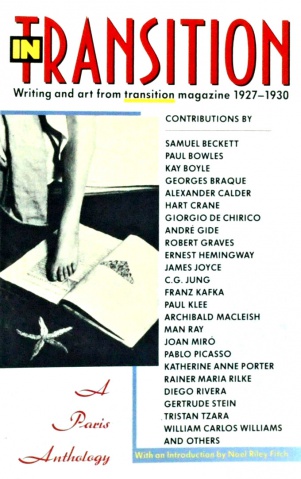
A selection of the some of the best writing to appear in transition, an experimental literary journal that featured surrealist, expressionist, and Dada art and artists. Founded in 1927 by Paris-based poet Eugene Jolas, it was originally intended to serve as an outlet for experimental poetry, but gradually expanded to incorporate contributions from sculptors, photographers, writers, civil rights activists, critics, and cartoonists. The magazine ran through the spring of 1938, with a total of 27 issues published.
With texts by Samuel Beckett, Paul Bowles, Kay Boyle, Georges Braque, Alexander Calder, Hart Crane, Giorgio De Chirico, Andre Gide, Robert Graves, Ernest Hemingway, James Joyce, C. G. Jung, Franz Kafka, Paul Klee, Archibald MacLeish, Man Ray, Joan Miro, Pablo Picasso, Katherine Anne Porter, Rainer Maria Rilke, Diego Rivera, Gertrude Stein, Tristan Tzara, William Carlos Williams and others.
With an Introduction by Noel Riley Fitch
Publisher Anchor Books, Doubleday, New York, 1990
ISBN 0385411502, 9780385411509
256 pages
via leninbert
PDF
Scans of 18 issues of the magazine (at National Library of France)
Kyōjirō Hagiwara: Death Sentence (1925) [Japanese]
Filed under poetry | Tags: · avant-garde, dada, graphic design, japan, poetry, typography, visual poetry

The poetry anthology Shikei senkoku “is one of Mavo’s best-known projects and the group’s only collaborative book design. Mavo executed the entire layout of Hagiwara’s anthology, deciding everything down to the pitch of the text. It is one of the finest examples of a successful integration of text, design, typography, and illustration.
At the time, Shikei senkoku was considered extremely experimental graphically. As Takahashi Shūichirō has noted, it was designed to fit Hagiwara’s persona as a kuroki hannin (black criminal, that is, an anarchist). Without the artistic constraints placed on many commercial publications, Mavo artists were free to produce a strong visual response to the tumultuous poems. Okada did most of the illustrations for the volume, as well as designing the cover. It consists of two bold black lattices on both the left and right borders, a yellow band at the top with the author’s name, a thicker red band with the book title below this, a bluish circle in the center, and a black-and-white grid pattern at the bottom with boxes filled in to create an abstract pattern. The tide consists of irregularly rendered, blocky characters, playfully tilted against one another, creating a horizontal rhythm across the top of the book.
Several of the illustrations inside Shikei senkoku are photographic reproductions of Mavo work already published in the group’s magazine. The rest are abstract linocuts. Line, dot, and arrow border patterns dynamically frame the texts, which are interspersed with full-page illustrations, some featuring bold, black-and-white abstract patterns.
In one example, illustrations by Okada Tatsuo and Yabashi Kimimaro face each other (pp 34-35). Okada’s untitled print, on the right-hand page, is largely rectilinear, with a few crisscrossing diagonals. The Still Life Yawns, Yabashi’s work on the left-hand page, consists of a black rectangular form with white areas cut away inside, producing free-form shapes. In another of Okada’s many untitled designs in Shikei senkoku, an anthropomorphic head springs into the composition from the left, its segmented neck pierced by a long protruding cone; black-and-white abstract shapes and line patterns animate the background (p 155). The typography used for the poems is also experimental, often incorporating symbols and shapes to substitute for characters and letters (pp 130-131).” (from Gennifer Weisenfeld, Mavo, 2002, pp 197-200)
With illustrations by Mavo (Tatsuo Okada, Kimimaro Yabashi, Tomoyoshi Murayama, Masamu Yanase, Hisao Maki, Shuzo Oura, Seiho Sawa, Tatsuo Toda, Michinao Takamizawa)
Publisher Chōryūsha, Tokyo, 1925
161+6 pages
via Waseda University Library, (2)
Commentary (John Solt, 1999)
MAVO at Monoskop wiki
PDF, JPGs (First edition, PDF 46 MB)
PDF, JPGs (Second edition, PDF 48 MB)
HTML (added on 2014-10-8)