

Le concept d’information dans la science contemporaine (1965) [French]
Filed under proceedings | Tags: · communication, computing, cybernetics, information, information theory, machine, mathematics, philosophy, science
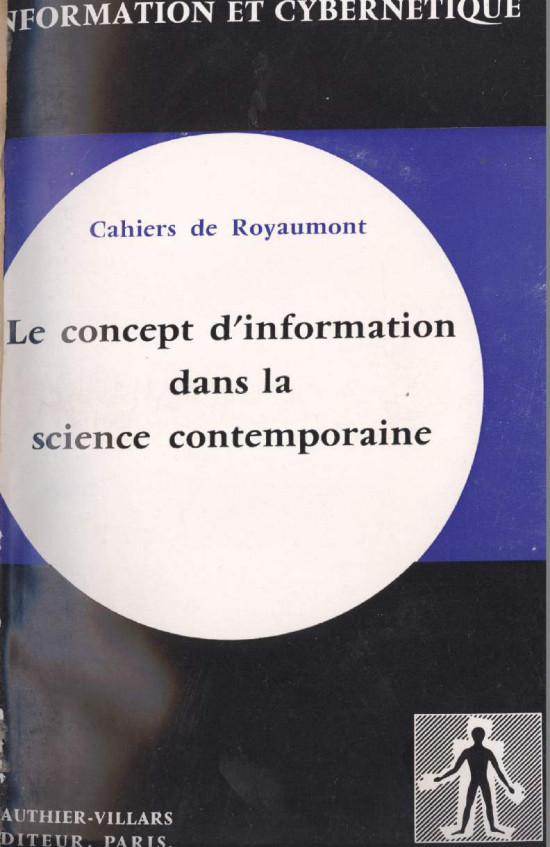
“The proceedings from the Sixth Symposium at Royaumont in 1962 were titled Le concept d’information dans la science contemporaine [The Concept of Information in Contemporary Science] and were published three years later in Paris by Les Éditions de Minuit.
In attendance were Gilbert Simondon, Norbert Wiener, Martial Gueroult, Giorgio de Santillana, Lucien Goldmann, Benoit Mandelbrot, René de Possel, Jean Hyppolite, André Michel Lwoff, Abraham Moles, Ferdinand Alquié, Henryk Greniewski, Helmar Frank, Jiri Zeman, François Bonsack, Louis Couffignal, Albert Perez, Maurice de Gandillac, Ladislav Tondl, Gilles-Gaston Granger, and Stanislas Bellert, among others.
Simondon was a very active organizer and introduced Wiener. The collection is fascinating for a number of reasons; most striking, perhaps, is the fact that a prominent Marxist (Goldmann) and a brilliant mathematician (Mandelbrot) were given equal opportunity to talk philosophically about the concept of information. Mathematicians like Mandelbrot and Wiener were given the same stage as philosophers like Simondon and Hyppolite.
Some of the papers are pretty scientific, but most of them are not. What you get is a collection of papers given and discussed (the Q & As are included and are revealing) by some of the individuals who heavily influenced Deleuze and a number of other French philosophers. This is an incredibly revealing volume and I will eventually work hard to translate some of the papers that are included.
Simondon’s paper, ‘L’Amplification dans les processus d’information’, was not included in the proceedings (only the abstract is provided at the very end of the book, along with the topic of Wiener’s response to Simondon), but was published and is available in the collection of his papers titled Communication and Information: Courses and Conferences (La Transparence, 2010).” (from a blog post by Andrew Iliadis)
Publisher Les Éditions de Minuit, Paris, 1965
425 pages
via Andrew Iliadis, HT babyalanturing
Review: D. Gabor (The British Journal for the Philosophy of Science, 1966, EN).
PDF (36 MB, updated on 2021-3-28)
multiple formats (Internet Archive)
Bruce Clarke, Mark B. N. Hansen (eds.): Emergence and Embodiment: New Essays on Second-Order Systems Theory (2009)
Filed under book | Tags: · autopoiesis, body, cognition, complexity, cybernetics, emergence, neocybernetics, science, systems theory

“Emerging in the 1940s, the first cybernetics—the study of communication and control systems—was mainstreamed under the names artificial intelligence and computer science and taken up by the social sciences, the humanities, and the creative arts. In Emergence and Embodiment, Bruce Clarke and Mark B. N. Hansen focus on cybernetic developments that stem from the second-order turn in the 1970s, when the cyberneticist Heinz von Foerster catalyzed new thinking about the cognitive implications of self-referential systems. The crucial shift he inspired was from first-order cybernetics’ attention to homeostasis as a mode of autonomous self-regulation in mechanical and informatic systems, to second-order concepts of self-organization and autopoiesis in embodied and metabiotic systems. The collection opens with an interview with von Foerster and then traces the lines of neocybernetic thought that have followed from his work.
In response to the apparent dissolution of boundaries at work in the contemporary technosciences of emergence, neocybernetics observes that cognitive systems are operationally bounded, semi-autonomous entities coupled with their environments and other systems. Second-order systems theory stresses the recursive complexities of observation, mediation, and communication. Focused on the neocybernetic contributions of von Foerster, Francisco Varela, and Niklas Luhmann, this collection advances theoretical debates about the cultural, philosophical, and literary uses of their ideas. In addition to the interview with von Foerster, Emergence and Embodiment includes essays by Varela and Luhmann. It engages with Humberto Maturana’s and Varela’s creation of the concept of autopoiesis, Varela’s later work on neurophenomenology, and Luhmann’s adaptations of autopoiesis to social systems theory. Taken together, these essays illuminate the shared commitments uniting the broader discourse of neocybernetics.”
Contributors. Linda Brigham, Bruce Clarke, Mark B. N. Hansen, Edgar Landgraf, Ira Livingston, Niklas Luhmann, Hans-Georg Moeller, John Protevi, Michael Schiltz, Evan Thompson, Francisco J. Varela, Cary Wolfe.
Publisher Duke University Press, 2009
Science and Cultural Theory series
ISBN 0822391384, 9780822391388
xiii+296 pages
Reviews: Ramesh Mishra (MetaPsychology, 2010), Ana Teixeira Pinto (Int’l Studies in the Philosophy of Science, 2011), Jon Goodbun (Radical Philosophy, 2011), Peter Cariani (Constructivist Foundations, 2010).
PDF (updated on 2020-4-17)
Comment (0)Francis Spufford: Red Plenty: Inside the Fifties’ Soviet Dream (2010)
Filed under book | Tags: · 1950s, 1960s, communism, cybernetics, economy, engineering, history of computing, mathematics, politics, science, soviet union

This book is about the moment in the mid-20th century when people believed that the state-owned Soviet economy might genuinely outdo the market, and produce a world of rich communists and envious capitalists. Specifically, it’s about the last and cleverest version of the idea – central planning via cybernetics – and about how and why, in the 1960s, it failed. To give the economics some human depth, Red Plenty generates a miniature Soviet Union on the page, peopled by scientists and politicians, fixers and managers, dreamers and cynics.
Publisher Faber & Faber, 2010
ISBN 0571269478, 9780571269471
356 pages
EPUB (updated on 2019-11-20)
See also:
Red Plenty Platforms, essay by Nick Dyer-Witheford, Culture Machine 14, 2013
Red Plenty: A Crooked Timber, collection of essays inspired by the book, 2012