

Walter Benjamin: Early Writings, 1910-1917 (2011)
Filed under book | Tags: · 1910s, art criticism, cultural criticism, literary criticism, literature, poetry

“Walter Benjamin became a published writer at the age of seventeen. Yet the first stirrings of this most original of critical minds—penned during the years in which he transformed himself from the comfortable son of a haute-bourgeois German Jewish family into the nomadic, uncompromising philosopher-critic we have since come to appreciate—have until now remained largely unavailable in English. Early Writings, 1910-1917 rectifies this situation, documenting the formative intellectual experiences of one of the twentieth century’s most resolutely independent thinkers.
Here we see the young Benjamin in his various roles as moralist, cultural critic, school reformer, and poet-philosopher. The diversity of interest and profundity of thought characteristic of his better-known work from the 1920s and 30s are already in evidence, as we witness the emergence of critical projects that would occupy Benjamin throughout his intellectual career: the role of the present in historical remembrance, the relationship of the intellectual to political action, the idea of truth in works of art, and the investigation of language as the veiled medium of experience.
Even at this early stage, a recognizably Benjaminian way of thinking comes into view—a daring, boundary-crossing enterprise that does away with classical antitheses in favor of the relentlessly-seeking critical consciousness that produced the groundbreaking works of his later years. With the publication of these early writings, our portrait of one of the most significant intellects of the twentieth century edges closer to completion.”
The book is a translation of selections from Walter Benjamin, Gesammelte Schriften, 1972-1989, Suhrkamp Verlag
Translated by Howard Eiland and Others
Publisher Belknap Press of Harvard University Press, Cambridge/MA and London, 2011
ISBN 0674049934, 9780674049932
303 pages
Benjamin at Monoskop wiki
publisher
Stephen Ramsay: Reading Machines: Toward an Algorithmic Criticism (2011)
Filed under book | Tags: · algorithm, digital humanities, literary criticism, machine, pataphysics, text, turing machine

“Rethinking digital literary criticism by situating computational work within the broader context of the humanities
Besides familiar and now-commonplace tasks that computers do all the time, what else are they capable of? Stephen Ramsay’s intriguing study of computational text analysis examines how computers can be used as “reading machines” to open up entirely new possibilities for literary critics. Computer-based text analysis has been employed for the past several decades as a way of searching, collating, and indexing texts. Despite this, the digital revolution has not penetrated the core activity of literary studies: interpretive analysis of written texts.
Computers can handle vast amounts of data, allowing for the comparison of texts in ways that were previously too overwhelming for individuals, but they may also assist in enhancing the entirely necessary role of subjectivity in critical interpretation. Reading Machines discusses the importance of this new form of text analysis conducted with the assistance of computers. Ramsay suggests that the rigidity of computation can be enlisted by intuition, subjectivity, and play.”
Publisher University of Illinois Press, 2011
Topics in the Digital Humanities series
ISBN 0252078209, 9780252078200
98 pages
Review: Matt Schneider (Digital Studies).
Comment (0)Vladislav Vančura: Řád nové tvorby (1972) [Czech]
Filed under book | Tags: · architecture, art criticism, art theory, avant-garde, cultural criticism, film criticism, linguistics, literary criticism, literature, theatre
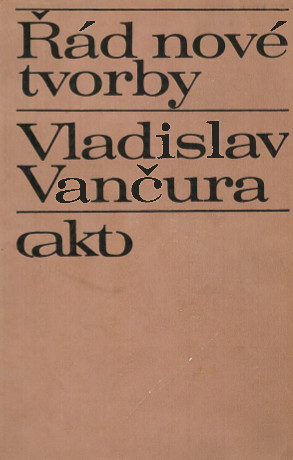
Souborné vydání statí, přednášek, referátů, lektorských posudků a glos o literatuře, filmu, výtvarném umění Vladislava Vančury.
Edited by Milan Blahynka a Štěpán Vlašín
Publisher Svoboda, Prague, 1972
635 pages
via Ústav pro českou literaturu AV ČR
Vančura at Wikipedia (Czech)
Comment (0)