
LEF, 1-7 (1923-25), & Novyi LEF, 1-24 (1927-29) [Russian, English]
Filed under magazine | Tags: · 1920s, art, art criticism, art theory, avant-garde, constructivism, factography, film, film theory, futurism, left, literature, poetry, productivism, revolution, russia, soviet union

LEF (“ЛЕФ”) was the journal of the Left Front of the Arts (“Левый фронт искусств” – “Levy Front Iskusstv”), a widely ranging association of avant-garde writers, photographers, critics and designers in the Soviet Union. It had two runs, one from 1923 to 1925 as LEF, and later from 1927 to 1929 as Novyi LEF (‘New LEF’). The journal’s objective, as set out in one of its first issues, was to “re-examine the ideology and practices of so-called leftist art, and to abandon individualism to increase art’s value for developing communism.”
Although LEF was catholic in its choices of writers, it broadly reflected the concerns of the Productivist left-wing of Constructivism. The editors were Osip Brik and Vladimir Mayakovsky: fittingly, one a Russian Formalist critic and one a poet and designer who helped compose the 1912 manifesto of Russian Futurists entitled, “A Slap in the Face of Public Taste”. The covers were designed by Alexander Rodchenko, and featured photomontages early on, being followed by photographs in New LEF. Among the writings published in LEF for the first time were Mayakovsky’s long poem About This, and Sergei Eisenstein’s The Montage of Attractions, as well as more political and journalistic works like Isaac Babel’s Red Cavalry. The journal had funding from the state, and was discussed critically, but not unsympathetically by Leon Trotsky in Literature and Revolution (1924).
The later New LEF (“Новый ЛЕФ” – “Novyi Lef”), which was edited by Mayakovsky along with the playwright, screenplay writer and photographer Sergei Tretyakov, tried to popularise the idea of ‘Factography’: the idea that new technologies such as photography and film should be utilised by the working class for the production of ‘factographic’ works. In this it had a great deal of influence on theorists in the West, especially Walter Benjamin and Bertolt Brecht. Linked journals also appeared such as the Constructivist architectural journal SA (edited by Moisei Ginzburg and Alexander Vesnin) and Proletarskoe Foto, on photography. The New LEF closed in 1929 over a dispute over its direction between Mayakovsky and Tretyakov, and under pressure for its ‘Formalism’, which jarred with the incipient Socialist Realism. (from Wikipedia)
LEF, 1-7 (ZIP; updated on 2012-7-19)
Novyi LEF, 1-24 (ZIP; updated on 2012-7-19)
All issues in PDF (added on 2015-7-21)
All issues in HTML (added on 2015-8-11)
English translations of selected essays (trans., ed. & intro. Richard Sherwood (LEF) and Ben Brewster (Novy LEF), Screen 12(4), Winter 1971-72; added on 2015-7-21)
De Stijl magazine (1917-1921) [Dutch]
Filed under magazine | Tags: · architecture, art, art criticism, art theory, avant-garde, de stijl, literature, neoplasticism, painting, poetry
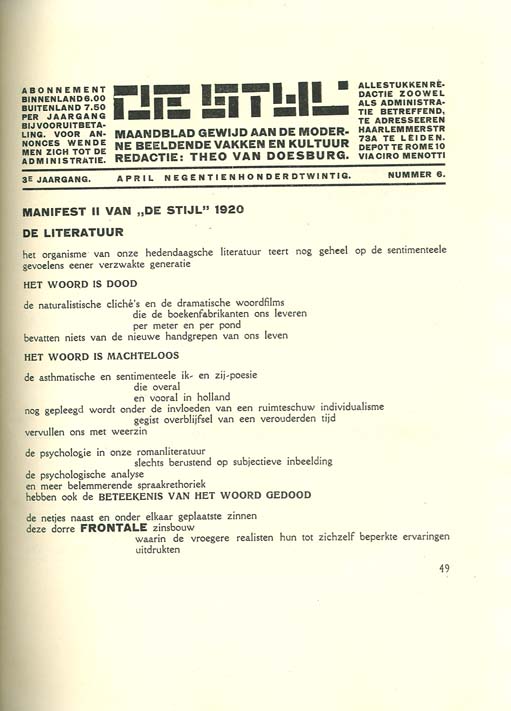
De Stijl, Dutch for “The Style”, also known as neoplasticism, was a Dutch artistic movement founded in 1917. In a narrower sense, the term De Stijl is used to refer to a body of work from 1917 to 1931 founded in the Netherlands. De Stijl is also the name of a journal that was published by the Dutch painter, designer, writer, and critic Theo van Doesburg (1883–1931), propagating the group’s theories. Though the magazine never sold more than 300 copies, it had a strong influence on art in the Netherlands and abroad.
De Stijl: Maanblad gewijd aan de moderne beeldende vakken en kultuur
Edited by Theo van Doesburg
Published in Delft (1917-18) and Leiden (1918-21)
Claire Huot: China’s New Cultural Scene: A Handbook of Changes (2000)
Filed under book | Tags: · art, avant-garde, china, cinema, cultural revolution, film, literature, music

The Cultural Revolution of China’s Maoist era has come and gone, yet another cultural revolution of a different sort has been sweeping through China in the 1990s. Although recently much interest has been focused on China’s economy, few Westerners are aware of the remarkable transformations occurring in the culture of ordinary people’s daily lives. In China’s New Cultural Scene Claire Huot surveys the wide spectrum of art produced by Chinese musicians, painters, writers, performers, and filmmakers today, portraying an ongoing cultural revolution that has significantly altered life in the People’s Republic.
Western observers who were impressed by the bravery of the demonstrators in Tiananmen Square—and stunned at the harshness of their suppression—will learn from this book how that political movement led to changes in cultural conditions and production. Attending to all the major elements of this vast nation’s high and low culture at the end of a landmark decade, Huot’s discussion ranges from the cinematic works of Zhang Yimou, Chen Kaige, and others to emerging musical forms such as rock, punk, and rap. Other topics include television, theater, and avant-garde art, the new electronic media, and subversive trends in both literature and the visual arts.
With a comprehensive index of artists and works, as well as a glossary of Chinese words, China’s New Cultural Scene will enlighten students of Chinese culture and general readers interested in contemporary Asia.
Publisher Duke University Press, 2000
ISBN 0822324458, 9780822324454
258 pages
PDF (no OCR; updated on 2012-7-14)
Comment (0)