

Stéphane Hessel: Time for Outrage! (2010-) [FR, EN, DE, IT, PT, GA]
Filed under pamphlet | Tags: · activism, democracy, economy, financial crisis, politics, protest, resistance

This controversial, impassioned call-to-arms for a return to the ideals that fueled the French Resistance has sold millions of copies worldwide since its publication in France in October 2010. Rejecting the dictatorship of world financial markets and defending the social values of modern democracy, 93-old Stéphane Hessel — Resistance leader, concentration camp survivor, and former UN speechwriter — reminds us that life and liberty must still be fought for, and urges us to reclaim those essential rights we have permitted our governments to erode since the end of World War II.
French edition
Publisher Indigène éditions, Montpellier, October 2010
ISBN 9782911939767
32 pages
English edition
Translated by Damion Searls
Publisher Published by Charles Glass Books, an imprint of Quartet Books
ISBN 0704372223, 9780704372221
40 pages
via Cari
commentary (Charles Glass, The Nation)
wikipedia (FR)
wikipedia (EN)
publisher (FR)
publisher (EN)
Indignez-vous! (French, 6th edition, December 2010, PDF)
Time for Outrage! (English, 2011, EPUB)
Time for Outrage! (English, published in The Nation, March 2011, PDF)
Empört Euch! (German, trans. Michael Kogon, 2011, PDF)
Empört Euch! (German, trans. Michael Kogon, 2011, EPUB)
Indignatevi! (Italian, Scribd.com, February 2011)
Indignai-vos! (Portuguese, trans. Marly Peres, 2011, PDF)
Indignádevos (Galician, trans. Henrique Harguindey, 2011, Scribd.com)
Nato Thompson, Gregory Sholette (eds.): The Interventionists: Users’ Manual for the Creative Disruption of Everyday Life (2004)
Filed under book, catalogue | Tags: · activism, art, cyberfeminism, education, participation, political art, politics, situationists, tactical media
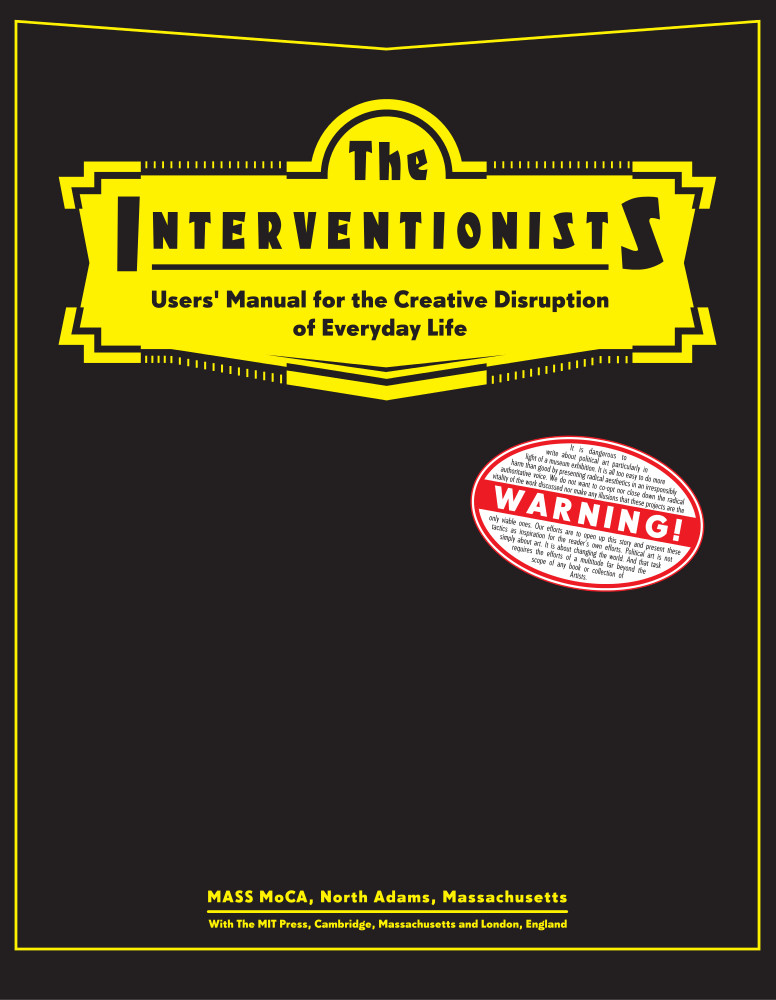
“Art made to attach to buildings or to be given away? Wearable art for street demonstrations or art that sets up a booth at a trade show? This is the art of the interventionists, who trespass into the everyday world to raise our awareness of injustice and other social problems. These artists don’t preach or proselytize; they give us the tools to form our own opinions and create our own political actions. The Interventionists, which accompanies an exhibit at MASS MoCA, serves as a handbook to this new and varied work. It’s a user’s guide to art that is exciting, provocative, unexpected, inspiring (artistically and politically), and fun. From Michael Rakowitz’s inflatable homeless shelter and William Pope.L’s “Black Factory” truck with pulverizer, gift shop, and giant inflatable igloo to the Biotic Baking Brigade’s political pie-throwing, the art of The Interventionists surveys a growing genre and offers a guide for radical social action.
The book classifies the artists according to their choice of tactics: the Nomads, who create mobile projects; Reclaim the Streets, artists who act in public places; Tools for Resistance: Ready to Wear, artists who produce fashion for political action; and the Experimental University, artists whose work engages pedagogy and theory. The accompanying text includes essays by noted scholars putting the work in a broader cultural and social context as well as texts by the artists themselves.”
With contributions by Nicholas Mirzoeff and Ondine C. Chavoya
With graphics by Arjen Noordeman
Publisher MASS MoCA Publications, North Adams/MA, 2004
154 pages
PDF (updated on 2019-12-18)
Comment (0)Krisis: Journal for Contemporary Philosophy, 3: Civil Disobedience (2012)
Filed under journal | Tags: · activism, disobedience, occupy movement, philosophy, politics, protest, resistance, theory

“Some of the most prominent theories of civil disobedience, e.g. those of Rawls and Habermas, highlight its primarily or even exclusively symbolic character. This, however, seems to reduce civil disobedience to a purely moral appeal. On a theoretical as well as on a practical level we are today faced with the question whether civil disobedience requires a moment of real confrontation for it to be politically effective. It seems that civil disobedience does in fact have an irreducible symbolic dimension, but that it cannot be reduced to this dimension, because without moments of real confrontation it would also lose its symbolic power and turn into a mere appeal to the conscience of the powers that be. The articles in this special section highlight various of the challenges and possibilities the theory and practice of civil disobedience is confronted with today, from the question whether Paraguayan campesinos have a right of necessity also to uncivil actions via the political potential of the apparently criminal behaviour of marginalized migrants and the effects of ‘hermeneutic invisibility’ on the public nature of civil disobedience to the effects rise of ‘art activism’ on the relation between the social and the artistic and the situatedness of the bodies of protesters in relation to changing police tactics.
In ‘The Misadventures of Critical Thinking’ Jacques Rancière explores the anti-emancipatory effect of an artistic and theoretical critique that specializes in unmasking how all attempts at critique are always already anticipated and incorporated by ‘the system’, suggesting that we should instead focus on what he calls ‘scenes of dissensus’. As Joost de Bloois argues in his comment on Rancière’s text, however, this analysis might not only underestimate the complexity of this unmasking critique, it also seems to run into some of the same problems it diagnoses.
In our interview with Wendy Brown we discuss the emancipatory potential as well as the theoretical and political limits of the notions of democracy and communism, the paranoid practice of walling with which states seem to compensate their waning sovereignty, the Occupy movement and the danger of Oedipalization, the varieties of secularism, and the responsibility of teaching.”
Published in Amsterdam, 2012
101 pages
via Jappe Groenendijk