

Jane Pavitt: Fear and Fashion in the Cold War (2008)
Filed under book | Tags: · 1940s, 1950s, 1960s, cold war, cybernetics, fashion, military, politics
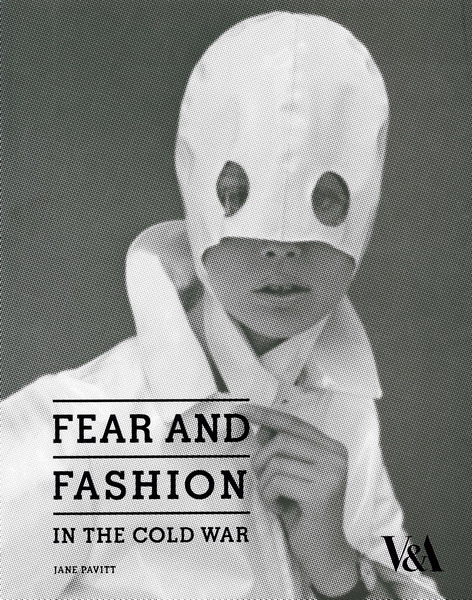
From Barbarella’s bikini to vinyl radiation suits to high-tech jewelry, the Cold War’s impact on fashion was unmistakable.
Atomic anxieties, the space race, technological developments, and the first forays into “super-reality” led to innovations in materials, the cybernetic visions of the 1960s, and a range of surprising responses from artists, filmmakers, scientists, and designers. With a stunning selection of images, including photographs by fashion luminaries such as John French, Fear and Fashion in the Cold War explores how the image of the body was shaped by Cold War concerns between 1945 and 1970. In this engaging book, Jane Pavitt incorporates military, political, and scientific research in an engrossing discussion of how countercultural theories and experiences in the later 1960s shaped an alternative view of the “Cold War Body.”
Publisher V&A, London, 2008
ISBN 1851775447, 9781851775446
128 pages
via Royal College of Art
Software: Information Technology: Its New Meaning for Art, catalogue (1970)
Filed under catalogue | Tags: · art, computer art, computing, conceptual art, cybernetics, machine, software, software art
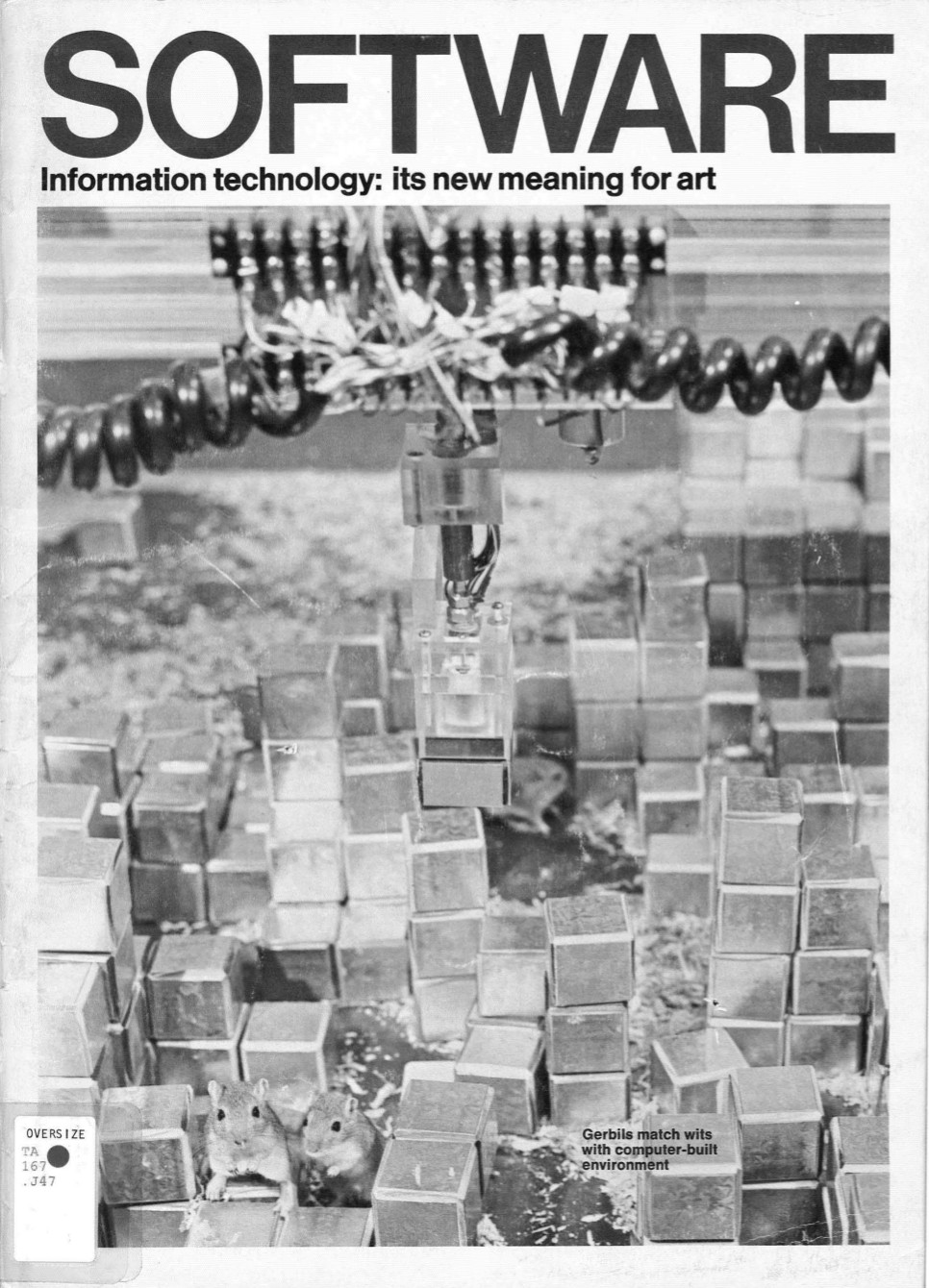
Software was a show curated by an artist and critic Jack Burnham for the Jewish Museum in Brooklyn, New York City, 16 September – 8 November 1970, and the Smithsonian Institution, Washington, D.C., 16 December 1970 – 14 February 1971. The show put together computers and conceptual artists, linking them through the idea of software as a process or a program to be carried out by a machine or, why not, by the audience based on “instruction lines” formulated by the artist.
Participating artists: Vito Acconci, David Antin, Architecture Group Machine M.I.T., John Baldessari, Robert Barry, Linda Berris, Donald Burgy, Paul Conly, Agnes Denes, Robert Duncan Enzmann, Carl Fernbach-Flarsheim, John Godyear, Hans Haacke, Douglas Huebler, Joseph Kosuth, Nam June Paik, Alex Razdow, Sonia Sheridan, Evander D. Schley, Theodosius Victoria, Laurence Weiner.
Catalogue coordinator Judith Benjamin Burnham
Publisher The Jewish Museum, 1970
71 pages
via Marina Noronha <3
more about the show (Monoskop wiki)
more about Jack Burnham (Monoskop wiki)
PDF (no OCR, black&white)
Comments (2)Armin Medosch: Automation, Cybernation and the Art of New Tendencies, 1961-1973 (2012)
Filed under thesis | Tags: · 1960s, 1970s, art, art history, computer art, computing, cybernetics, informational capitalism, media art, politics, technology, yugoslavia
“My research investigates exhibitions as sites of research and appraises the possibilities and contradictions of a progressive and socially engaged media art practice. The international art movement New Tendencies (NT) (1961-1973) provides the material evidence through its exhibitions, symposia, artworks, catalogues, newsletters and artist’s statements. The basic methodological assumption behind my research is that new insights are gained by questioning the various interdependencies between NT and historical change.
NT was searching for a synthesis between socialist emancipation and artistic modernism by proposing to replace the notion of art with visual research. The project emerged in Zagreb, capital of Croatia which was then part of Yugoslavia, a Socialist nation which did not belong to the Eastern bloc and experimented with market Socialism combined with social self-management and self-government. Yugoslavia’s unique role between the hegemonic power blocs made it possible that an international, humanistic, and progressive art movement could emerge from its territory.
With every exhibition and conference NT articulated its artistic position and set itself into relation with the respective techno-economic paradigm. NT began during the height of Fordism, continued during Fordism’s moment of crisis in 1968, and ended when a new paradigm – informational capitalism – started to develop from within the old one. In this historical context, my hypothesis is that NT’s exploration of participatory art stands in direct relation to the rise of automation and cybernation in society. A further layer of inquiry is the historically changing relationship between manual and intellectual labour and how art addresses it.
By contextualising NT my research contributes a new dimension to the history of media art. Through the chosen methodology, a new understanding is gained not only of this important art movement but of the general dynamics of media art in the second half of the 20th century.” (Abstract)
Doctoral thesis
Arts and Computational Technology, Goldsmiths, University of London
369 pages
PDF, PDF (updated on 2015-7-12)
Comment (0)