

Kontekst Archive 06/07/08 (2008) [English/Serbian]
Filed under brochure | Tags: · contemporary art, critique, kosovo, nationalism, politics, roma, serbia, sex work, society, surveillance, war

Gallery Kontekst represents one of the politically most important initiatives in Belgrade in the field of contemporary art. Through critical approach to the social reality and persistence to initiate
discussion on topics that are rarely discussed and thus take part in struggles against most conservative social processes, the team of *Kontekst Gallery *created unique space in the cultural-artistic scene in Belgrade. Some of the issues that Kontekst and people involved in its work dealt with (in collaboration with other artists, theorists, cultural workers and activists) are sex work (“Sex, Work and Society” project), Serbian nationalism and wars in Yugoslavia (especially through censored exhibition “Exception, contemporary art scene of Prishtina”), racism in Serbia (especially in relation to Roma community through actions against demolition and fencing of a Roma slum during the international sport event Universiade), contemporary mechanisms of surveillance (“Control and Resistance on the Street” project), privatization and illegal appropriation of public space (“Fifth Park-Struggle for the Everyday” project), homophobia (collaboration with QueerBelgrade festival), critical approach toward the process of the expansion of the European Union and its mechanisms of exclusion (Without Borders? project), etc.
The publication features interviews and program selection from 2006 to 2008.
Editors: Vida Knežević, Ivana Marjanović
Translation Novica Petrović, Vida Knežević, Ivana Marjanović
Publisher: Kontekst, Belgrade, 2008
ISBN 978-86-87291-01-0
208 pages
more info
gallery currently demands a new space
Norbert Wiener: The Human Use of Human Beings: Cybernetics and Society (1950–) [EN, FR, BR-PT, RU, ES, SC, IT, GR]
Filed under book | Tags: · computing, cybernetics, entropy, machine, society, theory of communication
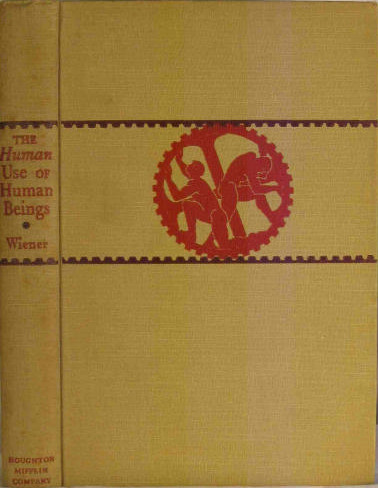
“Founder of the science of cybernetics—the study of the relationship between computers and the human nervous system—Wiener was widely misunderstood as one who advocated the automation of human life. As this book reveals, his vision was much more complex and interesting. He hoped that machines would release people from relentless and repetitive drudgery in order to achieve more creative pursuits. At the same time he realized the danger of dehumanizing and displacement. His book examines the implications of cybernetics for education, law, language, science, technology, as he anticipates the enormous impact—in effect, a third industrial revolution—that the computer has had on our lives.”
Publisher Houghton Mifflin, Boston, 1950
241 pages
New edition
With an Introduction by Steve J. Heims
Published by Free Association Books, London, 1989
ISBN 1853430757
xxx+199 pages
Wikipedia (EN)
The Human Use of Human Beings: Cybernetics and Society (English, 1950, added on 2021-4-8)
The Human Use of Human Beings: Cybernetics and Society (English, 1950/1989, updated on 2021-4-8)
Cybernétique et société: l’usage humain des êtres humains (French, 1952/2014, EPUB, added on 2021-4-8)
Cibernética e sociedade: o uso humano de seres humanos (BR-Portuguese, trans. José Paulo Paes, 2nd ed., 1954/1968, added on 2013-12-12)
Kibernetika i obshchestvo (Russian, trans. E.G. Panfilov, 1958, DJVU, added on 2021-4-8)
Cybernética y sociedad (Spanish, trans. José Novo Cerro, 1958, added on 2021-4-8)
Kibernetika i društvo: ljudska upotreba ljudskih bića (Serbo-Croatian, trans. Ljubomir Radanović, 1964, added on 2021-4-8)
Introduzione alla cibernetica: l’uso umano degli esseri umani (Italian, trans. Dario Persiani, 1966, added on 2021-4-8)
Kyvernētikē kai koinōnia: ē anthrōpinē chrēsimopoiēsē tōn anthrōpinōn ontōn (Greek, trans. Giannē Iōannidē, 1970, DJVU, added on 2021-4-8)
Sarai Reader 08: Fear (2010)
Filed under book | Tags: · communication, economy, politics, society

Fear aims to question how fear and anxiety shape individual and collective dispositions, how lives and social processes are designed around and against them, and what effects they have on our politics and our economy. It is especially interested in fear as language, as mode of communication, as a way of ordering and rendering the world.
Edited by: Monica Narula, Shuddhabrata Sengupta and Jeebesh Bagchi
Assistant Editor: Shyama Haldar Kilpady
Sarai Reader Editorial Collective: Monica Narula, Shuddhabrata Sengupta, Ravi Sundaram, Ravi Vasudevan, Awadhendra Sharan + Jeebesh Bagchi
Produced and Designed at the Sarai Media Lab, Delhi
Translations: Shveta Sarda
Published by The Director, Centre for the Study of Developing Societies, Delhi, india
ISBN 9788190585323
312 pages
PDF (updated on 2014-8-29)
PDFs (added on 2015-12-7)