

Winnie Soon, Geoff Cox: Aesthetic Programming: A Handbook of Software Studies (2020)
Filed under handbook | Tags: · aesthetics, algorithm, code, computation, data, programming, software, software studies
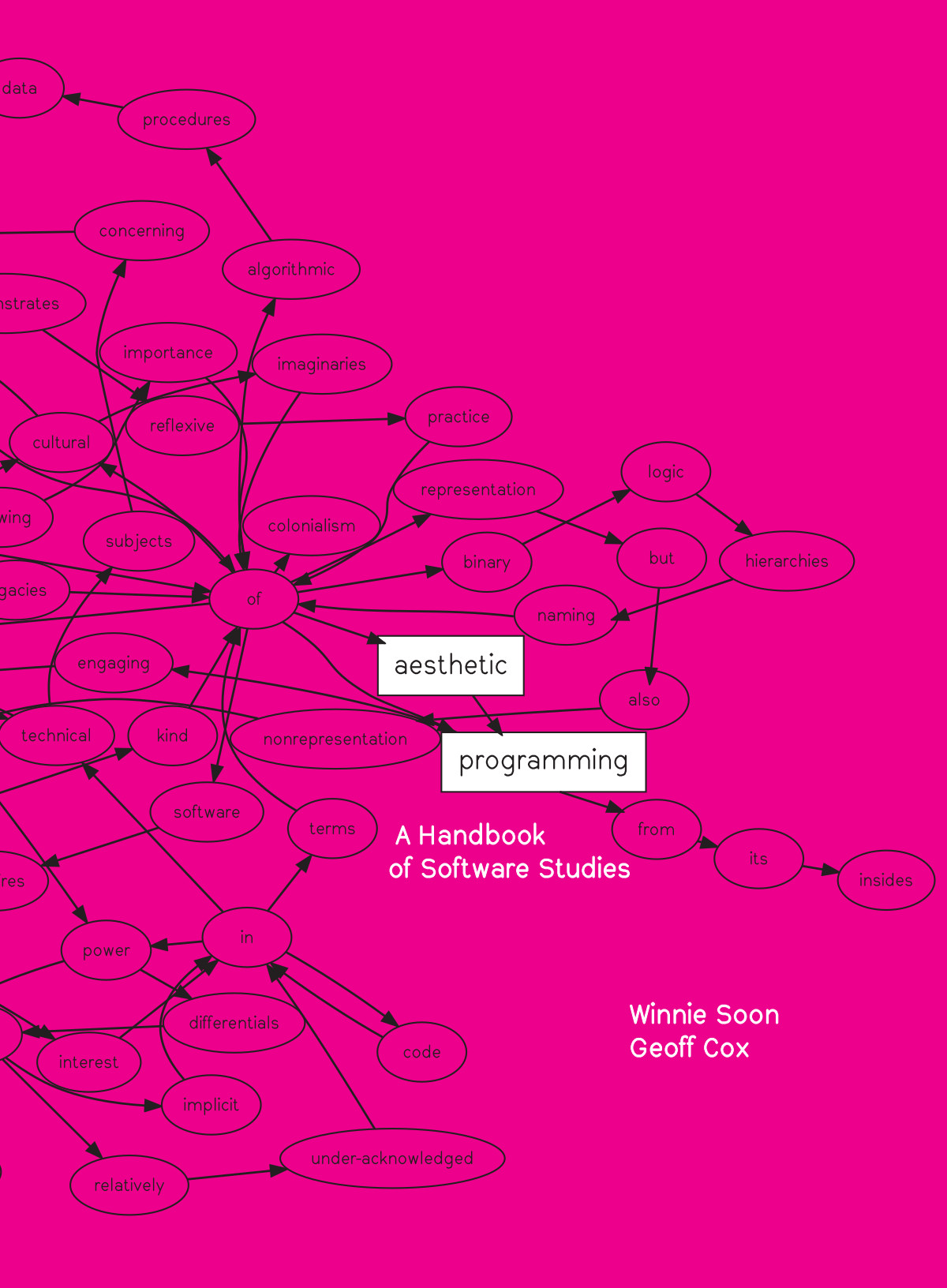
“Aesthetic Programming explores the technical as well as cultural imaginaries of programming from its insides. It follows the principle that the growing importance of software requires a new kind of cultural thinking — and curriculum — that can account for, and with which to better understand the politics and aesthetics of algorithmic procedures, data processing and abstraction. It takes a particular interest in power relations that are relatively under-acknowledged in technical subjects, concerning class and capitalism, gender and sexuality, as well as race and the legacies of colonialism. This is not only related to the politics of representation but also nonrepresentation: how power differentials are implicit in code in terms of binary logic, hierarchies, naming of the attributes, and how particular worldviews are reinforced and perpetuated through computation.
Using p5.js, it introduces and demonstrates the reflexive practice of aesthetic programming, engaging with learning to program as a way to understand and question existing technological objects and paradigms, and to explore the potential for reprogramming wider eco-socio-technical systems. The book itself follows this approach, and is offered as a computational object open to modification and reversioning.”
Publisher Open Humanities Press, 2020
Creative Commons BY-SA License
ISBN 9781785420948
293 pages
Review: David Young (Computational Culture, 2021).
PDF, PDF
HTML (added on 2021-6-8)
Git
DJ Lynnée Denise: Toni Morrison Inna London: Sonic Connections and the Literary Imagination (2020)
Filed under music video, video | Tags: · black people, djing, literature, women
“In this work, DJ Lynnée Denise offers a layered audio-visual response to the 1986 Guardian talk with Toni Morrison at the ICA. The visual essay brings together intimate reflections and propositions framed by Morrison’s 1992 novel Jazz. DJ Lynnée Denise explores the Black Atlantic sound, visuals and craft to render the life worlds behind Morrison’s oeuvre visible. Morrison’s writing is expanded into a visual vocabulary in which transatlantic conversations and new connections emerge. A praxis in translation.
Claudia Jones. Eartha Kitt. Fannie Lou Hamer. Lorraine Hansberry. Winnie Mandela. Sarah Vaughn. Lady G. Sister Rosetta Tharpe. Elizabeth Cotton. Augusta Savage. Judy Mowatt.
DJ Lynnée Denise creates what Louis Chude Sokei calls a diasporic “echo chamber” of Black women’s craft animated by the bricolage of drum and bass in which the sonic influences of Black Britain and Black America are an electronic undercurrent. The drum machine mixed with Morrison’s gestures, mannerisms, and reading speak to how Morrison’s is experienced through a multi-sensory engagement.
In Morrison’s interview with A.S. Byatt, she references the important inspiration of paintings in her writing practice and the relationship between musicians and their audience. In this work, a visual remixing of worlds happens in which Black girls jumping rope, everyday live in Harlem, the market space in Brixton are the aesthetics to Morrison’s writing or in her words “the access to the scene”. In DJ Lynnée Denise’s rendering, “the scene” is about Black wayward diasporic women whose craft is read through astrology, the politics of refusal and the secrets of Black social life.”
Publisher Institute of Contemporary Arts, London, March 2020
28 minutes
via ICA’s Five Volumes for Toni Morrison, HT dubravka
Interview with author: Chandra Frank (Journal of Popular Music Studies, 2020).
MP4 (218 MB)
Comment (0)Cedric J. Robinson: Black Marxism: The Making of the Black Radical Tradition (1983–)
Filed under book | Tags: · black people, capitalism, communism, marxism, race, slavery, socialism
“In this ambitious work, Cedric Robinson demonstrates that efforts to understand black people’s history of resistance solely through the prism of Marxist theory are incomplete and inaccurate. Marxist analyses tend to presuppose European models of history and experience that downplay the significance of black people and black communities as agents of change and resistance. Black radicalism must be linked to the traditions of Africa and the unique experiences of blacks on western continents, Robinson argues, and any analyses of African American history need to acknowledge this.
To illustrate his argument, Robinson traces the emergence of Marxist ideology in Europe, the resistance by blacks in historically oppressive environments, and the influence of both of these traditions on such important twentieth-century black radical thinkers as W. E. B. Du Bois, C. L. R. James, and Richard Wright.”
Foreword by Robin D. G. Kelley
Publisher Zed Press, London, 1983
487 pages
Second edition
New Preface by the author
Publisher University of North Carolina Press, Chapel Hill, NC, 2000
ISBN 0807848298, 9780807848296
xxxiii+436 pages
Third edition, Revised and updated
New Preface by Damien Sojoyner and Tiffany Willoughby-Herard
Publisher University of North Carolina Press, Chapel Hill, NC, 2021
ISBN 1469663724, 9781469663722
liii+436 pages
Commentary: Robin D. G. Kelley (Boston Review, 2017), .
Reviews: Cornel West (Monthly Review, 1988), Black Perspectives roundtable (2016): Paul Hébert, Joshua Guild, Jennifer L. Morgan, Carole Boyce Davies, Austin McCoy, Robyn C. Spencer; Bedour Alagraa (CLR James Journal, 2018), Austin Smidt (PPE Sydney, 2020), Minkah Makalani (Boston Review, 2021).
PDF (2nd ed., 2000, 14 MB)
PDF (3rd ed., 2020, 4 MB)
See also Robinson’s An Anthropology of Marxism (2001).
Comment (0)