

Walter Benjamin: The Work of Art in the Age of Its Technological Reproducibility (1936-) [FR, DE, CZ, RU, SK, ES, PT, EN]
Filed under book | Tags: · architecture, art, cinema, film, film theory, mass media, media theory, philosophy, photography

“Benjamin‘s famous ‘Work of Art’ essay sets out his boldest thoughts–on media and on culture in general–in their most realized form, while retaining an edge that gets under the skin of everyone who reads it. In this essay the visual arts of the machine age morph into literature and theory and then back again to images, gestures, and thought.
This essay, however, is only the beginning of a vast collection of writings that the editors have assembled to demonstrate what was revolutionary about Benjamin’s explorations on media. Long before Marshall McLuhan, Benjamin saw that the way a bullet rips into its victim is exactly the way a movie or pop song lodges in the soul.
This book contains the second, and most daring, of the four versions of the ‘Work of Art’ essay–the one that addresses the utopian developments of the modern media. The collection tracks Benjamin’s observations on the media as they are revealed in essays on the production and reception of art; on film, radio, and photography; and on the modern transformations of literature and painting. The volume contains some of Benjamin’s best-known work alongside fascinating, little-known essays–some appearing for the first time in English. In the context of his passionate engagement with questions of aesthetics, the scope of Benjamin’s media theory can be fully appreciated.”
Edited by Michael W. Jennings, Brigid Doherty, and Thomas Y. Levin
Translated by Edmund Jephcott, Rodney Livingstone, Howard Eiland, and others
Publisher The Belknap Press of Harvard University Press, Cambridge/MA and London, 2008
ISBN 0674024451, 9780674024458
448 pages
Wikipedia (EN)
The Work of Art in the Age of Its Technological Reproducibility, and Other Writings on Media (English, 2008, updated on 2019-12-9)
Versions and translations of the essay “Work of Art..”:
L’œuvre d’art à l’époque de sa reproduction méchanisée (French, trans. Pierre Klossowski, 1936, updated on 2013-1-12)
Das Kunstwerk im Zeitalter seiner technischen Reproduzierbarkeit (German, 1963, added on 2014-3-10)
Umělecké dílo v době své technické reprodukovatelnosti (Czech, trans. Věra Saudková, 1979, added on 2014-3-10)
Das Kunstwerk im Zeitalter seiner technischen Reproduzierbarkeit. Dritte Fassung (German, 1980, added on 2014-3-10)
Proizvedenie iskusstva v epokhu ego tekhnicheskoy vosproizvodimosti. Izbrannye esse (Russian, trans. S.A. Romashko, 1996, added on 2013-1-12)
Umelecké dielo v epoche svojej technickej reprodukovateľnosti (Slovak, trans. Adam Bžoch, 1999, added on 2014-3-10)
La obra de arte en la época de su reproductibilidad técnica. Urtext (Spanish, trans. Andrés E. Weikert, 2003, added on 2014-3-10)
A obra de arte na época da sua possibilidade de reprodução técnica. 3ª versão (Portuguese, trans. João Barrento, 2006, added on 2014-3-10)
For more versions of the essay see Benjamin’s bibliography on Monoskop wiki.
Comments (2)John Armitage (ed.): Virilio Live: Selected Interviews (2001)
Filed under book | Tags: · art, cultural theory, cyberwar, interview, land art, new media, philosophy, speed, technoculture

“Edited by one of the leading Virilio authority’s, this book offers the reader a guide through Virilio’s work. Using the interview form, Virilio speaks incisively and at length about a vast assortment of cultural and theoretical topics, including architecture and `speed-space’, `chronopolitics’, art and technoculture, modernism, postmodernism and `hypermodernism’, the time of the trajectory and the `information bomb’. His thoughts on Foucault, Baudrillard, Deleuze and Guattari, the performance artist Stelarc, the Persian War and the Kosovo War, are also gathered together.”
Publisher Sage, 2001
ISBN 0761968601, 9780761968603
218 pages
PDF (updated on 2020-6-3)
Comments (6)Florian Cramer: Words Made Flesh: Code, Culture, Imagination (2005)
Filed under book | Tags: · art, art history, code, code poetry, computation, experimental literature, kabbalah, language, literature, philosophy, poetry, religion, software, software art, technology
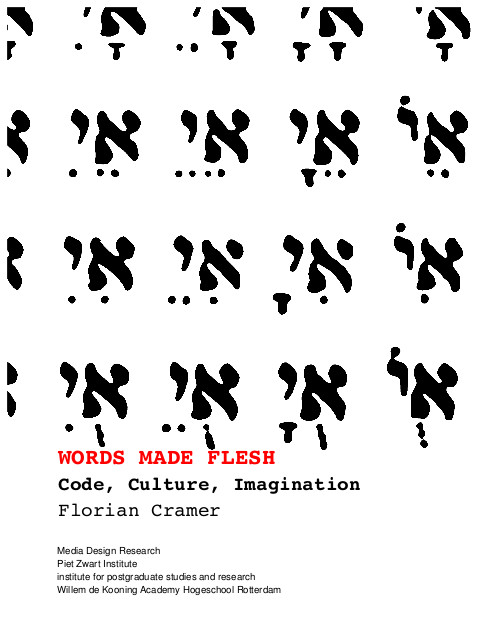
“Executable code existed centuries before the invention of the computer in magic, Kabbalah, musical composition and experimental poetry. These practices are often neglected as a historical pretext of contemporary software culture and electronic arts. Above all, they link computations to a vast speculative imagination that encompasses art, language, technology, philosophy and religion. These speculations in turn inscribe themselves into the technology. Since even the most simple formalism requires symbols with which it can be expressed, and symbols have cultural connotations, any code is loaded with meaning. This booklet writes a small cultural history of imaginative computation, reconstructing both the obsessive persistence and contradictory mutations of the phantasm that symbols turn physical, and words are made flesh.”
Editor: Matthew Fuller, additional corrections: T. Peal
Published within Media Design Research programme, Piet Zwart Institute, Willem de Kooning Academy Hogeschool, Rotterdam
GNU General Public License 2; GNU Free Documentation License 1.2; Creative Commons Attribution-ShareAlike License 2.0
141 pages
Review: Tomáš Javůrek (Joinme, 2018, CZ).
PDF (updated on 2012-10-11)
HTML (added on 2013-7-1)
Sequel: Exe.cut(up)able statements: Poetische Kalküle und Phantasmen des selbstausführenden Texts (2011, in German).
Comment (0)