

Ken Friedman (ed.): The Fluxus Reader (1998)
Filed under book | Tags: · 1950s, 1960s, aesthetics, art, avant-garde, fluxus
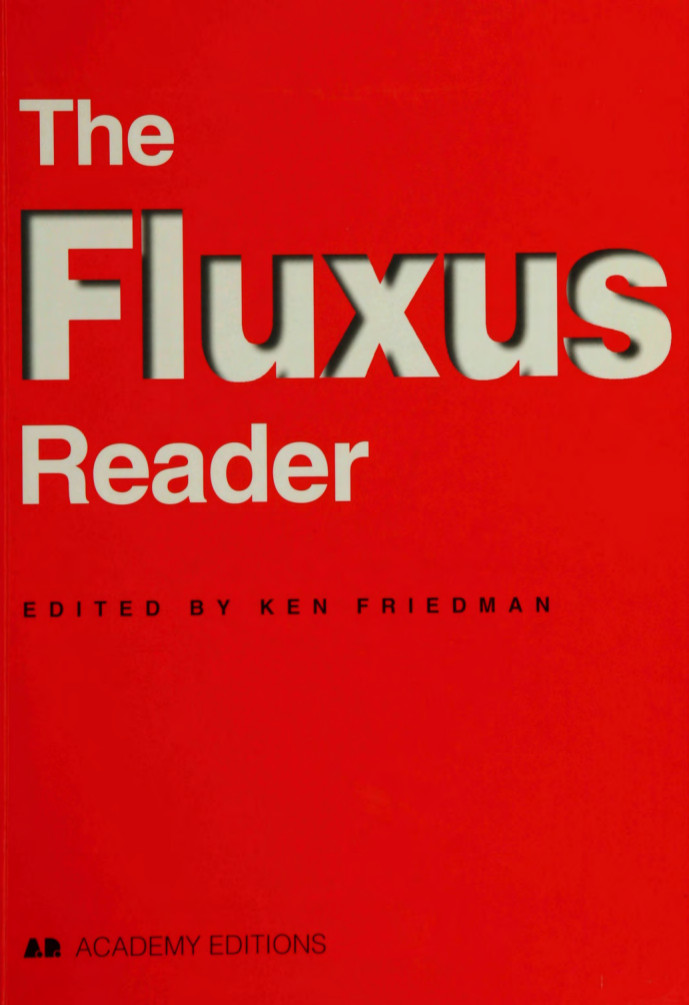
“Fluxus began in the 1950s as a loose, international community of artists, architects, composers and designers. By the 1960s, Fluxus has become a laboratory of ideas and an arena for artistic experimentation in Europe, Asia and the United States. Described as ‘the most radical and experimental art movement of the 1960s’, Fluxus challenged conventional thinking on art and culture for over four decades. It had a central role in the birth of such key contemporary art forms as concept art, installation, performance art, intermedia and video. Despite this influence, the scope and scale of this unique phenomenon have made it difficult to explain Fluxus in normative historical and critical terms. The Fluxus Reader offers the first comprehensive overview on this challenging and controversial group. It is written by leading scholars and experts from Europe and the United States.”
Publisher Academy Editions, UK, 1998
Creative Commons Attribution CC-BY 3.0 Unported licence
ISBN 0471978582, 9780471978589
309 pages
The version of the text provided for download here contains updates on the original 1998 edition.
via Joseph Nechvatal
Reviews: Elizabeth Beckman and Jonathan Applefield (Art J, 1999), Beáta Hock (Artpool, n.d.).
PDF (37 MB, updated on 2012-7-30)
PDF chapters
NJP Reader #1: Contributions to an Artistic Anthropology (2010) [English, Korean]
Filed under book | Tags: · aesthetics, anthropology, art, contemporary art
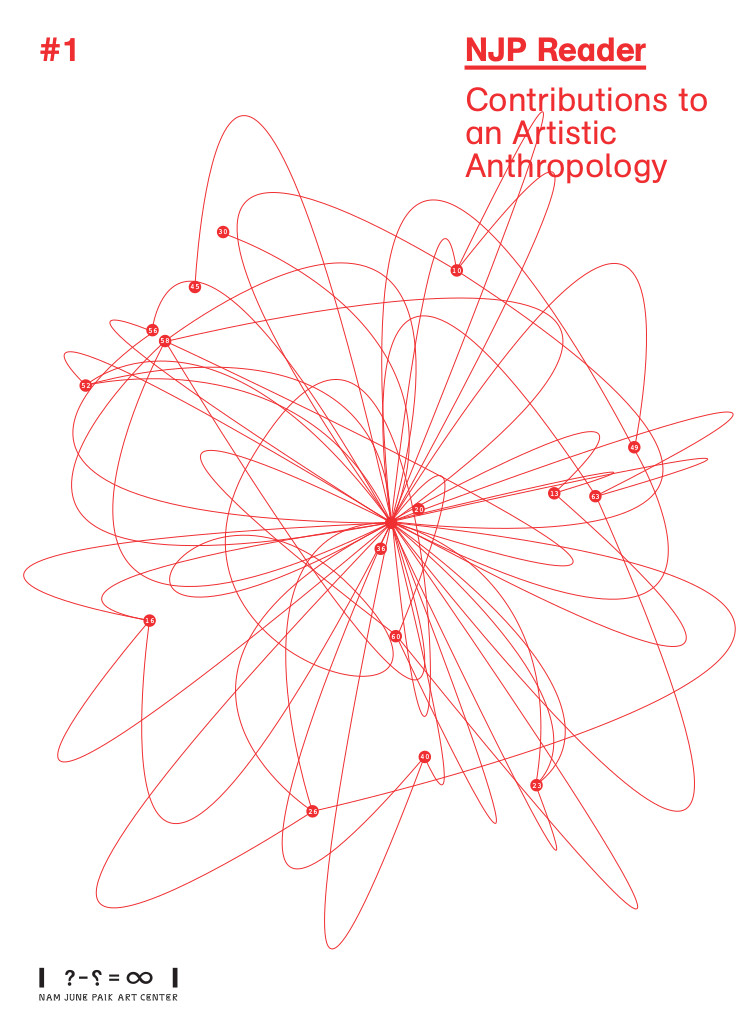
“The Nam June Paik Center is dedicated to the artistic and intellectual legacy of Nam June Paik, the renowned Korean-born artist who transformed visual art worldwide. In addition to its function as an exhibition space, the Nam June Paik Art Center developed a new publication, NJP Reader. The aim of the NJP Reader is to recontextualize Nam June Paik’s artistic thought and his ‘random access’ strategies in a topical discursive practice. Leading questions are: What is the meaning of Nam June Paik’s multi-medial experiments, performances, and sculpture for our current artistic practice and discourse? What new dimensions for re-imagining notions of technology, ubiquity, and human experience do Nam June Paik’s thinking and practice suggest? How does his practice potentiate paradigm shifts in broader understandings of the potentialities and characteristics of alternative processes of participation afforded by the introduction of media technology into artistic practice?
Obviously, Nam June Paik’s work requires a conceptual framework that goes beyond an art historical narrative. Therefore, for Issue #1, NJP Reader conducts an inquiry into the novel concept of artistic anthropology in art discourse as an invitation to produce new conceptual systems. The NJP Reader intends to be an open platform for generating novel ideas, connections and concepts (this intention is also reflected in choosing to use Nam June Paik’s initials for its title, rather than his full name). To this aim, the first edition of the NJP Reader is based on a questionnaire that as many artists and intellectuals as possible were invited to contribute responses to. Through this conceptual inquiry the NJP Reader hopes to help in creating novel lines of thought and conceptual schemes. For the questionnaire three questions were formulated:
1. Artistic anthropology intends to produce novel models of relationality and connectivity. Could – Nam June Paik’s legacy as a form of – artistic anthropology contribute to an artistic discourse going beyond the framework of relational aesthetics? Who are the artists in our day developing relevant examples of rethinking and recontextualizing an artistic anthropology?
2. What could artistic anthropology mean for a current artistic practice? How could it relate to medium-specific qualities? Is it a form of artistic communication defined by a post-medium condition? Or is it a practice that demands the concept of medium-specificity to change?
3. What could artistic anthropology – as a form of knowledge production – mean for the current classification system? Will it challenge the dominant paradigms of the established humanities and sciences? What type of new models might this trigger? How can artistic anthropology contribute to a better and more political understanding of the human condition? And what could artistic anthropology mean for the concept of art in general?”
Contributors: Ricardo Basbaum, Jean-Paul Fargier, Ranjit Hoskote and Nancy Adajania, Jeongwhan Jo, Clara Kim, Lev Manovich, Arjen Mulder, Simon O’Sullivan, Wongil Park, John Rajchman, Susanne Rennert, Szabolcs KissPál, Peter Weibel, Haegue Yang, Hiroshi Yoshioka, David Zerbib.
Editors: Youngchul Lee, Henk Slager
Final Editor: Annette W. Balkema
Publisher: Nam June Paik Art Center, Korea, 2010
ISSN 2092-9315
68 pages
PDF (English, updated on 2012-11-19)
PDF (Korean, updated on 2012-11-19)
George Gessert: Green Light: Toward an Art of Evolution (2010)
Filed under book | Tags: · aesthetics, art, bio art, biotechnology, ecology, evolution, hybrids, kitsch

Humans have bred plants and animals with an eye to aesthetics for centuries: flowers are selected for colorful blossoms or luxuriant foliage; racehorses are bred for the elegance of their frames. Hybridized plants were first exhibited as fine art in 1936, when the Museum of Modern Art in New York showed Edward Steichen’s hybrid delphiniums. Since then, bio art has become a genre; artists work with a variety of living things, including plants, animals, bacteria, slime molds, and fungi. Many commentators have addressed the social and political concerns raised by making art out of living material. In Green Light, however, George Gessert examines the role that aesthetic perception has played in bio art and other interventions in evolution.
Gessert looks at a variety of life forms that humans have helped shape, focusing on plants—the most widely domesticated form of life and the one that has been crucial to his own work as an artist. We learn about Onagadori chickens, bred to have tail feathers twenty or more feet long; pleasure gardens of the Aztecs, cultivated for intoxicating fragrance; Darwin’s relationship to the arts; the rise and fall of eugenics; the aesthetic standards promoted by national plant societies; a daffodil that looks like a rose; and praise for weeds and wildflowers. Gessert surveys recent bio art and its accompanying philosophical problems, the “slow art” of plant breeding, and how to create new life that takes into account what we know about ecology, aesthetics, and ourselves.
Publisher MIT Press, 2010
Leonardo Books series
ISBN 0262014149, 9780262014144
233 pages