

Armin Medosch: New Tendencies: Art at the Threshold of the Information Revolution, 1961–1978 (2016)
Filed under book | Tags: · art history, computer art, conceptual art, cybernetics, neo-avant-garde, new art practice, new tendencies, non-aligned movement

“New Tendencies, a non-aligned modernist art movement, emerged in the early 1960s in the former Yugoslavia, a non-aligned country. It represented a new sensibility, rejecting both Abstract Expressionism and socialist realism in an attempt to formulate an art adequate to the age of advanced mass production. In this book, Armin Medosch examines the development of New Tendencies as a major international art movement in the context of social, political, and technological history. Doing so, he traces concurrent paradigm shifts: the change from Fordism (the political economy of mass production and consumption) to the information society, and the change from postwar modernism to dematerialized postmodern art practices.
Medosch explains that New Tendencies, rather than opposing the forces of technology as most artists and intellectuals of the time did, imagined the rapid advance of technology to be a springboard into a future beyond alienation and oppression. Works by New Tendencies cast the viewer as coproducer, abolishing the idea of artist as creative genius and replacing it with the notion of the visual researcher. In 1968 and 1969, the group actively turned to the computer as a medium of visual research, anticipating new media and digital art.
Medosch discusses modernization in then-Yugoslavia and other nations on the periphery; looks in detail at New Tendencies’ five major exhibitions in Zagreb (the capital of Croatia); and considers such topics as the group’s relation to science, the changing relationship of manual and intellectual labor, New Tendencies in the international art market, their engagement with computer art, and the group’s eventual eclipse by other “new art practices” including conceptualism, land art, and arte povera. Numerous illustrations document New Tendencies’ works and exhibitions.”
Based on 2012 dissertation from Goldsmiths, University of London.
Publisher MIT Press, 2016
Leonardo series
ISBN 9780262034166, 0262034166
x+395 pages
Reviews: Oliver Schürer (Versorgerin, 2016, DE), Paula Barreiro López (Critique d’art, 2016, FR), Kristian Lukić (Furtherfield, 2017), Tomáš Glanc (Tech & Culture, 2017), Adair Rounthwaite (Art Bulletin, 2018), Adair Rounthwaite (Art Bulletin, 2018), Ivana Bago (ARTMargins, 2019).
HTML
PDF (added on 2022-10-11)
Pontus Hultén (ed.): The Machine as Seen at the End of the Mechanical Age (1968)
Filed under catalogue | Tags: · art, cybernetics, electronic art, machine, media art, technology

Exhibition catalogue of one of the most important exhibitions of the 1960s dealing with art and technology. The show was held at The Museum of Modern Art, New York, 25 November 1968 – 9 February 1969. Its curator K.G. Pontus Hultén described it as a “collection of comments on technology by artists of the Western world,” particularly in the modern age when “the mechanical machine – which can most easily be defined as an imitation of our muscles – is losing its dominating position among the tools of mankind; while electronic and chemical devices – which imitate the processes of the brain and the nervous system – are becoming increasingly important.”
The exhibition traveled to Rice Museum, Rice University, Houston, 25 March – 18 May 1969; San Francisco Museum of Art, San Francisco, 23 June – 24 August 1969.
Publisher Museum of Modern Art, New York, 1968
218 pages
via MoMA
Review: William A. Camfield (Art Bulletin, 1971).
Exh.review: Time (1968).
PDF (53 MB, updated on 2016-9-23: pagination corrected, bookmarks and metadata added, file optimized, page 59 still missing)
Comment (0)Short Circuit: A Counterlogistics Reader (2015)
Filed under book | Tags: · communism, cybernetics, infrastructure, logistics
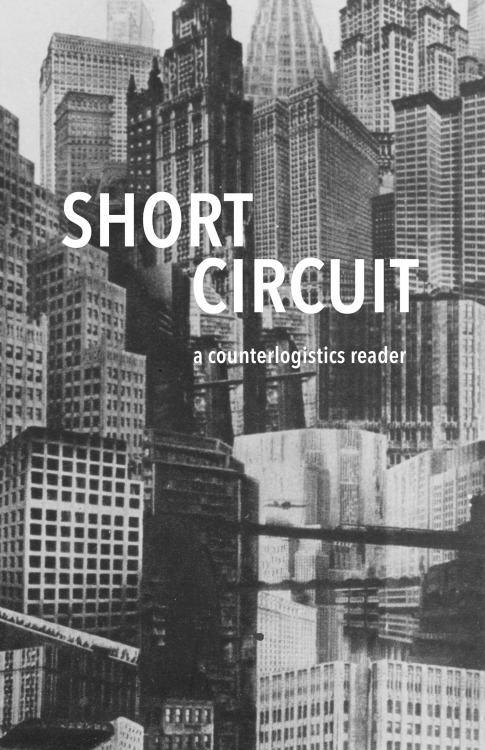
““Counter-logistics is not simply a matter of blocking all flows, of stopping movement, of locking things in place where they are. It is a matter of blocking those flows that constitute the material and metaphysical tissue of this world, while simultaneously enhancing our own ethical connections, movement, and friendship. Helping migrants to cross borders and remain undetected, helping information to cross through and within prison walls, destroying surveillance cameras, defending the basis of new worlds seized in opposition to the old—these are as important as blocking rail lines and disrupting commerce.”
This book is a collection of critical texts focused on logistics, counter-logistics, and cybernetics. It attempts to combine some disparate groups and tendencies that have all taken a recent turn towards evaluating infrastructure and logistics as a crucial element in the perpetuation of capital and control, and as vulnerable points worthy of study, evaluation, and attack.”
With texts by Anonymous, Jasper Bernes, Max L’Hameunasse, Tiqqun, Leon de Mattis, Out of the Woods, 1882 Woodbine, and Degenerate Communism.
Publisher No New Ideas, Aug 2015
xiii+245 pages
via pht
single PDF (4 MB)
PDF chapters