

Nikolaus Gansterer (ed.): Drawing A Hypothesis: Figures of Thought (2011)
Filed under book | Tags: · abstraction, art, contemporary art, data visualisation, diagram, drawing, image, knowledge, perception, representation, research, science, theory

“Drawing a Hypothesis is a reader on the ontology of forms of visualizations and on the development of the diagrammatic view and its use in contemporary art, science and theory. In a process of exchange with artists and scientists, Nikolaus Gansterer reveals drawing as a media of research enabling the emergence of new narratives and ideas by tracing the speculative potential of diagrams. Based on a discursive analysis of found figures with the artists’ own diagrammatic maps and models, the invited authors create unique correlations between thinking and drawing. Due to its ability to mediate between perception and reflection, drawing proves to be one of the most basic instruments of scientific and artistic practice, and plays an essential role in the production and communication of knowledge. The book is a rich compendium of figures of thought, which moves from scientific representation through artistic interpretation and vice versa.”
Translation: Veronica Buckley, Aileen Derieg
Publisher Springer, 2011
Edition Angewandte
ISBN 3709108020, 9783709108024
352 pages
Review: Mark Robert Doyle, Gert Hasenhuetl (in German).
PDF (updated on 2021-12-17)
Comments (4)Nelson Goodman: Ways of Worldmaking (1978–) [EN, DE, ES, CZ, CR]
Filed under book | Tags: · aesthetics, art, art theory, epistemology, knowledge, metaphysics, perception, philosophy, representation, science, style, truth
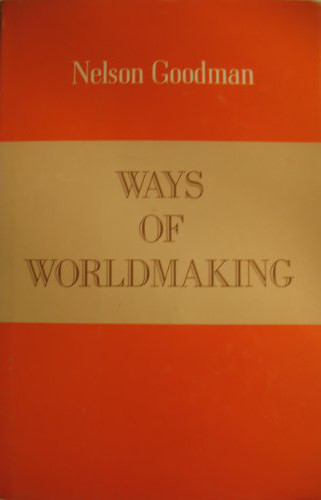
“A major thesis of this book is that the arts must be taken no less seriously than the sciences as modes of discovery, creation, and enlargement of knowledge in the broad sense of advancement of the understanding, and thus that the philosophy of art should be conceived as an integral part of metaphysics and epistemology.” (p 102)
Publisher Hackett Publishing, Indianapolis, 1978
ISBN 0915144514, 9780915144518
148 pages
Reviews: Hilary Putnam (Journal of Philosophy, 1979), W. Charlton (Philosophical Quarterly, 1980), Robert Howell (Philosophical Review, 1982), Jay F. Rosenberg (Noûs, 1982), Jon W. Sharer (Leonardo, 1981).
Commentaries: Xavier de Donato-Rodríguez (Theoria, 2009), Pierre-André Huglo (Philopsis, 2012, FR).
Preface to an Italian edition (Achille C. Varzi, 2008, IT)
Commentary on Goodman’s aesthetics (Stanford Encyclopedia of Philosophy).
Ways of Worldmaking (English, 1978; HTML).
Ways of Worldmaking (English, UK edition by Harvester Press, 1978)
Weisen der Welterzeugung (German, trans. Max Looser, 4th ed., 1984/1998, added on 2014-10-28)
Maneras de hacer mundos (Spanish, trans. Carlos Thiebaut, 1990, no OCR)
Způsoby světatvorby (Czech, trans. Vlastimil Zuska, 1996, first 4 chapters, HTML)
Načini svjetotvorstva (Croatian, trans. Damjan Lalović, 2008)
Jacques Rancière: Aisthesis: Scenes from the Aesthetic Regime of Art (2011/2013)
Filed under book | Tags: · aesthetics, art, art history, art theory, body, cinema, dance, film, life, literature, music, painting, pantomime, philosophy, photography, poetry, politics, representation, sculpture, theatre, theory
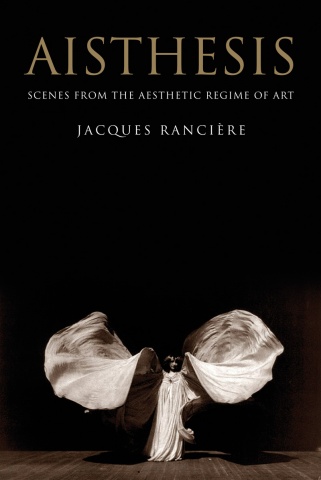
Rancière’s magnum opus on the aesthetic.
“Composed in a series of scenes, Aisthesis–Rancière’s definitive statement on the aesthetic–takes its reader from Dresden in 1764 to New York in 1941. Along the way, we view the Belvedere Torso with Winckelmann, accompany Hegel to the museum and Mallarmé to the Folies-Bergère, attend a lecture by Emerson, visit exhibitions in Paris and New York, factories in Berlin, and film sets in Moscow and Hollywood. Rancière uses these sites and events—some famous, others forgotten—to ask what becomes art and what comes of it. He shows how a regime of artistic perception and interpretation was constituted and transformed by erasing the specificities of the different arts, as well as the borders that separated them from ordinary experience. This incisive study provides a history of artistic modernity far removed from the conventional postures of modernism.”
First published as Aisthesis : Scènes du régime esthétique de l’art, Éditions Galilée, 2011
Translated by Zakir Paul
Publisher Verso Books, 2013
ISBN 1781680892, 9781781680896
304 pages
via falsedeity
Reviews: Hal Foster (London Review of Books), Joseph Tanke (Los Angeles Review of Books), Marc Farrant (The New Inquiry), Ali Alizadeh (Sydney Review of Books), Jean-Philippe Deranty (Parrhesia).
Roundtable discussion with Rancière at Columbia (video, 43 min)
Selected interviews and reviews (in French)