

Laurence A. Rickels: Ulrike Ottinger: The Autobiography of Art Cinema (2008)
Filed under book | Tags: · cinema, documentary film, film, film criticism, photography
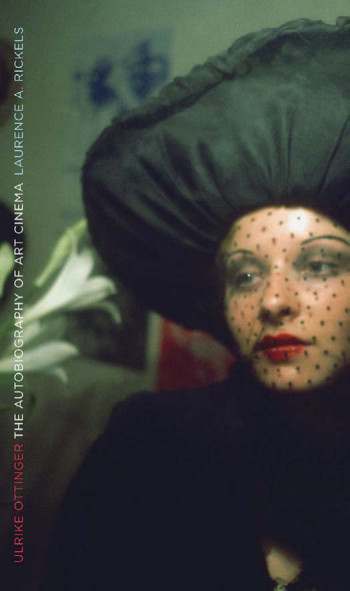
Since 1974, German filmmaker Ulrike Ottinger has created a substantial body of films that explore a world of difference defined by the tension and transfer between settled and nomadic ways of life. In many of her films, including Exile Shanghai, an experimental documentary about the Jews of Shanghai, and Joan of Arc of Mongolia, in which passengers on the Trans-Siberian Express are abducted by Mongolian bandits, she also probes the encounter with the other, whether exotic or simply unpredictable.
In Ulrike Ottinger Laurence A. Rickels offers a series of sensitive and original analyses of Ottinger’s films, as well as her more recent photographic artworks, situated within a dazzling thought experiment centered on the history of art cinema through the turn of the twenty-first century. In addition to commemorating the death of a once-vital art form, this book also affirms Ottinger’s defiantly optimistic turn toward the documentary film as a means of mediating present clashes between tradition and modernity, between the local and the global.
Widely regarded as a singular and provocative talent, Ottinger’s conspicuous absence from critical discourse is, for Rickels, symptomatic of the art cinema’s demise. Incorporating interviews he conducted with Ottinger and illustrated with stunning examples from her photographic oeuvre, this book takes up the challenges posed by Ottinger’s filmography to interrogate, ultimately, the very practice—and possibility—of art cinema today.
Publisher University of Minnesota Press, 2008
ISBN 0816653305, 9780816653300
288 pages
Jim Ellis: Derek Jarman’s Angelic Conversations (2009)
Filed under book | Tags: · activism, aesthetics, art, biography, film, politics, punk, situationists

Best known as an iconoclastic, wildly inventive filmmaker, Derek Jarman was also an accomplished author, painter, and landscape artist. In Derek Jarman’s Angelic Conversations, Jim Ellis considers Jarman’s wide-ranging oeuvre to present a broad perspective on the career and life of one of the most provocative, engaged, and important artists of the twentieth century.
Derek Jarman’s Angelic Conversations analyzes Jarman’s work—including his famous films Caravaggio, Jubilee, Edward II, Blue, and Sebastiane—in relation to his critiques of the government and his activism in the gay community, from the liberationist movement to the AIDS epidemic. While others have frequently focused on Jarman’s biography, Ellis looks at how his politics and aesthetics are intertwined to comprehend his most radical aspects, particularly in films such as War Requiem and The Last of England.
Here Jarman is revealed as an artist who keenly understood the role of history and mythology in creating a personal and national identity: as an activist, he sought to challenge old histories while producing new ones to carve out a space for alternative communities in Britain late in the twentieth century.
Publisher University of Minnesota Press, 2009
ISBN 0816653135, 9780816653133
312 pages
Rudolf Arnheim: Radio: An Art of Sound (1936/1971)
Filed under book | Tags: · film, listening, public broadcasting, radio, sound recording, voice
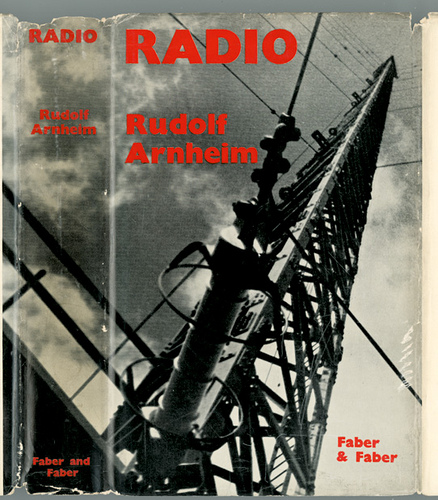
“Arnheim treats all aspects of sound. He explores words and music as kinds of sounds; discusses direction and distance, spatial resonance, sequence and juxtaposition in radio sound; makes comparisons between sound film and radio techniques and effects; and details the benefits of imagination with sound from a creative and emotional point of view. The art of announcing, the psychology of the listener, and two generalized discussions of radio around the world, and the prospects for television are covered in the last chapters.”
Translated by Margaret Ludwig and Herbert Read
First published by Faber and Faber, London, 1936
Publisher Arno Press, New York, 1971
287 pages