

Jacques Rancière: Aisthesis: Scenes from the Aesthetic Regime of Art (2011/2013)
Filed under book | Tags: · aesthetics, art, art history, art theory, body, cinema, dance, film, life, literature, music, painting, pantomime, philosophy, photography, poetry, politics, representation, sculpture, theatre, theory
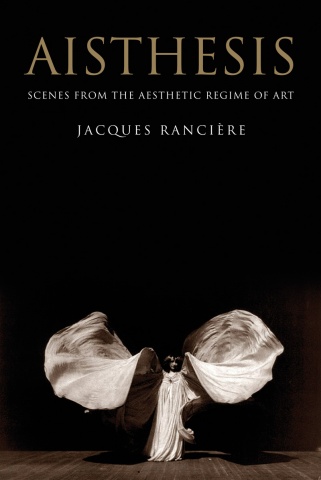
Rancière’s magnum opus on the aesthetic.
“Composed in a series of scenes, Aisthesis–Rancière’s definitive statement on the aesthetic–takes its reader from Dresden in 1764 to New York in 1941. Along the way, we view the Belvedere Torso with Winckelmann, accompany Hegel to the museum and Mallarmé to the Folies-Bergère, attend a lecture by Emerson, visit exhibitions in Paris and New York, factories in Berlin, and film sets in Moscow and Hollywood. Rancière uses these sites and events—some famous, others forgotten—to ask what becomes art and what comes of it. He shows how a regime of artistic perception and interpretation was constituted and transformed by erasing the specificities of the different arts, as well as the borders that separated them from ordinary experience. This incisive study provides a history of artistic modernity far removed from the conventional postures of modernism.”
First published as Aisthesis : Scènes du régime esthétique de l’art, Éditions Galilée, 2011
Translated by Zakir Paul
Publisher Verso Books, 2013
ISBN 1781680892, 9781781680896
304 pages
via falsedeity
Reviews: Hal Foster (London Review of Books), Joseph Tanke (Los Angeles Review of Books), Marc Farrant (The New Inquiry), Ali Alizadeh (Sydney Review of Books), Jean-Philippe Deranty (Parrhesia).
Roundtable discussion with Rancière at Columbia (video, 43 min)
Selected interviews and reviews (in French)
Roswitha Mueller: Bertolt Brecht and the Theory of Media (1989)
Filed under book | Tags: · aesthetics, cinema, film, film theory, media, media theory, opera, politics, radio, theatre
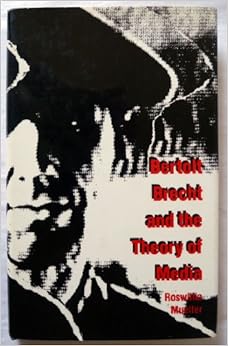
Bertolt Brecht spent a career puncturing artistic illusion while casting a spell as an innovator that has continued since his death in 1956. Best known to theater goers for “The Threepenny Opera,” “Mother Courage and her Children,” “The Caucasian Chalk Circle” and other production, the great playwright was, in fact, a man of all media. He was interested in radio and the cinema as soon as they appeared in Europe and brought to them, as well as to the stage, a dramatic theory so radical and influential that it has come to be known by the adjective “Brechtian.”
Publisher University of Nebraska Press, Lincoln & London, 1989
Modern German Culture and Literature series
ISBN 0803231326, 9780803231320
149 pages
Reviews: Katie Trumpener, Susan Bennett (Theatre Research International).
PDF (no OCR)
Comment (0)Owen Hatherley: Militant Modernism (2009)
Filed under book | Tags: · aesthetics, architecture, avant-garde, constructivism, design, film, modernism, theatre, vorticism

“This book is a defence of Modernism against its defenders. In readings of modern design, film, pop and especially architecture, it attempts to reclaim a revolutionary modernism against its absorption into the heritage industry and the aesthetics of the luxury flat. Militant Modernism features new readings of some familiar names – Bertolt Brecht, Le Corbusier – but more on the lesser known, quotidian modernists of the 20th century. The chapters range from a study of industrial and brutalist aesthetics in Britain, Russian Constructivism in architecture, the Sexpol of Wilhelm Reich in film and design, and the alienation effects of Brecht and Hanns Eisler on record and on screen – all arguing for a Modernism of everyday life, immersed in questions of socialism, sexual politics and technology.”
Publisher Zero Books, 2009
ISBN 1846941768, 9781846941764
146 pages
Reviews: Will Self (London Review of Books, 2012), PD Smith (The Guardian, 2009), Jonathan Meades (New Statesman, 2009), Dan Hicks (Planning Perspectives, 2009), Kat Koh (2011).
Interview (Andrew Stevens, 3:AM Magazine, 2009)
Comment (0)