The CryptoParty Handbook (2012)

4 October 2012, dusan

This handbook is designed to help those with no prior experience to protect their basic human right to Privacy in networked, digital domains. By covering a broad array of topics and use contexts it is written to help anyone wishing to understand and then quickly mitigate many kinds of vulnerability using free, open-source tools. Most importantly however this handbook is intended as a reference for use during Crypto Parties.

Facilitated by Adam Hyde
Core Team: Marta Peirano, Asher Wolf, Julian Oliver, Danja Vasiliev, Malte Dik, Brendan Howell, Jan Gerber, Brian Newbold,
Assisted by Teresa Dillon, AT, Carola Hesse, Chris Pinchen, ‘LiamO’, ‘l3lackEyedAngels’, ‘Story89′, Travis Tueffel
Creative Commons BY-SA 4.0 Unported license
386+ pages
via Julian Oliver

discussion and criticism (Liberationtech list)

authors and more information

Download the latest edition
Contribute (via GitHub)
Contribute (via Booki)

Hyde, Perez, Safadi, Adams, Fuzz, Phillips, Thorne: An Open Web (2011)

18 February 2012, dusan

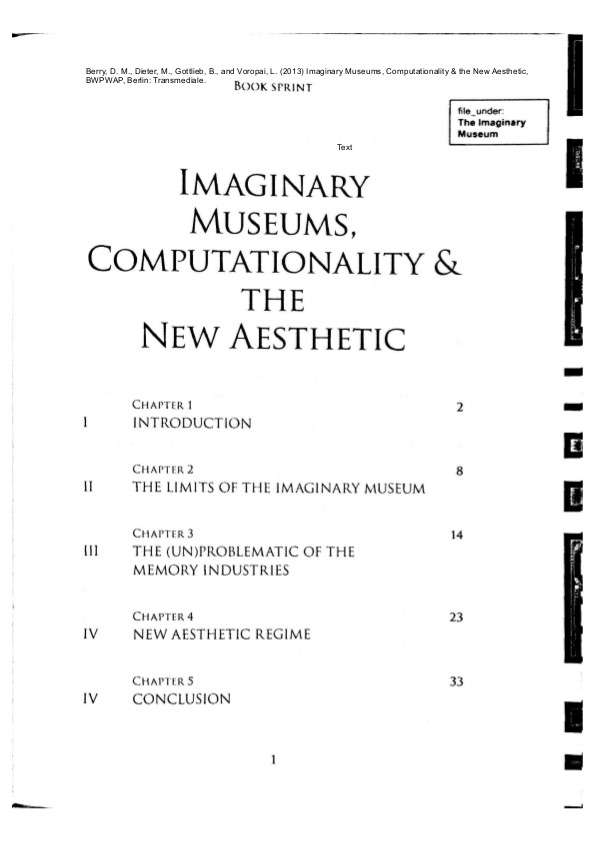
This book was created in a Book Sprint over 5 days between January 17 and January 21, 2011 in Berlin. It was an enormous achievement by the handful of people brought together to write a Book about the ‘Open Web’. The event was hosted by transmediale.11 and the Collegium Hungaricum Berlin (CHB), based on an idea and concept initiated by transmediale artistic director Stephen Kovats and Adam Hyde of FLOSS Manuals. To write the book the authors used the FLOSS Manuals installation of Booki.

The book takes the view that the Open Web is an essential technology and cultural practice for the future of the Internet and human society. The Web as we know it has had a positive and even revolutionary impact on key areas of science, technology, politics and culture. It has opened up new fields of individual rights and responsibilities, in terms of legal structures, community standards, privacy and the control of data. The rapid pace of technological change is bringing ever more powerful threats (and opportunities) to the Open Web.

Written by Adam Hyde, Alejandra Perez, Bassel Safadi, Christopher Adams, Mick Fuzz, Jon Phillips,
Michelle Thorne
Publisher in 2011
Creative Commons Attribution 3.0 Unported license
63 pages

authors

Direct download (PDF)
Direct download (EPUB)
View online (HTML)

Grover, Debatty, Evans, Garcia, Thumb: New Art/Science Affinites (2011)

26 October 2011, dusan

The Miller Gallery at Carnegie Mellon University and the STUDIO for Creative Inquiry have co-published “New Art/Science Affinities,” a 190-page book on contemporary artists that was written and designed in one week by four authors (Andrea Grover, Régine Debatty, Claire Evans and Pablo Garcia) and two designers (Luke Bulman and Jessica Young of Thumb).

“New Art/Science Affinities,” which focuses on artists working at the intersection of art, science and technology, was produced by a collaborative authoring process known as a “book sprint.” Derived from “code sprinting,” a method in which software developers gather in a single room to work intensely on an open source project for a certain period of time, the term book sprint describes the quick, collective writing of a topical book.

The book includes meditations, interviews, diagrams, letters and manifestos on maker culture, hacking, artist research, distributed creativity, and technological and speculative design. Chapters include Program Art or Be Programmed, Subvert! Citizen Science, Artists in White Coats and Latex Gloves, The Maker Moment and The Overview Effect.

Sixty international artists and art collaboratives are featured, including Agnes Meyer-Brandis, Atelier Van Lieshout, Brandon Ballengée, Free Art and Technology (F.A.T.), Rafael Lozano-Hemmer, The Institute for Figuring, Aaron Koblin, Machine Project, Openframeworks, C.E.B. Reas, Philip Ross, Tomás Saraceno, SymbioticA, Jer Thorp, and Marius Watz.

The authors collectively wrote and designed the book during seven, 10-14 hour-days in February 2011 at the STUDIO for Creative Inquiry. During their sessions they held conversations with CMU faculty, staff and students from the STUDIO, Miller Gallery, College of Fine Arts, Robotics Institute, Machine Learning Department and BXA Intercollege Degree Program.

“The book sprint method was adopted in order to understand this very moment in art, science and technology hybrid practices, and to mirror the ways Internet culture and networked communication have accelerated creative collaborations, expanded methodologies, and given artists greater agency to work fluidly across disciplines,” says lead author Andrea Grover.

The publication is part of Grover’s Andy Warhol Foundation for the Visual Arts Curatorial Research Fellowship at CMU’s STUDIO for Creative Inquiry and Miller Gallery. “Intimate Science,” an exhibition that will be the product of Grover’s research, will take place in early 2012 at the Miller Gallery.

Published by Miller Gallery at Carnegie Mellon University + CMU STUDIO for Creative Inquiry, October 2011
ISBN 0977205347
190 pages
Licensed under Creative Commons Attribution-NonCommercial-NoDerivs 3.0 License

commentary (We-Make-Money-Not-Art.com)
authors

Direct download

Collaborative Futures, 2nd ed. (2010)

12 December 2010, dusan

Despite these words, the true nature of collaborative culture as a form of creative expression in the context of digital and network technologies has remained elusive, a buzzword often falling prey to corporate and ideological interests. This book was first created by 6 core collaborators, as an experimental five day Book Sprint in January 2010. Developed under the aegis of transmediale.10, this third publication in the festival’s parcours series resulted in the initiation of a new vocabulary on the forms, media and goals of collaborative practice.

In June 2010, the book was rewritten as a part of the Re:Group exhibition at Eyebeam, NY. This second edition invited three new collaborators to challenge the free culture sentiment underlying the original writing. The result is a deliberately multi-voiced tone pondering the merits and shortcomings of this new emerging ideology.

Core writers: Adam Hyde, kanarinka, Mike Linksvayer, Michael Mandiberg, Marta Peirano, Sissu Tarka, Astra Taylor, Alan Toner, Mushon Zer-Aviv.
ISBN: 9780984475018
Licensed under a Creative Commons Attribution-ShareAlike 3.0 Unported License.

first edition
authors

Direct download
Read online

Collaborative Futures (2010)

24 January 2010, dusan

This book was written in a collaborative Book Sprint by six core authors over a five-day period in January 2010. It was developed under the aegis of transmediale, and executed by FLOSS Manuals. The six starting authors each come from different perspectives, as are the contributors who were adding to this living body of text.

“As we began the collaborative process of crafting this book on the future of collaboration, we realized we were all working from a set of assumptions, many of them shared, some of them divergent. We were talking about a specific form of collaboration, specific media of collaboration, and specific goals of collaboration. And we were talking about a specific history of collaboration, and a correspondingly specific set of futures.

To begin looking at those futures, we look back to others who have looked into the future. Marshall McLuhan’s quote above, from “The Medium is the MESSAGE” give us our first clue about all of these assumptions we are making. We are talking about media, we are talking about freedom, we are talking about technologies, and we are talking about culture. McLuhan’s prophetic utterance, several decades before the photocopier fueled the punk cut-up design aesthetic, or the profusion of home-brew zines, is still a prophecy unmet. We are still chasing it. Mainstream culture continues to consolidate around block buster films, books, and music. Copyright restrictions make it harder and harder to exercise the creative power of these reproduction tools without breaking increasingly restrictive intellectual property rights laws. But one thing is unanimously true: “Teamwork succeeds private effort.” ”

© Collaborative Futures Book Sprint team 2010
Written and produced by Mushon Zer-Aviv, Mike Linksvayer, Michael Mandiberg, Marta Peirano, Alan Toner and Adam Hyde with a number of special guest writers
Produced by FLOSS Manuals and Transmediale
To be published by Transmediale
Series: parcours #3

organisers

Direct download (PDF)
View online (by chapter; HTML)
View online (full; HTML)

Recent comments
Recent entries
More resources