

Trevor Wishart: Audible Design: A Plain and Easy Introduction to Practical Sound Composition (1994)
Filed under book, handbook | Tags: · composing, composition, electronic music, music, sound
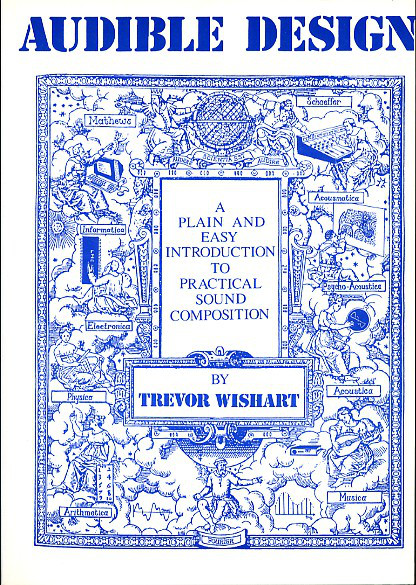
“This book provides detailed description of the craft of sound transformation using software instruments, with non-mathematical explanations and recorded music examples of all processes.
Many of these processes (e.g. sound morphing, spectral stretching, waveset distortion, sound shredding, grain manipulation, moving harmonic field filters) were first developed by Trevor Wishart, either at IRCAM, or as part of the Composers Desktop Project.”
Publisher Orpheus the Pantomime, 1994
139 pages
via author, HT xgz
PDF, PDF
Appendices PDF, PDF (57 MB)
Audio examples: Chapters 1-3, Chapter 4-6, Chapter 7-10, Chapter 11-13 (Bandcamp)
Gordon Mumma: Cybersonic Arts: Adventures in American New Music (2015)
Filed under book | Tags: · avant-garde, composing, composition, electronic music, music, music history, performance

“A candid account of a broad artistic community by an active participant and observer
Composer, performer, instrument builder, teacher, and writer Gordon Mumma has left an indelible mark on the American contemporary music scene. A prolific composer and innovative French horn player, Mumma is recognized for integrating advanced electronic processes into musical structures, an approach he has termed “Cybersonics.”
Musicologist Michelle Fillion curates a collection of Mumma’s writings, presenting revised versions of his classic pieces as well as many unpublished works from every stage of his storied career. Here, through words and astonishing photos, is Mumma’s chronicle of seminal events in the musical world of the twentieth century: his cofounding the Cooperative Studio for Electronic Music; his role in organizing the historic ONCE Festivals of Contemporary Music; performances with the Sonic Arts Union; and working alongside John Cage and David Tudor as a composer-musician with the Merce Cunningham Dance Company. In addition, Mumma describes his collaborations with composers, performers, dancers, and visual artists ranging from Robert Ashley and Pauline Oliveros to Marcel Duchamp and Robert Rauschenberg.”
Edited with Commentary by Michelle Fillion
Foreword by Christian Wolff
Publisher University of Illinois Press, November 2015
ISBN 9780252039430, 0252039432
xxxiv+339 pages
Reviews: Eric Smigel (Intersections, 2015), Daniel Barbiero (Avant Music News, 2016), Aurelio Cianciotta (Neural, 2016).
PDF (updated on 2022-11-21)
Comment (0)Hugh Davies: Sounds Heard: A Potpourri of Environmental Projects and Documentation, Projects with Children, Simple Musical Instruments, Sound Installations, Verbal Scores, and Historical Perspectives (2002)
Filed under sound recording | Tags: · composition, electronic music, environment, experimental music, improvised music, music, music criticism, musical instruments, sound, sound art
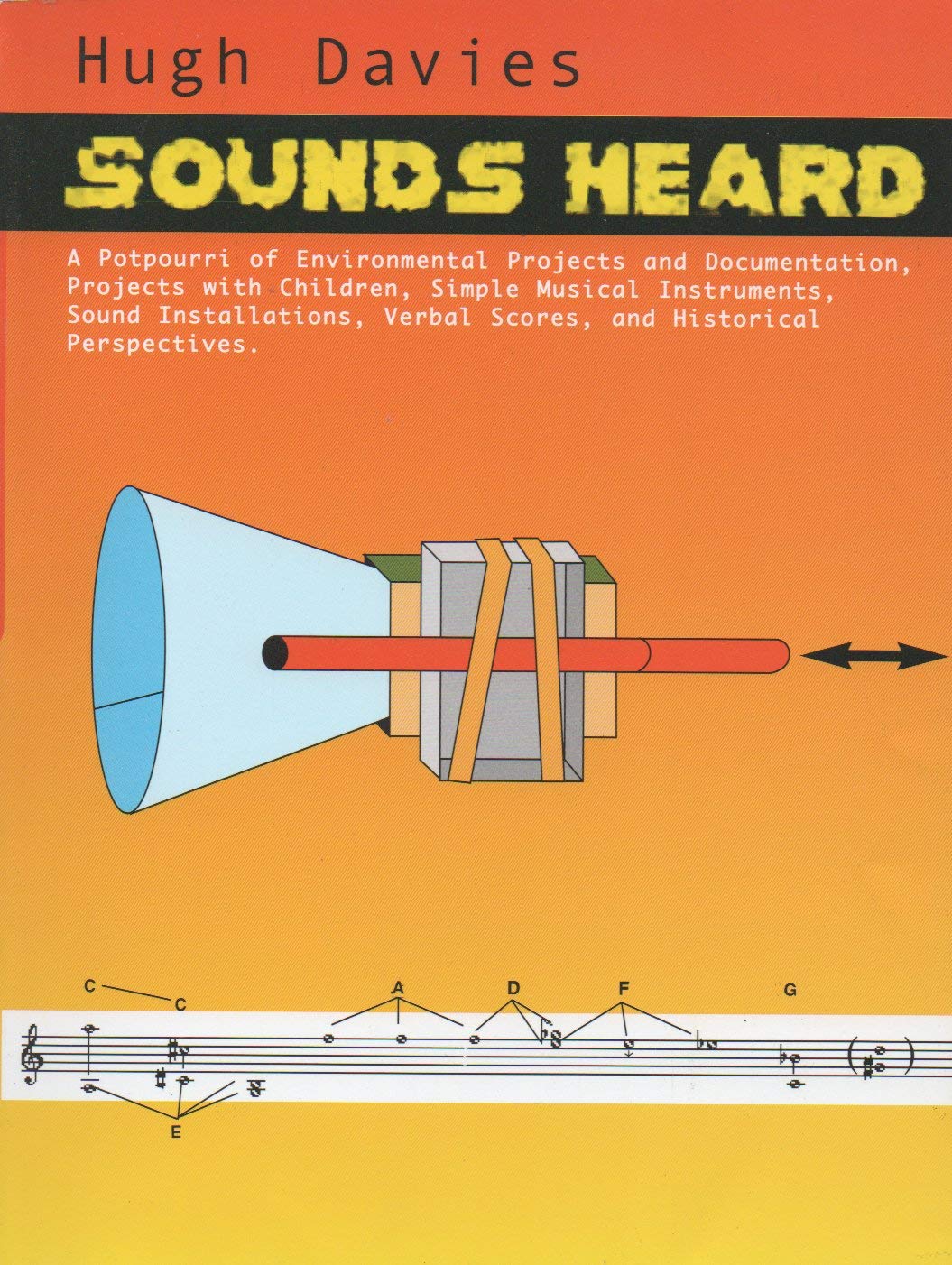
“Sounds Heard is not only a collection of writings intended for people who are interested or involved in contemporary music, especially those performers – including children – who lack a formal musical training. It also charts a wide cross-section of the activities of an intriguing musical personality. At different times in Hugh Davies’ nearly 40 year career he has been variously described as “the world’s leading electromusicologist”, “the most informed person around on the general subject of new instruments”, “unique English composer”, “one of the most interesting instrument inventors of recent decades”, “the remarkable live-electronics ‘freak”‘, an “electronic wizard”, “a humanist” and “I have never seen any music teacher who is as fond of children as he is”. Do these really refer to only one person? Who is the real Hugh Davies? Why has his modesty prevented him from being better known?
This book focuses on many of Davies’ insights about working as an artist, a musician, a composer, a performer, an instrument inventor, an educator and a researcher. He takes nothing for granted, and there are always wider implications than his own immediate involvement. Even his more avantgarde scenarios are tempered with his “very British sense of humour”. Many of the different areas of experimental music since the 1960s are touched on, including electronic music, live electronics, invented instruments, sound sculpture, sound installations and free improvisation, in all of which he was one of the British pioneers.
The CD illustrates a cross-section of the themes covered in the book. As with most of Hugh Davies’ solo performances and recordings, no conventional instruments were used on the entire album, with the exception of one short piece in which existing music has been manipulated with tape techniques.” (from back cover)
Publisher Soundworld Publishers, Chelmsford, 2002
ISBN 1902440056, 9781902440057
124 pages
PDF (29 MB)
Selections from accompanying CD