

Almanacco Letterario Bompiani: Elettronica e letteratura (1961) [Italian]
Filed under magazine | Tags: · automation, computing, digital humanities, humanities computing, language, linguistics, literary theory, literature, philology, robots

An early document from the field of humanities computing, today widely known as digital humanities.
Elettronica e letteratura is the title of the thematic section of an annual literary almanac published by Valentino Bompiani since 1925. The section contains the historical excursions by Rinaldo De Benedetti, Michele Pacifico and Franco Lucentini, and the reports on scientific research sponsored by Olivetti and IBM Italy and conducted by Roberto Busa, Stanislao Valsesia, Carlo Tagliavini, Silvio Ceccato, and Nanni Balestrini.
In one of the articles, the Jesuit priest Roberto Busa, often cited as the pioneer of the field, gives an account of his work on Index Thomisticus, a complete lemmatization of the works of Thomas Aquinas, started in the late 1940s (elsewhere: “During the World War II, between 1941 and 1946, I began to look for machines for the automation of the linguistic analysis of written texts. I found them, in 1949, at IBM in New York City.”).
Included is also a survey about the potential use of computers in literary scholarship (including a response from Pier Paolo Pasolini), entitled “Le due culture” [Two Cultures], and an essay by Umberto Eco.
in Almanacco Letterario Bompiani 1962: Le applicazioni dei calcolatori elettronici alle scienze morali e alla letteratura
Edited by Sergio Morando
Publisher Bompiani, Milan, December 1961
pages 87-188 (of 324)
via P–DPA log
Commentary (Adriano Comai, 1985, in Italian)
PDF (62 MB; large portion of the survey missing, 313ff)
See also an online emulator of Tape Mark 1 and Monoskop page on digital humanities.
Comments (2)Cabinet, 36: Friendship (2010)
Filed under magazine | Tags: · art, culture, friendship, philosophy, psychology, self

“The nature of friendship has been a subject of inquiry from the beginnings of the western philosophical tradition. Socrates considers the question of philia in one of Plato’s earliest dialogues, declaring that his “passion for friends” causes him to value them above even gold. Subsequent thinkers have continued the inquiry, yet friendship remains a phenomenon that “may well be reckoned,” as Emerson wrote, “the masterpiece of nature.”
Issue 36 of Cabinet, with its special section on friendship, features Svetlana Boym on Hannah Arendt’s definition of friendship as freedom from “totalitarianism for two”; Ruben Gallo on Freud’s school friend with whom he communicated mainly in Spanish; and Regine Basha on Sol Lewitt’s exchange of gifts with other artists. Elsewhere in the issue: Paul La Farge on the color black; Kevin McCann on the life and work of schizophrenic author Louis Wolfson, the object of fascination for a generation of French intellectuals; Helen Polson on the fate of lost teeth; Bertell Ollman on his infamous board game Class Struggle; and an artist project by Zoe Bellof.”
Edited by Sina Najafi
Publisher Immaterial Incorporated, New York, Winter 2009/10
HTML
Other issues (articles from sold-out issues are available online)
Quoz? (1975)
Filed under magazine | Tags: · dada, drawing, mail art, poetry, visual poetry
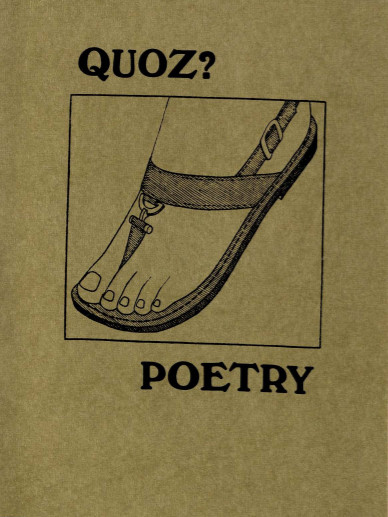
Two issues of a “Bay Area Dada” magazine from the mid-1970s.
The first one is a collection of short poems by over 40 authors including Anna Banana, Ken Friedman, and Genesis P. Orridge.
The latter issue features pen and ink drawings by Opal L. Nations divided into four sections entitled “On the Study of Genetics”, “On Physical Culture”, “On the Art of Surgery” and “Some General Observations”.
Edited by Carlo Giovanni Cicatelli (aka Charles Chickadel)
Associate Editor: Carol Ann See
Publisher Trinity Press, San Francisco
via Matt Wellins
Commentary (John Held Jr.)
Volume III, Number 10 (Summer 1975, 49 pp)
Volume III, Number 12 (Winter 1975-76, 44 pp)