

Tiqqun: This Is Not a Program (2001/2011)
Filed under book | Tags: · biopolitics, capitalism, critique, critique of technology, cybernetics, resistance, surveillance

“Traditional lines of revolutionary struggle no longer hold. Rather, it is ubiquitous cybernetics, surveillance, and terror that create the illusion of difference within hegemony. Configurations of dissent and the rhetoric of revolution are merely the other face of capital, conforming identities to empty predicates, ensuring that even ‘thieves,’ ‘saboteurs,’ and ‘terrorists’ no longer exceed the totalizing space of Empire. This Is Not a Program offers two texts, both originally published in French by Tiqqun with Introduction to Civil War in 2001. In This Is Not a Program, Tiqqun outlines a new path for resistance and struggle in the age of Empire, one that eschews the worn-out example of France’s May ‘68 in favor of what they consider to be the still fruitful and contemporary insurrectionary movements in Italy of the 1970s. ‘As a Science of Apparatuses’ examines the way Empire has enforced on the subject a veritable metaphysics of isolation and pacification, “apparatuses” that include chairs, desks, computers; surveillance (security guards, cameras); disease (depression); crutch (cell phone, lover, sedative); and authority.
Tiqqun’s critique of the biopolitical subject and omnipresent Empire is all the more urgent as we become inured to the permanent state of exception that is the War on Terror and to other, no less intimate forms of pacification. But all is not lost. In its unrelenting production of the Same, Empire itself creates the conditions necessary for the insurrection to come.”
Originally published by Editions La Fabrique in 2009. Earlier published in issue 2 of Tiqqun (2001).
Translated by Joshua David Jordan
Publisher Semiotext(e), 2011
Intervention series, 7
ISBN 1584350970, 9781584350972
215 pages
PDF (updated on 2017-6-26)
Comment (1)Richard J. Aldrich: GCHQ: The Uncensored Story of Britain’s Most Secret Intelligence Agency (2010)
Filed under book | Tags: · code, cold war, computing, encryption, history, intelligence agency, surveillance, technology, united kingdom

The gripping inside story of the last unknown realm of the British secret service: GCHQ (Government Communication Headquarters).
GCHQ is the successor to the famous Bletchley Park wartime code-breaking organisation and is the largest and most secretive intelligence organisation in the country. During the war, it commanded more staff than MI5 and MI6 combined and has produced a number of intelligence triumphs, as well as some notable failures. Since the end of the Cold War, it has played a pivotal role in shaping Britain’s secret state. Still, we know almost nothing about it.
In this ground-breaking new book, Richard Aldrich traces GCHQ’s evolvement from a wartime code-breaking operation based in the Bedfordshire countryside, staffed by eccentric crossword puzzlers, to one of the world leading espionage organisations. It is packed full of dramatic spy stories that shed fresh light on Britain’s role in the Cold War – from the secret tunnels dug beneath Vienna and Berlin to tap Soviet phone lines, and daring submarine missions to gather intelligence from the Soviet fleet, to the notorious case of Geoffrey Pine, one of the most damaging moles ever recruited by the Soviets inside British intelligence. The book reveals for the first time how GCHQ operators based in Cheltenham affected the outcome of military confrontations in far-flung locations such as Indonesia and Malaya, and exposes the shocking case of three GGHQ workers who were killed in an infamous shootout with terrorists while working undercover in Turkey.
Today’s GCHQ struggles with some of the most difficult issues of our time. A leading force of the state’s security efforts against militant terrorist organisations like Al-Qaeda, they are also involved in fundamental issues that will mould the future of British society. Compelling and revelatory, Aldrich’s book is the crucial missing link in Britain’s intelligence history.
Publisher HarperPress, 2010
ISBN 0007278470, 9780007278473
666 pages
review (Richard Norton-Taylor, The Guardian)
review (Sinclair McKay, The Telegraph)
review (Duncan Campbell, New Statesman)
review (The Economist)
Limn, 0-2: Prototyping Prototyping / Systemic Risk / Crowds and Clouds (2010-2012)
Filed under magazine | Tags: · big data, cloud computing, crowdsourcing, data mining, economy, financial crisis, internet, networks, politics, social media, surveillance
Limn, 0: Prototyping Prototyping, Nov 2010
“Before there was LIMN, there were several different prototypes. The first was occasioned by a conference: on prototypes. Held in Madrid in November of 2010, and organized by Adolpho Estalella and Alberto Corsín Jimenez, it was a conference for which this issue was imagined as a kind of pre-conference publication–another riff on the prototype. Many of the problems LIMN seeks to address were worked out in part through this conference and the publication: from the use of new media, to the function of conferences and conference papers, to the idea of a publication that precedes or determines a social event. Issue Number Zero was very much a prototype, and bears the traces of that concept and the discussion of it by the generous participants.”
Contributors: George Marcus, Marilyn Strathern, James Leach, Alberto Corsin Jimenez and Adolfo Estalella, Alex Wilkie, Nerea Calvillo, Javier Lezaun, Lucy Suchman, Lina Dib, Michael Guggenheim, Alain Pottage
HTML (updated on 2019-7-8)
Limn, 1: Systemic Risk, Jan 2011
“Systemic risk has become a central topic of expert discussion and political debate amidst the financial crisis that began in 2008, but it also has resonances across many other domains in which catastrophic threats loom – including internet security, supply chain management, catastrophe insurance, and critical infrastructure protection. In this issue, we invited scholars to contribute genealogical and conceptual framings that inform critical inquiry into this increasingly important concept. The result is not a traditional collection of academic articles but a set of brief, preliminary reflections, prepared on short notice, that address a common set of questions, along with a handful of documents, links, images and videos that illustrate different aspects of the concept.”
Contributors: Benjamin Sims, Deborah Cowen, Myriam Dunn Cavelty, Elizabeth Cullen Dunn, Christopher M. Kelty, Philip Bougen, Stephen J. Collier, Andrew Lakoff, Onur Ozgöde, Douglas R. Holmes, Rebecca Lemov, Brian Lindseth, Martha Poon, Grahame Thompson
HTML (updated on 2019-7-8)
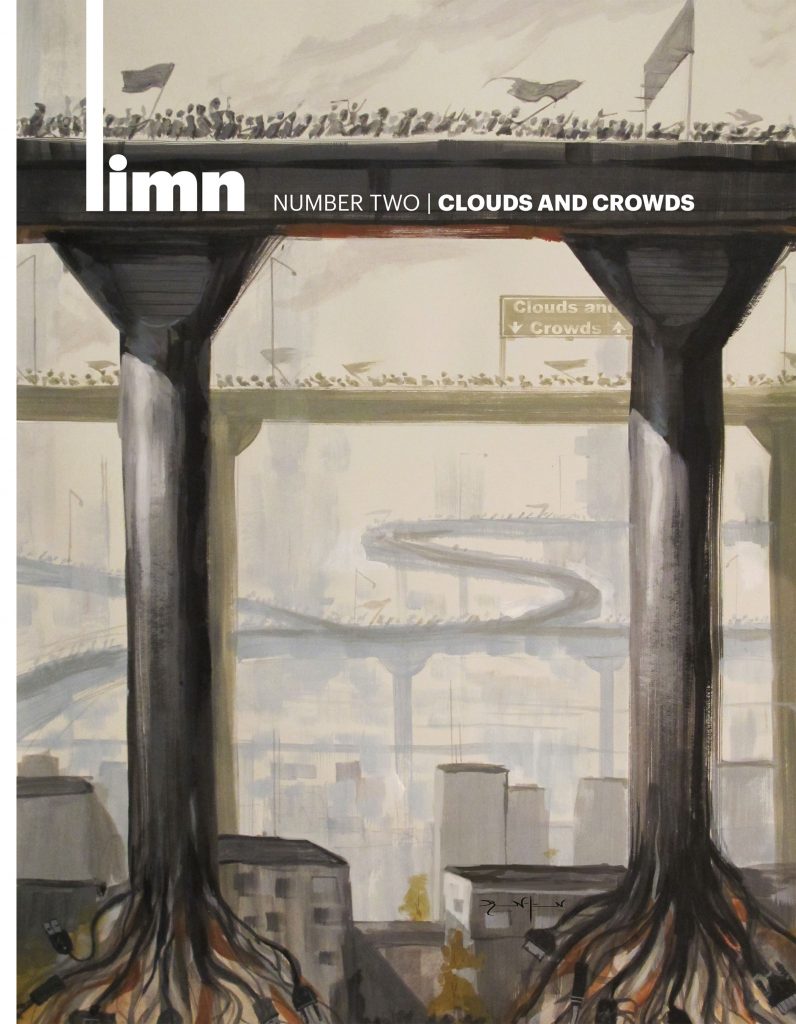
Limn, 2: Crowds and Clouds, Mar 2012
“This issue of LIMN focuses on new social media, data mining and surveillance, crowdsourcing, cloud computing, big data, and Internet revolutions. Rather than follow the well-worn paths of argument typical today, our contributors address the problems in new ways and at odd angles: from the power and politics of statistics and algorithms to crowdsourcing’s discontents to the capriciousness of collectives in an election; from the focus group and the casino to the worlds of micro-finance and data-intensive policing. Together they raise questions about the relationship of technology and the collectives that form in and through them.”
Contributors: Christopher Kelty, Alain Desrosières, Lilly Irani, Chris Csikszentmihályi, Gabriella Coleman, Nick Seaver, Emmanuel Didier, Alek Felstiner, Tarleton Gillespie, Roma Jhaveri, Daniel Kreiss, Natasha Dow Schüll, Rebecca Lemov, Maria Vidart, Amira Pettus, Jonathan R. Baldwin, and Ruben Hickman
HTML (updated on 2019-7-8)
“Limn is somewhere between a scholarly journal and an art magazine. It is an attempt to communicate and display ongoing scholarly research. Limn outlines contemporary problems. It draws material from networks of experts in the social and human sciences and is intended to be timely, diverse in perspective, authoritative, well written and beautifully designed. The focus is on contemporary problems in our global, politically interconnected, technologically intense culture: problems of infrastructure, ecological vulnerability, economic interdependence, and relentless technological invention.”
Editors: Stephen J. Collier, Christopher M. Kelty, Andrew Lakoff
Creative Commons BY-SA 3.0 Unported License