

Margot Lovejoy: Digital Currents: Art in the Electronic Age (2004)
Filed under book | Tags: · art, electronic art, film, image, postmodern, technology, television, virtual reality

Digital Currents explores the growing impact of digital technologies on aesthetic experience and examines the major changes taking place in the role of the artist as social communicator. Just as the rise of photographic techniques in the mid 1800s shattered traditional views about representation, so too have contemporary electronic tools catalyzed new perspectives on art, affecting the way artists see, think, and work, and the ways in which their productions are distributed and communicated.
Margot Lovejoy recounts the early histories of electronic media for art making – video, computer, the internet – in the new edition of this richly illustrated book. She provides a context for the works of major artists in each media, describes their projects, and discusses the issues and theoretical implications of each to create a foundation for understanding this developing field.
Digital Currents fills a major gap in our understanding of the relationship between art and technology, and the exciting new cultural conditions we are experiencing.
Publisher Routledge, 2004
ISBN 0415307805, 9780415307802
342 pages
Keywords and phrases
Bill Viola, Walter Benjamin, Nam June Paik, postmodern, Laurie Anderson, Christa Sommerer, Jenny Holzer, Miroslaw Rogala, virtual reality, Roy Ascott, Joan Jonas, Andy Warhol, Bruce Nauman, Eduardo Kac, Chris Burden, Electronic Arts, John Cage, Vito Acconci, Dara Birnbaum, Kit Galloway
PDF (updated on 2012-8-14)
Comments (2)Ken Hillis: Digital Sensations: Space, Identity, and Embodiment in Virtual Reality (1999)
Filed under book | Tags: · body, technology, virtual reality, virtuality
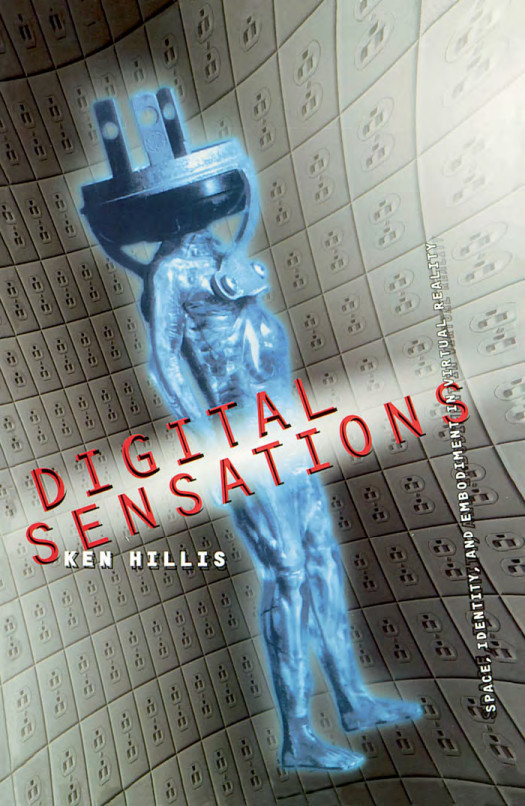
“Virtual reality is in the news and in the movies, on TV and in the air. Why is the technology — or the idea — so prevalent precisely now? What does it mean — what does it do — to us? Digital Sensations looks closely at the ways representational forms generated by communication technologies — especially digital/optical virtual technologies — affect the “lived” world.
Virtual reality, or VR, is a technological reproduction of the process of perceiving the real; yet that process is “filtered” through the social realities and embedded cultural assumptions about human bodies, perception, and space held by the technology’s creators.
Through critical histories of the technology — of vision, light, space, and embodiment — Ken Hillis traces the various and often contradictory intellectual and metaphysical impulses behind the Western transcendental wish to achieve an ever more perfect copy of the real. Because virtual technologies are new, these histories also address the often unintended and underconsidered consequences — such as alienating new forms of surveillance and commodification — flowing from their rapid dissemination. Current and proposed virtual technologies reflect a Western desire to escape the body Hillis says.
Exploring topics from VR and other, earlier visual technologies, Hillis’s penetrating perspective on the cultural power of place and space broadens our view of the interplay between social relations and technology.”
Publisher University of Minnesota Press, 1999
Electronic Mediations series, 1
ISBN 0816632502, 9780816632503
271 pages
PDF (updated on 2017-2-10)
Comments (2)Oliver Grau: Virtual Art: From Illusion To Immersion (2001–)
Filed under book | Tags: · art, illusion, immersion, media history, new media, telepresence, virtual art, virtual reality, virtuality

“Although many people view virtual reality as a new phenomenon, it has its foundations in an unrecognized history of immersive images. Indeed, the search for illusionary visual space can be traced back to antiquity. In this book, Oliver Grau shows how virtual art fits into the art history of illusion and immersion. He describes the metamorphosis of the concepts of art and the image and relates those concepts to interactive art, interface design, agents, telepresence, and image evolution. Grau retells art history as media history, helping us to understand the phenomenon of virtual reality beyond the hype.
Grau shows how each epoch used the technical means available to produce maximum illusion. He discusses frescoes such as those in the Villa dei Misteri in Pompeii and the gardens of the Villa Livia near Primaporta, Renaissance and Baroque illusion spaces, and panoramas, which were the most developed form of illusion achieved through traditional methods of painting and the mass image medium before film. Through a detailed analysis of perhaps the most important German panorama, Anton von Werner’s 1883 The Battle of Sedan, Grau shows how immersion produced emotional responses. He traces immersive cinema through Cinerama, Sensorama, Expanded Cinema, 3-D, Omnimax and IMAX, and the head mounted display with its military origins. He also examines those characteristics of virtual reality that distinguish it from earlier forms of illusionary art. His analysis draws on the work of contemporary artists and groups ART+COM, Maurice Benayoun, Charlotte Davies, Monika Fleischmann, Ken Goldberg, Agnes Hegedues, Eduardo Kac, Knowbotic Research, Laurent Mignonneau, Michael Naimark, Simon Penny, Daniela Plewe, Paul Sermon, Jeffrey Shaw, Karl Sims, Christa Sommerer, and Wolfgang Strauss. Grau offers not just a history of illusionary space but also a theoretical framework for analyzing its phenomenologies, functions, and strategies throughout history and into the future.”
This book is a translation of a revised and expanded version of a book entitled Virtuelle Kunst in Geschichte und Gegenwart: Visuelle Strategien, Berlin: Reimer, 2001.
Translated by Gloria Custance
Publisher MIT Press, 2004
Leonardo Books series
ISBN 0262572230, 9780262572231
430 pages
PDF (updated on 2019-10-13)
Comment (0)