
MIT Comparative Media Studies student theses (2001-2008)
Filed under thesis | Tags: · cartography, curating, data visualisation, internet art, media culture, net art, politics
AMANDA FINKELBERG
Space, Place, and Database: Digital Cartography in the Network Age (2007)
This paper addresses the changes in cartography since digitization and widespread popular dissemination. Cybercartography, an emergent system of maps, mapmaking tools, and mapmakers, forces a rethinking of spatial representations. The implicit distinction in digital media enables a new type of map user or neo-geographer that creates layers of expressions based on subjective experience. This paper argues that the neogeographer signifies a new cartographic behavior that affords a complex subjectivity. This behavior is further exhibited in the practice of navigable maps and virtual globes which lead the way to a paradigmatic change in the way we represent and interact with space. It is divided into three parts: Part I addresses the role of digitization in maps and lays out framework and vocabulary. Part II examines layers of spatial representations in historical context. Part III opens room for future study in the quickly developing inhabitable cartographic spaces of virtual globes and virtual worlds.
PDF
KAREN VERSCHOOREN
.art: situating internet art in the modern museum (2007)
This thesis provides a critical analysis of the relation between Internet art and the traditional institution for contemporary art in the North American and West-European regions. Thirteen years after its inception as an art form, the Internet art world finds itself in a developmental stage and its relation to the traditional institution for contemporary art is accordingly. Through an elaborate discussion of the key players, institutions and discourses on aesthetics, economics and exhibition methodologies, this sociological analysis of the past and current situation hopes to offer a solid ground for extrapolation and predictions for Internet art’s future as an art world in its relation to the traditional art institutions.
PDF
STEPHANIE DAVENPORT
Experiments in Corporate Collaboration: The Case of the Ars Electronica FutureLab (2003)
PDF
SOPHIE ORMEROD
The Medium Still Isn’t the Message: Revisiting the Link Between Communication Technologies and Political Liberalization (2002)
PDF
Charlie Gere: Art, Time, and Technology (2006)
Filed under book | Tags: · art, avant-garde, conceptual art, electronic art, mail art, net art, technology, time

Art, Time and Technology examines the role of art in an age of ‘real time’ information systems and instantaneous communication. The increasing speed of technology and of technological development since the early nineteenth century has resulted in cultural anxiety. Humankind now appears to be an ever-smaller component of dauntingly complex technological systems, operating at speeds beyond human control or even perception. This perceived change forces us to rethink our understanding of key concepts such as time, history and art. Art, Time and Technology explores how the practice of art – in particular of avant-garde art – keeps our relation to time, history and even our own humanity open. Examining key moments in the history of both technology and art from the beginnings of industrialization to today, Charlie Gere explores both the making and purpose of art, and how much further it can travel from the human body.
Published by Berg, 2006
ISBN 1845201353, 9781845201357
195 pages
Key terms: net.art, Staiti, avant-garde, conceptual art, Bernard Stiegler, real-time computing, Lyotard, John McHale, Suprematism, Jacques Derrida, Suprematist, Hans Haacke, mail art, DEW Line, Vincent Van Gogh, Roy Ascott, Buckminster Fuller, Douglas Huebler, Metal Machine Music
PDF (updated on 2012-7-24)
Comment (0)Tatiana Bazzichelli: Networking: The Net as Artwork (2006/2008) [IT, EN]
Filed under book | Tags: · cyberfeminism, hacktivism, internet, internet art, italy, net art, net culture, network art
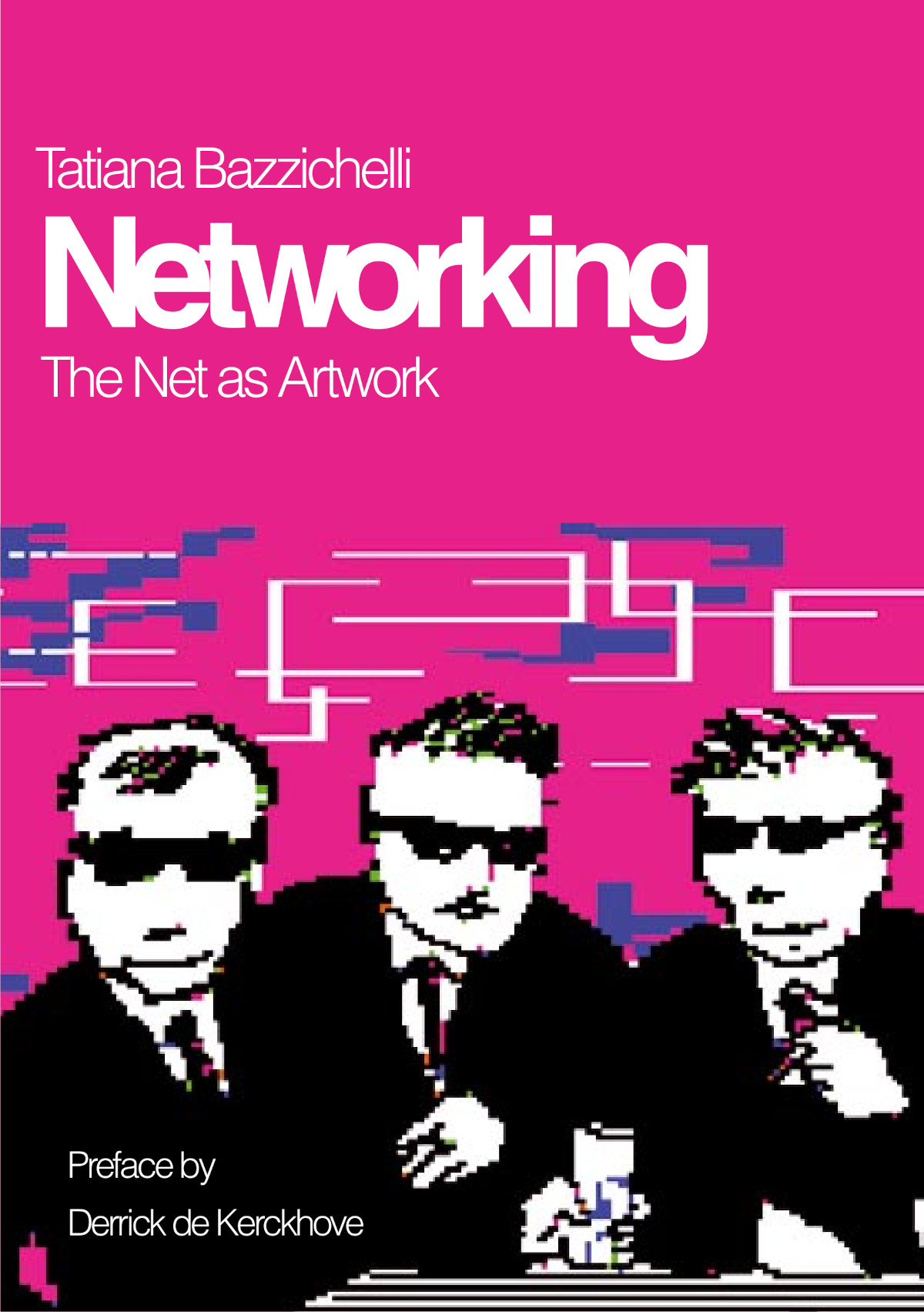
“A reconstruction of the history of artistic networking in Italy and of the Italian hacker communitiy from the 1980s to date.
Networking means to create nets of relations, where the publisher and the reader, the artist and the audience, act on the same level. The book represents a first tentative reconstruction of the history of artistic networking in Italy, through an analysis of media and art projects which during the past twenty years have given way to a creative, shared and aware use of technologies, from video to computers, contributing to the creation of Italian hacker communities.
The Italian network proposes a form of critical information, diffused through independent and collective projects where the idea of freedom of expression is a central theme. In Italy, thanks to the alternative use of Internet, during the past twenty years a vast national network of people who share political, cultural and artistic views has been formed.
The book describes the evolution of the italian hacktivism and net culture from the Eighties till today. At the same time, it builds a reflection on the new role of the artist and author who become networker, operating in collective nets, reconnecting to Neoavant-garde practices of the 1960s (first and foremost Fluxus), but also Mail art, Neoism and Luther Blissett.
A path which began in BBS, alternative web platforms diffused in Italy through the 1980s even before Internet even existed, and then moved on to Hackmeetings, to Telestreet and networking art of different artists such as 0100101110101101.ORG, [epidemiC], Jaromil, Giacomo Verde, Giovanotti Mondani Meccanici, Correnti Magnetiche, Candida TV, Tommaso Tozzi, Federico Bucalossi, Massimo Contrasto, Mariano Equizzi, Pigreca, Molleindustria, Guerriglia Marketing, Sexyshock, Phag Off and many others.”
Networking. La rete come arte
Preface by Derrick de Kerckhove
Postface by Simonetta Fadda
Publisher Costa & Nolan, Milan, 2006
Creative Commons Attribuzione-Noncommerciale-Condividi allo stesso modo 2.5 Italia
ISBN 8874370474, 9788874370474
333 pages
English edition
Preface by Derrick De Kerckhove
Afterword by Simonetta Fadda
Publisher DARC, Digital Aesthetics Research Center of Aarhus University, 2008
GNU Free Documentation License, Version 1.3, November 2008
336 pages
Networking. La rete come arte (Italian, 2006, 4 MB, added on 2016-2-19)
Networking. The Net as Artwork (English, 2008, PDF, 3 MB)