

Lou Andreas-Salomé: The Freud Journal (1958/1964)
Filed under book, personal journal | Tags: · love, memory, narcissism, psychoanalysis, sexuality
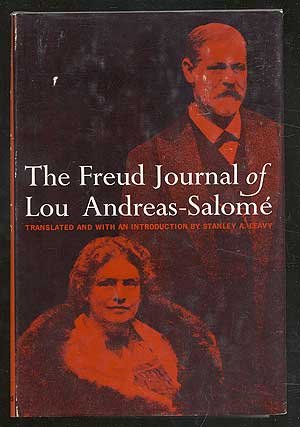
Lou Andreas-Salomé (1861–1937) was a Russian-born psychoanalyst and author of studies on Nietzsche and Rilke.
In 1911, she participated in the International Psychoanalytic Congress in Weimar, and shortly after went to Vienna to undergo a training analysis with Freud. Written during the years 1912-1913, the journal begins with her participation in his Wednesday evening study group and Saturday evening lectures. Following her training, Salomé worked together with her friend the physician and analyst Viktor Tausk at Frankl-Hochwart’s clinic in Vienna and attended both the meetings of the Vienna Psychoanalytic Society and the discussion evenings hosted by Alfred Adler, all reflected in the diary.
Originally published as In der Schule bei Freud, 1958
Translated and With an Introduction by Stanley A. Leavy
Publisher Basic Books, New York, 1964
211 pages
review (Ban Wang, American Imago)
Salomé’s biography at padd.at
Salomé at Wikipedia
PDF (112 MB, no OCR)
See also Victor Tausk’s On the Origin of the “Influencing Machine” in Schizophrenia (1919/1933)
Henrik Bogdan, Martin P. Starr (eds.): Aleister Crowley and Western Esotericism (2012)
Filed under book | Tags: · esotericism, magick, mysticism, occultism, occultural studies, religion, sexuality

Henrik Bogdan and Martin P. Starr offer the first comprehensive examination of one of the twentieth century’s most distinctive occult iconoclasts. Aleister Crowley (1875-1947) was a study in contradictions. He was born into a Fundamentalist Christian family, then educated at Cambridge where he experienced both an intellectual liberation from his religious upbringing and a psychic awakening that led him into the study of magic. He was a stock figure in the tabloid press of his day, vilified during his life as a traitor, drug addict and debaucher; yet he became known as the perhaps most influential thinker in contemporary esotericism.
The practice of the occult arts was understood in the light of contemporary developments in psychology, and its advocates, such as William Butler Yeats, were among the intellectual avant-garde of the modernist project. Crowley took a more drastic step and declared himself the revelator of a new age of individualism. Crowley’s occult bricolage, Magick, was a thoroughly eclectic combination of spiritual exercises drawing from Western European ceremonial magical traditions as practiced in the nineteenth-century Hermetic Order of the Golden Dawn. Crowley also pioneered in his inclusion of Indic sources for the parallel disciplines of meditation and yoga. The summa of this journey of self-liberation was harnessing the power of sexuality as a magical discipline, an instance of the “sacrilization of the self” as practiced in his co-masonic magical group, the Ordo Templi Orientis. The religion Crowley created, Thelema, legitimated his role as a charismatic revelator and herald of a new age of freedom under the law of “Do what thou wilt.”
The influence of Aleister Crowley is not only to be found in contemporary esotericism-he was, for instance, a major influence on Gerald Gardner and the modern witchcraft movement-but can also be seen in the counter-culture movement of the late 1960s and early 1970s, and in many forms of alternative spirituality and popular culture. This anthology, which features essays by leading scholars of Western esotericism across a wide array of disciplines, provides much-needed insight into Crowley’s critical role in the study of western esotericism, new religious movements, and sexuality.
Publisher Oxford University Press, 2012
ISBN 0199863091, 9780199863099
406 pages
Eva Illouz: Why Love Hurts (2012)
Filed under book | Tags: · desire, emotion, freedom, love, men, power, sexuality, sociology, women

“Few of us have been spared the agonies of intimate relationships. They come in many shapes: loving a man or a woman who will not commit to us, being heartbroken when we’re abandoned by a lover, engaging in Sisyphean internet searches, coming back lonely from bars, parties, or blind dates, feeling bored in a relationship that is so much less than we had envisaged – these are only some of the ways in which the search for love is a difficult and often painful experience.
Despite the widespread and almost collective character of these experiences, our culture insists they are the result of faulty or insufficiently mature psyches. For many, the Freudian idea that the family designs the pattern of an individual’s erotic career has been the main explanation for why and how we fail to find or sustain love. Psychoanalysis and popular psychology have succeeded spectacularly in convincing us that individuals bear responsibility for the misery of their romantic and erotic lives. The purpose of this book is to change our way of thinking about what is wrong in modern relationships. The problem is not dysfunctional childhoods or insufficiently self-aware psyches, but rather the institutional forces shaping how we love.
The argument of this book is that the modern romantic experience is shaped by a fundamental transformation in the ecology and architecture of romantic choice. The samples from which men and women choose a partner, the modes of evaluating prospective partners, the very importance of choice and autonomy and what people imagine to be the spectrum of their choices: all these aspects of choice have transformed the very core of the will, how we want a partner, the sense of worth bestowed by relationships, and the organization of desire.
This book does to love what Marx did to commodities: it shows that it is shaped by social relations and institutions and that it circulates in a marketplace of unequal actors.”
Publisher Polity, 2012
ISBN 0745661521, 9780745661520
300 pages
review (David Wolpe, Los Angeles Review of Books)
review (Jacqui Gabb, LSE Review of Books)